Search This Blog

Showing posts with label Greg Boyd. Show all posts

Thursday, December 26, 2019

The Hermeneutics of C.S. Lewis: A Review of "Reflections on the Psalms"

It is Christ Himself, not the Bible, who is the true word of God. The Bible, read in the right spirit and with the guidance of good teachers will bring us to Him. We must not use the Bible as a sort of encyclopedia out of which texts can be taken for use as weapons.
Every year or so I see this C.S. Lewis quote make the social media rounds. It is inevitably cheered and championed by progressive and other non-Evangelical Christians and is scorned, challenged, and/or ignored by the Evangelical and Fundamentalist crowd. The quality of the challenge varies but the strongest one I have encountered is this post from William O'Flaherty who has written an (occasionally helpful) book on Lewis misquotes. O'Flaherty's argument is that while it is not a mis-quote (he acknowledges that it comes from a letter Lewis wrote in 1958) it also should not be shared because it is from a letter and is therefore a response to a specific question (the question was about what Lewis though of the doctrine of inspiration but O'Flaherty neglects to mention this). O'Flaherty then suggests that if Lewis had wanted to write extensively or publicly on the subject of inspiration we would have an essay from him on the topic.

This is not an especially good argument (it is essentially an argument from silence that the quote has been taken out of context) but it is at least an argument. For all of that it is an argument which fails pretty miserably as an example of C.S. Lewis scholarship. While it is true that Lewis did not write any essay on the doctrine of inspiration (one has to wonder how careful O'Flaherty is being with his word choice) Lewis did write three chapters on the subject of inspiration and Biblical interpretation in his book Reflections on the Psalms.

The first nine chapters of the book are roughly what you would expect from Lewis: a thematic analysis of the book of Psalms, interspersed with reflections and insights on a variety of topics. While the whole is well worth reading, Chapter 9 A Word About Praising is so insightful and (almost ironically) timely that it merits a detour and select quoting. Lewis project in the chapter is dealing with the "stumbling block" Lewis claims to have encountered early in his time as a Christian. In Lewis' words:
We all despise the man who demands continued assurance of his own virtue, intelligence or delightfulness; we despise still more the crowd of people round every dictator, every millionaire, every celebrity, who gratify that demand. Thus a picture at once ludicrous and horrible, both of God and of His worshippers, threatened to appear in my mind.
Lewis solves this conundrum (one he thought almost embarrassingly simple to many but which I suspect many in our own age have not even risen to) by reflecting further on his own experiences of delight and love:
I had never noticed that all enjoyment spontaneously overflows into praise unless (sometimes even if) shyness or the fear of boring others is deliberately brought in to check it. The world rings with praise--lovers praising their mistresses, readers their favorite poet, walkers praising the countryside, players praising their favorite game--praise of weather, wines, dishes actors, motors, horses, colleges, countries, historical personages, children, flowers, mountains, rare stamps, rare beetles, even some politicians or scholars. I had not noticed how the humblest , and at the same time most balanced and capacious minds, praised most,  while the cranks, misfits, and malcontents praised least. The good critics found something to praise in many imperfect works; the bad ones continually narrowed the list of books we might be allowed to read. The healthy and unaffected man, even if luxuriously brought up widely experienced in good cookery, could praise a very modest meal; the dyspeptic and the snob found fault with all.
A few years worth of meditation and spiritual growth lie in those words.

And for all of that wealth (the above digression is the smallest sampling, each chapter contains gems of similar worth), it is Lewis' treatment of Scripture and Scripture interpretation in chapters ten, eleven, and twelve which I was most strongly driven to write about.

Lewis' Hermeneutics


In the last three chapter of Reflections on the Psalms Lewis addresses, not the psalms or themes from the psalms directly, but questions of Biblical interpretation which arise from a study of the Psalms in a modern (and post NT) context and his own methods and approaches to Biblical interpretation. In chapters ten and twelve his primary focus is on what he refers to as second meanings--meanings within the psalms that the original authors themselves might (or even certainly) not have seen in their own works--Lewis comes out in favor of allegorical and prophetic second meaning interpretations of the psalms (as well as other OT passages) and uses an argument from his own work in literary criticism to do so:
The status I claim for such things [second meanings], then, is neither that of coincidence on the one hand nor that of supernatural prevision on the other. I will try to illustrate  it by three imaginable cases. i. A holy person, explicitly claiming to prophesy by the Spirit tells us that there is in the universe such and such a creature. Later we learn (which God forbid) to travel in space and distribute upon new worlds the vomit of our own corruption; and, sure enough, on the remote planet of some remote star, we find that very creature. This would be prophesy in the strictest sense. This would be evidence for the prophets's miraculous gift  and strong presumptive evidence for the truth of anything else he had said. ii. A wholly unscientific writer of fantasies invents a creature for purely artistic reasons. Later on, we find a creature recognisably like it. This would be just the writer's luck. A man who knows nothing about racing may once in his life back a winner. iii. A great biologist, illustrating the relation between animal organisms and their environment, invents for this purpose a hypothetical animal adapted to a hypothetical environment. Later, we find a creature very like it (of course in an environment very like the one he had supposed). This resemblance is not in the least accidental. Insight and knowledge, not luck, led to the invention. The real nature of life explains why there is such a creature in the universe and also why there was such a creature in his lectures. If while we re-read the lectures, we think of the the reality, we are not bringing arbitrary fancies of our own to bear on the text. This second meaning is congenial to it. The examples I have in mind correspond to this third case; except of course that something more sensitive and personal  than scientific knowledge is involved--what the writer or speaker was, not only what he knew.
Lewis proceeds to helpfully apply this lens to New Testament and Patristic readings of the Old Testament. As an aside I suspect that he has established here a principle which may go a great ways towards resolving certain tensions between "death of the author" and "authorial intent" disputes in our own day. In Chapter ten Lewis primarily deploys this insight to defend the idea of true pagan prophets (he points primarily to Plato and to Virgil though I think the same argument serves in favor of Lao Tzu as well) making similar arguments to those he makes in Mere Christianity and other works concerning similarities between pagan "Corn King" myth and the truth myth of Christianity. In Chapter twelve he applied the ideas more directly to Old Testament passages and to the surprising, allegorical, and symbolic readings of them that we find in the New Testament and the Patristics.

Chapter eleven is an exposition of Lewis' own beliefs on the nature of the Bible and of Bible interpretation (hermeneutics), and it is the existence of this chapter which wholly undermines the claims O'Flaherty makes about the quote I began with. Throughout the chapter Lewis shows himself to be very much in line with a neo-orthodox and christocentric/red-letter understanding of the nature of inspiration and the proper interpretation of the Bible.

The chapter merits a close, point-by-point examination. Lewis opens by straightforwardly disclosing his project:
For us these writings are "holy", or "inspired", or, as St. Paul says, "The Oracles of God". But this has been understood in more than one way, and I must try to explain how I understand it at least so far as the Old Testament is concerned. [emphasis mine]
Lewis will, in fact, also clarify a good deal of how he understands inspiration in the New Testament as well. He continues,
I have been suspected of being what is called a Fundamentalist. That is because I never regard any narrative as unhistorical simply on the ground that includes the miraculous.
I do not think that any Lewis scholar would suggest that Lewis was anything but a thoroughgoing supernaturalist and, from the perspective of those who subscribe to "liberal theology" in the 19th century German tradition, this would seem to locate him in the camp of the Fundamentalists or Evangelicals. This, however, is a mistake of the sort we call the false dilemma. There are more than two possible theologies of inspiration--even when painting with a very broad brush--and Lewis is neither a 19th century German style liberal or a Fundamentalist as he goes on to clarify:
 Some people find the miraculous so hard to believe that they cannot imagine any reason for my acceptance of it other than a prior belief that every sentence of the Old Testament has historical or scientific truth. But this I do not hold, any more than St. Jerome did when he said that Moses described Creation "after the manner of a popular poet" (as we should say mythically) or than Calvin did when he doubted whether the story of Job were history or fiction. [emphases mine]
Lewis here is clearly in the same position which so many of us who are currently being labeled "progressive" Christians find ourselves: on the one hand, robust supernaturalists happy to affirm the creeds and the rest and thus seen as still "Evangelical" or "Fundamentalist" by certain liberal and mainline theologians (I remember one moment in recent Twitter history wherein non-Evangelical Chrisitian Twitter was shocked to discover that so many still believe in the bodily resurrection of Christ); on the other hand non-interrantists who cheerfully apply non-literalist readings of a wide variety when approaching the text of the Bible.  Lewis clarifies that his reason for accepting the miraculous is philosophical:
I have never found any philosophical grounds for the universal negative proposition that miracles do not happen. I have to decide on quite other grounds (if I decide at all) whether a given narrative is historical or not. The Book of Job appears to me unhistorical because it begins about a man quite unconnected with all history or even legend, with no genealogy, living in a country of which the Bible elsewhere has hardly anything to say; because, in fact, the author quite obviously writes as a story-teller not as a chronicler. [emphasis mine]
In that last clause we get a glimpse of how Lewis individual vocation as a literary scholar informed his hermeneutic. As a man well versed in genre, he allowed what he knew about classical and ancient literary writing and genre to inform the way he interpreted the Bible.

If all of this were not enough, Lewis breaks cleanly from any Fundamnetalist (and many Evangelical) intepretative doctrines when he continues:
I have therefore no difficulty in accepting, say, the view of those scholars who tell us that the account of Creation in Genesis is derived from earlier Semitic stories which were Pagan and mythical.
And Lewis has already shown in chapter ten why such a proposition is no threat to his view of scripture as a whole--much less his faith. He spends a few paragraphs making this connection explicit, concluding:
There are poets like those in the Song of Songs who probably never dreamed of any but a secular and natural purpose in what they composed. There is (and it is no less important) the work first of the Jewish and then of the Christian Church in preserving and canonising just these books. There is the work of redactors and editors in modifying them. On all of these I suppose a Divine pressure; of which not by any means all need have been conscious.
The human qualities of the raw materials show through. Naivety, error, contradiction, even (as in the cursing psalms) wickedness are not removed. [emphasis mine]
So much for the Chicago Statement on Biblical Inerrancy.

Immediately following this Lewis locates himself squarely within the neo-orthodox tradition on inspiration and summarily demolishes Mr. O'Flaherty's argument:
The total result is not "the Word of God" in the sense that every passage, in itself, gives impeccable science or history. It carries the Word of God; and we (under grace, with attention to tradition and to interpreters wiser than ourselves, and with the use of such intelligence and learning as we may have) receive that word from it not by using it as an encyclopedia or an encyclical but by steeping ourselves in its tone or temper ad so learning its overall message.
This statement might have appeared in any of a number of the theologians who claim that the Bible is a  medium through which we come to know the Word of God but is not itself that Word (a title the Bible grants to Jesus).

From here, Lewis goes on to recognize that the nature of the Bible as an "untidy and leaky vehicle" is frustrating to some (so much so that many of them resort to denying it altogether)
One can respect, and at moments envy, both the Fundamentalist's view of the Bible and the Roman Catholic's view of the Church. 
but, Lewis holds that it is actually a very good thing, and in his argument to that effect his christocentric/red-letter hermeneutic shines through:
We may observe that the teaching of Our Lord Himself, in which there is no imperfection, is not given us in that cut-and-dried, fool-proof, systematic fashion we might have expected or desired. He wrote no book. We have only reported sayings, most of them uttered in answer to questions, shaped in some degree by their context. And when we have collected them all we cannot reduce them to a system. He preaches but He does not lecture. He uses paradox, proverb, exaggeration, parable, irony; even (I mean no irreverence) the 'wisecrack'. He utters maxims which, like popular proverbs, if rigorously taken, may seem to contradict one another. His teaching therefore cannot be grasped by the intellect alone, cannot be "got up" as if it were a "subject". If we try to do that with it, we shall find Him the most elusive of teachers. He hardly ever gave a straight answer to a straight question. He will not be, in the way we want, "pinned down". The attempt is (again, I mean no irreverence) like trying to bottle a sunbeam.
Lewis argues that what is true of Jesus' teaching is also ultimately true of Paul's teaching and of the Bible as a whole. In fact it is in his statement on that point that the final piece falls into place and the degree to which he affirmed the doctrine (currently enunciated by Greg Boyd and others) that the Bible is most accurately interpreted when Jesus' teachings are taken to be the center and highest point of revelation such that the rest, in varying degrees, should be understood by the light of what Jesus more authoritatively taught. Lewis in fact divides the Bible into three levels or degrees for the purpose of interpretation, first the teachings of Jesus, then in the teachings of Paul (for myself I would want to expand that to the epistles as a whole), and then the rest of Scripture. Each lower level can thus best be interpreted only by the light of the level(s) above it; all (as we saw earlier) only being profitably interpreted by the light of grace and the supervention of the Holy Spirit. As Lewis puts it:
Thus on three levels, in appropriate degrees, we meet the same refusal of what we might have thought best for us--in the Word Himself [Jesus], in the Apostle to the Gentiles [St. Paul], in Scripture as a whole.
Lewis goes on to connect this view of Scripture to the meaning of the incarnation where he almost tangentially embraces the Eastern Orthodox doctrine of theosis:
For we are taught that the Incarnation itself proceeded "not by the conversion of the godhead into flesh but by the taking of (the) manhood into God"; in it the human life becomes the vehicle of Divine life. If the Scriptures proceed not by conversion of God's word into a literature but by taking up of a literature to be the vehicle of God's word, this is not anomalous. 
Returning to his beloved theme of anti-reductionism, Lewis ventures an explanation for why and how all of this should be so:
Because the lower nature, in being taken up and loaded with a new burden and advanced to anew privilege, remains, and is not annihilated, it will always be possible to ignore the up-grading and see nothing but the lower. Thus men can read the life of Our Lord (because it is a human life) as nothing but a human life. Many, perhaps most, modern philosophies read human life merely as an animal life of unusual complexity. The Cartesians read animal life as mechanism. Just in the same way Scripture can be read as merely human literature. No new discovery, no new method, will ever give a final victory to either interpretation. For what is required, on all these levels alike, is not merely knowledge but a certain insight; getting the focus right. Those who can see in each of these instances only the lower will always be plausible. One who contended that a poem was nothing but black marks on white paper would be unanswerable if he addressed an audience who couldn't read. Look at it through microscopes, analyse the printer's ink and the paper, study it (in that way) as long as you like; you will never find something over and above all the products of analysis whereof you can say "This is the poem". Those who can read however, will continue to say the poem exists.
Thus the Bible is, according to Lewis, a fundamentally spiritual text without at any moment ceasing to be a material and literary text. The great mistake of the fundamentalists in his view amounts to a sort of bizarre flattening in which the spiritual dimension of the Bible is substituted for the material and literary text, with the result that Fundamentalists and Evangelicals are constantly, and futilely, trying to equate the spiritual meaning of the Bible with the standard and literary lower meaning of the Bible. The materialists commit the same error of flattening the text but they do it by simply denying the second meaning. Neither group is, in the end, willing to let the Bible be the haunted and holy text that it is.

So Anyway

I highly recommend Reflections on the Psalms 5/5

Friday, May 18, 2018

Deconstructing as a Legacy of Modernism

As a heads up this is a particularly in-the-weeds post about my relationship with exEvangelicalism and some of the minutia of Christian theology in the United States.


Stories of deconstruction are a pretty solid way to get a blog post to go viral on the Christian internet these days. The haters (mostly conservative white Evangelicals) get to hate and break down your story into a million little warnings about the danger of doubt, Progressive Christians cheer you on and leap to your defense (sometimes after a little checking to make sure that you aren't harboring any problematically oppressive views which you haven't quite managed to deconstruct away just yet) and and since nothing drives site hits so much as controversy, your blog stats spike nicely. If you are really lucky you might even get invited to do a podcast with one of the more influential progressive Christian conversation leaders. 

All of that probably sounds cynical so let me follow with this: aside from the vitriol which tends to work its way into these things, I think this is a really good thing and a natural outgrowth of the desperate need so many Christian and Christian-adjacent people in the US have to know that they are not alone, aren't insane, and aren't going to hell because of their doubts, thoughts, and concerns. I do not think it would be accurate to classify white Evangelicalism as a cult, but I do think that it has in common with cults, the need for those who are trying to leave it to find a way to deprogram ourselves from ideas and thinking patterns which are so ingrained that they still shape our lives and reactions even though we no longer accept them on a cognitive level. "My Deconstruction" stories can be really helpful towards that end—which is probably also why Conservative Evangelical leaders make such a point of attacking them and the people who pen them. 

All of that said, I don't have a deconstruction story. Or at least, if I do, I certainly didn't experience my own story in a way that felt particularly like deconstruction to me. It mostly felt like growth. And yet, I get asked about my deconstruction and the people whose theology and life/faith experiences I identify most closely with are people who speak fairly regularly about their deconstructions. I was raised in solidly conservative white US Evangelicalism. There were a few quirks (and, as I will point out later, they were pretty important) but on the whole I can tell an honest and accurate version of my childhood which fits the deconstruction narrative really well.

I have attended Evangelical churches my entire life*. I was home schooled in elementary, at least in part to protect me from the "New Age agenda" (look it up); I attended a Christian private school; my parents were part of a church start-up/planting team; I attended a conservative southern Bible College, I have—on more than one occasion—thrown away collections of "secular" media; I debated classmates and teachers as a staunch young-earth creationist; there is a picture of my still floating around the internet wearing a "straight pride" t-shirt while attending a Christian music festival (LGBTQ+ friends, I am so sorry for that); the list could go on and on. Now I could probably be accurately described as a Progressive Christian (I am a Charismatic Anabaptist and my politics are unorthodox but that term probably fits better than any other) so how did I transition from the one to the other without a deconstruction?

I think the answer lies in the way I understand the project of understanding reality—I have tended towards a more pre-modern than enlightenment modernist approach to understanding the world. I could be very wrong here and I would love to get feedback from people who have gone through a deconstruction (and maybe their own reconstruction process?) to let me know whether I have understood y'all's experience accurately, but my impression is that—for a lot of folks—deconstruction is a bit like messing with a house of cards. Over time, they start to worry more and more that some aspect or tenet of their faith may not be all that accurate. This leads to a period (short or long) wherein they are internally wrestling with whether or not it is "safe" to examine that bit of their faith structure. The worry frequently seems to be based on a conviction that all the parts of their faith need all the other parts of their faith. This often seems to be related to their understanding of the Bible and its relationship to the truth value of much or all of their understanding of reality as a whole. White US Evangelicalism deeply inculcates its adherents with the conviction that the Bible accurately describes reality. If a proposition contradicts "the Bible" then it is necessarily wrong and the job of good intellectual Christians becomes finding a way to demonstrate that wrongness. Of course there are many, many problems with this approach to understanding realty (the Bible is a text which needs to be interpreted, there is no structure for determining an "absolute" interpretation of the Bible, the Bible doesn't actually speak about every aspect of reality etc...) but that hasn't deterred its near-total integration into the very meaning of Evangelical. 

Back to the house of cards. 

Eventually, the person in question will either repress their concerns, avoid a deconstruction, and go back to being a good (if somewhat defensive) Evangelical or they will bite the bullet and take a good hard look at the tenet which was giving them all the trouble. In my experience—and this is part of what makes being in a supportive relationship with doubting Evangelicals so tense—they almost always find that they can't really support a continued adherence to the tenet they are examining. Whether it is young earth creationism, LGBTQ+ exclusion, gender complimentarity, a particular reading of the "texts of terror", the historicity of the exodus, the authorship of Isaiah, or something else entirely, a doubt which had to be so painfully resisted almost always turns out to be a pretty legitimate doubt. This then seems to usually presage entry into "full deconstruction". It doesn't always, some folks (and I suspect that this has a lot to do with the specifics of the denomination and the tenet in question) manage to maintain themselves as slightly unorthodox Evangelicals but it seems that often the removal of the this tenet starts a cascade of other tenets the total removal and examination of which amounts to what Progressive Christians seem to be talking about when they talk about their deconstruction: a semi-systematic examination of much of their worldview with a subsequent rejection of many aspects of it. 

Or, at least, that is how it is often described. In fact (and I want to say that I think that this is inevitable given basic human psychology) it often seems to mean the systematic examination of a number of tenets of Evangelical faith followed by a reidentification on the part of the deconstructor as an ex-evangelical (or possibly as an agnostic or atheist) once a critical mass of tenets is reached. For some folks I know that critical mass has been a single tenet (young earth creationism), for others it took more that ten to reach the critical mass. However it goes though, the effect is that the person who is "going through the deconstruction" eventually rejects much of the structure and content of their previous faith. Depending on what is left afterwards (and this varies significantly but that is probably a subject for another post) the person may or may not follow this by a period of reconstruction in which they carefully build a new structure incorporating what survived the deconstruction. 

As best as I have been able to observe, all of that describes a fairly "typical" deconstruction process**. The thing is, it doesn't really describe the process by which I moved from there to here and after years of wondering about it, I finally have a theory. I think it has a lot to do with how we think about reality. I will take it as a matter of agreement that humans like certainty. We like to know and be confident about how things are. I am sure that psychologists have a lot of explanations for why—I am partial to the view that feeling certain about how things are gives us a sense of control and security—but at the end of the day it seems clear that we do. We also tend to cluster in ideologically homogeneous communities. As a result I suspect (and my conversations with many of my friends who go through deconstruction have borne this out) that we tend to build ideological structures which are both extremely strong, and extremely brittle. They are strong insofar as they are really resistant to change once they "set" and they are brittle insofar as the removal of any one part of them tends to represent a threat to the entire structure. 

That approach, the strength and the brittleness are, I think, representative of the great strength and
brittleness of western enlightenment modernism as a whole. Before the enlightenment, Western society tended to understand reality in terms of a great, intricate, complex, yet fluid structure (imagine a chandelier or a symphony). Premodern society tended to understand reality in terms of stories, music, and logic. When some new proposition was presented to a pre-modern thinker and accepted as true, the thinker would then cheerfully insert that proposition into the edifice which was their model of reality and then get to work tweaking assumptions, re-telling stories, and re-tuning harmonies, until the whole thing came back into some sort of resonance. When presented with evidence or argument that a previously accepted proposition was actually false, that proposition would be removed and the removal would necessitate years of discussion, argumentation, and re-interpretation in order to be re-tuned back to a resonant state. 

In contrast to that, the enlightenment model worked far more carefully to examine each proposition for it's truth value before incorporating it into the model as seamlessly as possible (imagine building a stone wall). The goal for any proposition was indubitability, (un-doubt-able-ness) arguably the highest bar for confidence we, as a species, have managed to devise. In fact, indubitability turns out to be an impossible bar—though many Enlightenment thinkers managed to stay in denial about that for several hundred year—but it has remained as the sort of "gold standard" or aspiration for people who build their understanding of reality under the influence of enlightenment modernism. For Evangelical Christians, the Bible worked dangerously well as a source of indubitable "knowledge". The only catch was that the Bible is not indubitable in and of itself—billions of people manage to doubt it every day—so it can only serve as an indubitable truth-source by an act of trust or a white-knuckled act of the will. As children who were raised in churches, we trusted the adults who just told us that the "Bible is true" and, for a time, that enabled us to treat it as a source of indubitablity. But as we grew we eventually faced the challenge of working out for ourselves just what it was that made the Bible indubitable. In my experience the answer comes down, not to an explanation but to the command to "not doubt". We are told that doubting the Bible is a sin and we might (or might not) be pointed towards some thinker or other who has scraped together an apologetic defense of the doctrine of inspiration (which can temporarily alleviate the tension but doesn't actually solve the problem in the long run). This amounts to the "white-knuckled act of the will" approach which cannot last. 

Footnotes:

*With the exception that I am currently attending (and a member of) a wonderful open and affirming Mennonite church.
**I want to clarify that nearly every person I know who has been through this process would not want to use the term "typical" to describe their experience. It is a journey which requires significant personal and intellectual courage and I have great respect for those friends of mine who have been able to manage it regardless of where they "ended up". 

Resources;
When it comes to facing the importance of doubt I would recommend. Pete Enns' The Sin of Certainty and The Bible Tells Me So as well as Greg Boyd's Benefit of the Doubt.

Wednesday, July 19, 2017

5 Good Books Which Will Challenge Your Conservative Evangelicalism

In reading Chesterton, as in reading MacDonald, I did not know what I was letting myself in for. A young man who wishes to remain a sound Atheist cannot be too careful of his reading. There are traps everywhere—"Bibles laid open, millions of surprises," as Herbert says, "fine nets and stratagems." God is, if I may say it, very unscrupulous.
- C.S. Lewis, Surprised by Joy
Writing as someone who has traversed the bridge from Solidly Evangelical to, well, not (I identify as a Charismatic Anabaptist) I thought it might be fun annotating a list of books which, once read, are likely to ease a person's transition out of Evangelicalism (of the American and White variety) and into some other form of Christianity. As such, this isn't a list of books by the "New Atheists" but a list of books by authors who operate in and around the edges of Conservative American Evangelicalism and who are all dedicated Christians.

Of course there are millions of Evangelicals (and I am using the term to designate those culturally conservative Christians in America who self-identify as Evangelical and have, in recent history been associated with right-wing politics) who who have read and appreciated these books, they don't have any mysterious power to rip the evangelicalism out of someone. What they do, and do well, is fuzz the (mostly cultural) boundaries which have been set up around American white Evangelicalism. Not challenging any of the basic tenets of the faith (the authors are all robustly Nicene or, as Lewis would have said, "Mere" Christians) allowing alert and critical readers the realization that God is, indeed, moving powerfully out there

The Great Divorce by C.S. Lewis

'Ye can know nothing of the end of all things, or nothing expressible in those terms. It may be, as the Lord said to the Lady Julian, that all will be well, and all will be well, and all manner of things will be well. But it's ill talking of such questions.'
'Because they are too terrible, Sir?'
'No. Because all answers deceive. If ye put the question from within Time and are asking about possibilities, the answer is certain. The choice of ways is before you. Neither is closed. Any man may choose eternal death. Those who choose it will have it. But if ye are trying to leap on into eternity, if ye are trying to see the final state of all things as it will be (for so ye must speak) when there are no more possibilities left but only the Real, then ye ask what cannot be answered to moral ears. Time is the very lens through which ye see—small and clear, as men see through the wrong end of a telescope—something that would otherwise be too big for ye to see at all. That thing is Freedom: the gift whereby ye most resemble your Maker and are yourselves parts of eternal reality. 

Nobody ever really warned me about C.S. Lewis back when I was an Evangelical. In fact, throughout my childhood and through college he remained something of a hero among Evangelicals of my stripe. Mere Christianity (having been instrumental in the conversion of so many Baby Boomers) was, and still is, revered as am Evangelical classic.

I, like many others, first encountered Lewis through The Chronicles of Narnia and later his Space Trilogy and The Screwtape Letters. I started to read his apologetic and theological works in college and moved on to his Literary theory while working on my masters. I remain an enormous fan. There are, to my mind, few authors of the 20th century who possess the lucidity of thought, keenness of intellect, and sheer creativity that Lewis demonstrates in so many of his works—academic or fictional.

Of course Lewis himself was an Anglican, not an Evangelical and his writing doesn't back down from that, so it shouldn't be surprising that reading and agreeing with Lewis will have the tendency of moving someone's "center" away from Evangelicalism and towards something more like "mere" Christianity. All the same, I don't know that there are any of his works which will prove more challenging to the Evangelicalism of a person, than The Great Divorce. The book is a fictional supposal in which Lewis goes on a bus ride to the outskirts of heaven where he encounters a series of individuals being given the opportunity to stay and flourish. The book is a masterwork of theological psychology as Lewis uses it to examine our reasons for resisting a Very Good God, the reasons a person might choose their own misery over infinite joy. Critical to our purposes here however, the conversations the fictional Lewis has with his "Master" George MacDonald, will do much to gently yet firmly undermine a good Evangelical's confidence in doctrines like eternal damnation. It isn't perfect (it contains a little too much of neo-Platonism to my mind) but it is both good and powerful.


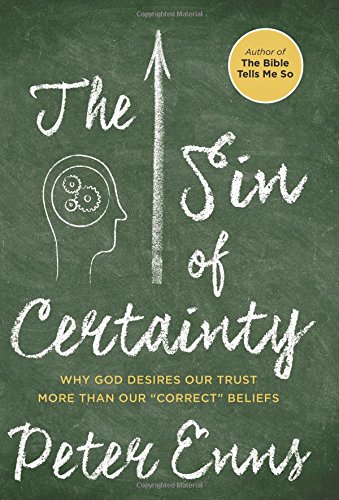
The Sin of Certainty by Pete Enns

Correct thinking provides a sense of certainty. Without it, we fear that faith is on life support at best, dead and buried at worst. And who wants a dead or dying faith? So this fear of losing a handle on certainty leads to a preoccupation with correct thinking, making sure familiar beliefs are defended and supported at all costs. How strongly do we hold on to the old ways of thinking? Just recall those history courses where we read about Christians killing other Christians over all sorts of disagreements about doctrines few can even articulate today. Or perhaps just think of a skirmish you’ve had at church over a sermon, Sunday-school lesson, or which candidate to vote into public office. Preoccupation with correct thinking. That’s the deeper problem. It reduces the life of faith to sentry duty, a 24/7 task of pacing the ramparts and scanning the horizon to fend off incorrect thinking, in ourselves and others, too engrossed to come inside the halls and enjoy the banquet. 
This book is specifically targeted at one of the great fetishes of Evangelicalism: The conviction that certainty = faith and that the basic duty of  a good Christian is to police a particular set of propositions. I think the first attack God mounted on this stronghold in my life was through the Catholic Philosopher Peter Kreeft who once remarked on how bizarre (and un-biblical) it was to think that one had to pass a theology exam in order to get into heaven. Enns writes in a conversational, confessional style and his own commitment to God and his love of the Bible come through clearly. This book makes the list specifically because it is not the sort of book that an Evangelical who reads it will be able to dismiss as having been written by someone without a deep trust in God. Enns' life and reasoning work together to force the reader to take him seriously. Then, once he is taken seriously, the arguments cut winsomely and incisively right at the heart of the "salvation by correct-thoughts-alone" heresy.


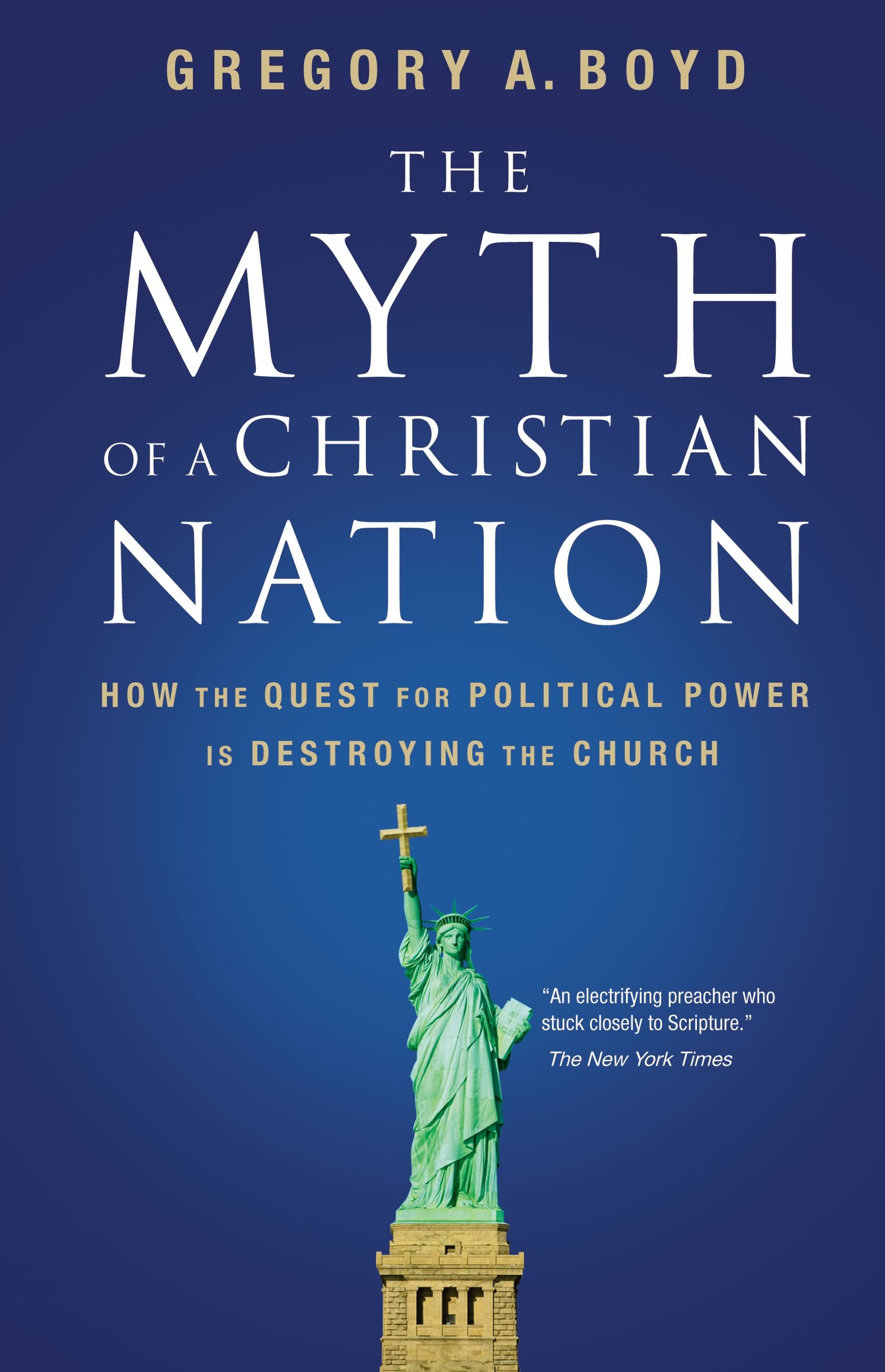
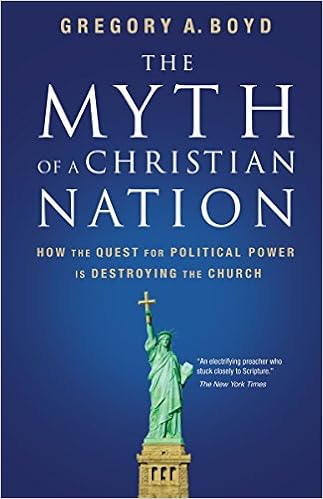
The Myth of a Christian Nation by Greg Boyd

Consider these questions: Did Jesus ever suggest by word or example that we should aspire to acquire, let alone take over, the power of Caesar? Did Jesus spend any time and energy trying to improve, let alone dominate, the reigning government of his day? Did he ever work to pass laws against the sinners he hung out with and ministered to? Did he worry at all about ensuring that his rights and the religious rights of his followers were protected? Does any author in the New Testament remotely hint that engaging in this sort of activity has anything to do with the kingdom of God? The answer to all these questions is, of course, no.
What Lewis does to the Evangelical doctrine of hell, and Enns does to the salvation-by-correct-thoughts-alone doctrine, Boyd does to the civil religion endemic to so much of white Evangelicalism in America today. Like the previous two authors, Boyd is a committed Christian (and a Charismatic to boot). He takes the Bible seriously and Jesus even more so, he is committed to spreading the Gospel, and speaks, fluently, the language of Evangelicalism—he has even written a book of personal apologetics: Letters From a Skeptic: A Son Wrestles with his Father's Questions about Christianity.

Meanwhile, this book is an axe at the root of the tree of civil religion. In it, Boys works with both narrative and lucid argument to demonstrate that the Kingdom of God, as Jesus and Paul taught about it throughout the New Testament, is utterly different from governments as we understand them. He cuts right thought the false equation of "Good Christianity" with "Patriotism", carefully distinguishing this world's power over approach from Jesus' power under. 


The Civil War as Theological Crisis by Mark Noll

The Book that made the nation was destroying the nation; the nation that had taken to the Book was rescued not by the Book but by the force of arms.
It is worth stating up front that Noll is an Evangelical Christian with all of the Evangelical bona fides—a Wheaton College graduate, and later professor who has taught at Notre Dame and is currently at Regent—because this book will feel far more challenging to many Evangelicals than several of the previous ones. It doesn't so much challenge a particular belief of pillar of Evangelicalism as it does shake a basic conceit. When I was an Evangelical I held on hard to the belief that people who worked hard to interpret the Bible, so long a they worked at it in good faith, would arrive at the same, correct, conclusion. This book holds an almost painfully revealing mirror up to that conceit by examining the theological crisis among Evangelicals who lived up to and during the American civil war (yes there is some important historical difference between them and the Evangelicals of today). Noll's history is alarmingly reminiscent of the sorts of theological arguments Evangelicals are having today and most troublingly (to the Evangelical mind) it was the thinkers and pastors who were arguing for slavery—either as a necessary evil or as an outright good—who most clearly map onto the Evangelicals of today. They were the one's arguing for the "plain meaning of Scripture" they were the ones who accused their theological opponents of obfuscation-through-nuance. The Evangelical who reads this book will begin to find herself more and more nonplussed and eventually disturbed by the sort of arguments she sees her Evangelical compatriots making when they argue about the "hot button issues" facing the church today.


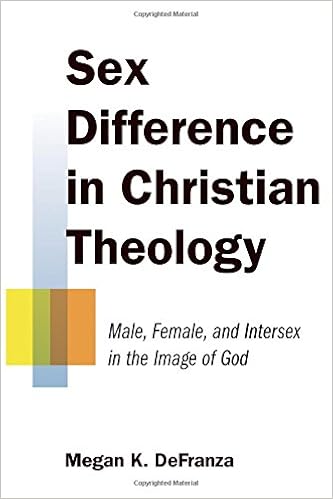
Sex Difference in Christian Theology by Megan DeFranza


We need to say, is Genesis giving us Adam and Eve as the ideal for all times and places? Or are we bringing those assumptions to the text? I think, too, about racial difference. If we're trying to get back to Adam and Eve, we'll lose racial difference. And yet we don't just have Genesis. We have a whole canon that ends with this glorious vision of every tribe and language and nation gathered before the throne and worshiping. We have racial difference, not in Eden, but in the new creation. I think we're trying to ask too much of Genesis 1, 2, and 3 to give us all of God's blueprint for a good creation and anything that doesn't fit there is a result of the fall. I think that's a false reading. I think it's the beginning of the story, but there's so much more that God has done in the scriptures and in creation that we need to consider.
Like Noll, Megan DeFranza checks all of the Evangelical boxes. She grew up in a conservative Evangelical context, managed a couple of masters (Theology and Biblical Languages) at Gordon-Conwell before getting he Ph.D. in Religious studies, and speaks fluent Evangelicalese. She understands her current calling to be bridge-building between conservatives and intersex people. And yet this book smashes headlong into nearly all of the basic Evangelical assumptions about the nature of sex and gender. Sex Difference in Christian Theology meticulously examines the current science on how bodies are formed and what contributes to the ways in which doctors and scientists assign gender and sex labels to individual persons, and in that light critically (using fully approved Evangelical exegetic techniques) examines the witness of the Bible concerning gender and sex. The result for an Evangelical who reads the book with an open, yet still critical, mind is likely to be the crumbling, not of the book, but of his own understanding of what the Bible does and does not actually have to say about the meaning of physical sex and about gender. Having been disarmed by her passion and care for Scripture, the Evangelical will soon be alarmed to discover just how many of his beliefs on this subject were little more than assumptions—and weak assumptions at that.

How about you?

Are there any books you would like to add to the list. Leave them in the comments section together with a brief explanation.

Sunday, April 16, 2017

Having the Gall to Hope: An Easter Reflection


So, broadly speaking, 2016 really sucked, 2017 was a constant struggle, and (updated one year later) 2018 is looking to be just as rough. Tragedy seems (accurately or inaccurately) to be on the increase and the world's politics are (with a few exceptions) trending authoritarian in remarkably troubling ways. Add to that the ongoing social and religious tensions in my own, western, corner of the globe and everything stacked up for a remarkably powerful lent.

Since lent is the season where Christians engage in reflection, and repentance, the fact that my attention was already on the many broken parts of the world, made it far easier than normal for me to reflect on my own role in the world and to take a serious look at how I could be living a life which contributed more to the good goal I believe Jesus has for this world, and less to the ultimately destructive destination we seem so hell bent on dashing towards as a species. That isn't to suggest that people haven't been suffering or that there haven't been tragedies and injustices for millennia—I know that there have been—it is just that they were far harder to ignore this year.

So, yeah, lent worked for me this year.

And that meant that Easter—the resurrection—caught me almost entirely off guard in the best possible way.

Today we celebrate the utter victory of God over death, over injustice, over the broken and destructive systems of the world. For Christians, this weekend marks the celebration of the time God, having entered into the full experience of Humanity, allowed all the the power systems of the world to fall squarely on himself and then he defeated them without using a single one of those tools. Jesus has already rejected the opportunity to use religious or political power to fix things. He rejected violence, he rejected nationalism. And then he allowed all of those powers to sentence him to death. He let them bring the full weight of their force and scorn (what Greg Boyd refers to as power over) and they killed him.

They achieved their ultimate end.

What more is there to do to your enemy once you have alienated him from his friends, tortured and broken his body, and killed him. Jesus didn't just die, he died and outcast, abandoned by his closest friends, deemed a heretic and blasphemer by the religious leaders, designated treasonous by both the political empire and the rebellion against the empire. He was the scapegoat that both factions used to ease the tension between themselves for a time. In dying, Jesus exposed all of these systems for what they were. He unmasked them as the price for his death. They could not bring their full force to bear on the god-man without showing themselves in their full brokenness. So they were exposed, and he died.

Which is why there is a good bit of despair built into Good Friday. The forces, powers, and systems of the world had killed the man who identified as Love and as Truth, and in doing so they had shown themselves to be evil. And that seemed to leave us without Love, without Truth, and without the ability to pretend that the powers which took them from us are anything but perverse. God and Humanity died that day. Our powers, the systems we built, killed the best of us. So if our best could lead to nothing but death for the best among us, what could there be for us but death?

And then, on Easter morning, dawn broke, and Love, Hope, and Faith—the Truth, the very Logic of being inextricably, incomprehensibly bound up with humanity, Life himself—came storming out of grave. And death, empire, nationalism, religion, oppression, injustice was defeated. What is there but defeat when your enemy can unmake your very best without recourse to anything of yours?

And it is too good to believe. In fact it is galling.

This cornerstone of Christian faith is that Jesus defeated the greatest power structures of the world without using a single one of them. In the Sermon on the Mount, Jesus had said that there was a better way to be human, and on this weekend, he proved that this new way—this way of Love, of Peace, of Meekness, of Humility, of Suffering, and of Joy—is ultimately triumphant.

So today we were in church singing Up from the Grave He Arose
Low in the grave he lay, Jesus my Savior, waiting the coming day, Jesus my Lord! 
Up from the grave he arose; with a mighty triumph o'er his foes; he arose a victor from the dark domain, and he lives forever, with his saints to reign. He arose! He arose! Hallelujah! Christ arose! 
Vainly they watch his bed, Jesus my Savior, vainly they seal the dead, Jesus my Lord! 
Death cannot keep its prey, Jesus my Savior; he tore the bars away, Jesus my Lord!  
a pretty darned traditional Easter hymn, and I was struck by the nerve. Here Turkey is in the middle of a referendum to turn itself into a dictatorship, the country which bills itself as the defender of freedom and human rights just dropped the largest non-nuclear bomb in human history, petty tyrants and dictators are killing their own people in horrific ways and testing nuclear technology; Chechnya has started up concentration camps for gay men, more than 3/4 of a billion people don't have access to clean water, and the list goes on and on... death is still throwing its weight around, power, destruction, tribalism, and hate are still running strong. And Christians around the world today are declaring our belief that these forces cannot win in the end, that resurrection—not death—marks the next chapter in the human story. That takes some serious nerve.

At the risk of stealing a book title from our recent president, we have audacious hope. Not just hope that the story of humanity will somehow end well, but that it can end well at all. Easter is our feast day for celebrating the victory of God's way of being over our own violent, tribal, hierarchical solutions. Today we have the unmitigated gall to declare the suffering, love, peacemaking, faithfulness, and seemingly irrational hope, are not in vain but must ultimately win.


Thursday, February 23, 2017

Review of Jesus Untangled: Crucifying our Politics to Pledge Allegiance to the Lamb

Speakeasy, gave me an opportunity to read and review a free copy of Keith Giles' Jesus Untangled: Crucifying Our Politics to Pledge Allegiance to the Lamb. I was not required to write a positive review. The opinions I express are my own. I am disclosing this in accordance with the Federal Trade Commission's 16 CFR, Part 255.

I have been on the hunt, for quite a while now, for good books which will address the complicated relationship between US Christians and the US Government from a (broadly) Anabaptist perspective. Giles' Jesus Untangled is in a league with Greg Boyd's Myth of a Christian Nation though it has something of a different focus and intended audience. 

Giles explains in the introduction that this book began life as a series of blogs which were then edited and reworked into the final book. This is actually evident when reading it, both for good and for ill. On the positive side, the blog-like informality (though the book is well sourced with supporting research) is really compelling and makes for an easy read. Many of the later chapters in the book, very much "feel" like reading well written blog posts. On the negative end though, those same chapters have a bit of a tendency to repeat themselves in a way that would make sense on a periodical blog series but seems superfluous in a book. Overall though Jesus Untangled is scores high marks for readability, which is an important quality for those of us looking for resources to recommend to our more nationalist-inclined Christian friends. 

In Jesus Untangled Keith Giles sets out a strong argument that Christians have, since Constantine, become entangled with the politics of "this world" to the detriment of our capacity to focus on and inhabit the Kingdom of God. Throughout the book he works to demonstrate that "to be friends with the world is to be against God" and he makes his point compellingly. 

In fact I think the real strength of the book is in its ability to introduce readers to an Anabaptist, "Kingdom Theology" approach to thinking about their own relationship to government. Giles is both charming and challenging throughout, and nearly always grounds his arguments in the sort of solid, conservative, exegesis which is so compelling to many Evangelicals. It is likely that the average US Christian will want to reject many of Giles ideas about voting (Giles is against it), violence (Giles insists that the Way of Jesus is non-violent), corporate power (remember the camel and the eye of the needle) and so forth. The temptation will probably be to dismiss him as a liberal (Giles refuses the identity) but it will be hard for them to do so in light of his careful interpretation and application of the Bible. So for those who are already sympathetic to an Anabaptist Christian politics, this book will be an excellent conversation starter with your more Evangelical friends. They may not like it exactly, but they won't be able to simply dismiss it either.

My personal favorite portion of the book was actually something of a lemma. In Chapter 2 A Matter of Perspective Giles spends some time outlining and justifying his hermeneutics. He sets his approach—which he refers to as "Jesus-centric"—in apposition to what he calls "flat-bible" interpretation. I suspect that this section in particular will serve as a strong introduction to Christocentric hermeneutics—an approach which many Evangelicals have hardly encountered. Giles is at his best here, dancing back and forth between being challenging and being winsome. 


He also includes this illustration by David Hayward in the
book and it just made me really happy to see it in print.
My only real critique of the book has more to do with false expectations than with any real failing on the author's part. Because I have already read a number of books in this vein, and because Giles opens with references to the 2016 election, I had hopes that he would move beyond pointing out the problematic nature of Christian entanglement in the power and political structures of human government, to recommendations and reflections on what disentanglement ought to look like in today's world. There is some of this—Giles is clearly against voting, war, and capitalist oppression—but he really doesn't get into some of the more thorny practical and pastoral questions. I finished the book still wanting to know what he thought about Christians in America protesting against violent, unjust, and oppressive policies of the government. It never really became clear to me whether he was advocating a sort of withdrawal from public involvement, or had some third way of "disentangled engagement" in mind. 

Overall then, I would highly recommend Jesus Untangled for anyone who is interested in, or even just willing to engage in, questions about the legitimacy of Christian engagement in politics. My take is that this book is written largely with conservative Evangelicals in mind and it is just the sort of medicine I would have benefited from back when I was a conservative Evangelical. If you have already moved into a post-republi-christianity mindset, then you will still find the book encouraging (and will likely find that Chapter 2 alone is worth the price of admission) but you probably won't find it as challenging as the first group. Either way, Jesus Untangled is an easy, and engaging read and very much the sort of book that I would like to see talk about more.

Friday, January 27, 2017

Christians Don't Have to Submit to Government.


Several of my friends have recently asked me how I (as Christian with a high view of Scripture) handle Romans 13 and sometimes and answer requires a blog post. For context, the relevant portion of Romans 13 reads as follows:

Everyone must submit to the governing authorities, for there is no authority except from God, and those that exist are instituted by God. So then, the one who resists the authority is opposing God’s command, and those who oppose it will bring judgment on themselves. For rulers are not a terror to good conduct, but to bad. Do you want to be unafraid of the authority? Do what is good, and you will have its approval. For government is God’s servant for your good. But if you do wrong, be afraid, because it does not carry the sword for no reason. For government is God’s servant, an avenger that brings wrath on the one who does wrong. Therefore, you must submit, not only because of wrath, but also because of your conscience. And for this reason you pay taxes, since the authorities are God’s public servants, continually attending to these tasks. Pay your obligations to everyone: taxes to those you owe taxes, tolls to those you owe tolls, respect to those you owe respect, and honor to those you owe honor.(HCSB Romans 13:1-7)


Now I am not going to offer a developed theology of how Christians are to relate to the state or the best, most rigorous, exegesis of "submission" in Romans 13. If you are looking for resources on that I would point you to the work of Greg Boyd, Brian Zahnd, Scot McKnight, or another specialist in the field. Instead I want to talk about who it is that we are supposed to submit (to whatever degree and in whatever way).

The specific concept that I want to look at is that of "governing authority". When Christians in the United States go about applying this passage to our own lives, the easy tendency is to map our government onto the passage as a neat contextual equivalent to the government Paul was telling the Roman church to submit to. It is obvious - their "governing authority" was the Roman Governement (Caesar) and our "governing authority" is the President (and maybe Congress and the Supreme Court). It may be obvious but I don't think it is correct. So far as I can tell from my rusty and limited Koine Greek, the words which give us "governing authority" essentially mean "the authority over them". That's not too different (and I wouldn't quibble with the translation), but places the focus of the "whom" on "that which has legitimate authority over the Christian". And in the United States (as well as in many other countries in the modern world) that is not the Government.

The major political revolution of the enlightenment was the shift from thinking of Government as a deriving it's authority directly from God (what is known as "divine right" or "mandate of heaven" theory) to thinking of Government as deriving its authority directly from the people themselves. The clearest example of this is in John Locke's Second Treatise of Government wherein Locke argues extensively that political powerwhich he defines as "a right to •make laws—with the death penalty and consequently all lesser penalties—for regulating and preserving property, and to •employ the force of the community in enforcing such laws and defending the commonwealth from external attack; all this being only for the public good.is basic to each individual. Then the individuals provisionally grant their power to an institution which is intended to wield it for the good of the community. As a result, in an enlightenment style polity, power is passed around to various individuals and institutions (the president, the legislature, etc...) while the authority over that power only ever rests with the citizens of the polity.

Now I am not trying to argue that this understanding of the basis of government is inherently better or worse that the divine right theory. My point is only that it is different, and that that difference requires a different application of the text. Specifically, the "governing authority" to whom US Christians are to submit is not the Government but the people. The United States government is not our authority, it is the collection of employees we hire to administer our collective political power.
And the fact of the matter is that this makes the American Christian's job really complicated because we are not "under Caesar" as the first century church was, we are Caesar. And just as the only child of a medieval monarch had no functional choice about becoming the ruler one day, we don't really have any choice about being sovereign. 

I think that there are a lot of conclusions and applications which need to be drawn from this but let me just point out one. Calling out, protesting, blocking, obstructing, and otherwise non-violently interfering with elected officials is not a direct violation of any part of Romans 13 regardless of what you think it means to "submit", because they aren't the "governing authority" we are to submit to, and these are some of the many means we have established for the rightful authority effect its will (or at least the part of it you represent) on its employees. When you protest or engage in civil disobedience (within the bounds of love for one another and all persons), you aren't opposing the "governing authority" you are embodying the conscience of the "governing authority". 


P.S.
If you are looking for a good, but easy read on how a follower of Jesus should think about political power, I would highly recommend Greg Boyd's Myth of  A Christian Nation