Search This Blog

Showing posts with label Solus Jesus. Show all posts

Saturday, July 28, 2018

Solus Jesus Proposes a Way Forward in an Increasingly Post-Evangelical World

Having finished Solus Jesus: A Theology of Resistance I found myself feeling massively encouraged about the future of post-Evangelical Christianity in the United States. Ken Wilson​ and Emily Swan​ have written a book which focuses far more on how to move forward than it does on what was wrong with the way "we used to think about things". Not that there isn't anything wrong with doing the latter (critique—prophetic or otherwise—is important), but it is just as important to start actually going somewhere once we decide to leave behind what we have found to be broken.

For many ex-Evangelicals, the process of breaking ties with American White Evangelicalism is two-fold: there is the breaking away from and also the clinging to. The "breaking away from" part is pretty straight forward and much discussed these days. White Evangelicalism in the United States has (despite the heroic efforts of many outstanding Christians) aligned itself with forces of authoritarianism, racism, and exclusion, forces that (to borrow from this book's observations) align more often with oppression rather than with the oppressed. All this is well documented and properly discussed. But it is never enough to know that you are not part of a thing, and many of us who have left Evangelicalism remain deeply committed to Jesus and his Way. The first great joy of Solus Jesus for me is that it proposes a vision of what next might look like for us—more than being a book which calls us to leave or fix the broken thing, it is a vision for what is (and I will say always was) better.

This is a book I have been looking forward to since I first heard that Ken Wilson and Emily Swan, the co-pastors of Blue Ocean Faith Ann Arbor, were working on it. I have already done some writing on how the concept of Solus Jesus has been of significant benefit to my theology and life as a whole, so it should not be surprising to hear that I was thrilled. There is a LOT going on in this book. It certainly did not disappoint, but it did surprise me—in a remarkably encouraging way.

When I sat down to read Solus Jesus: A Theology of Resistance, I was expecting an extended explanation and defense of what Blue Ocean Faith people mean when they talk about the concept. As someone who has been hanging around the fringes of the Blue Ocean Faith community (and cheering it on) for a while now, I was already familiar with the idea in broad terms. Essentially Solus Jesus is a riff on, and reaction to, the reformation credo "Sola Scriptura". Inspired by Phyllis Tickle's suggestion that the Church, guided by the Holy Spirit, will begin to work in a fresh paradigm every five hundred years or so, Solus Jesus recommends a decentering of the Bible as a source of certainty and instead placing our confidence in the person of Jesus Christ. Ken Wilson and Emily Swan are both post-Evangelicals who were put through the ringer by the Evangelical "machine" over the issue of  full LGBTQ+ inclusion (Ken Wilson tells the story of this in his previous book A Letter to My Congregation). It was probably for that reason, as well as the general timeliness of the subject, that I expected this book to be that defense and explanation.

It turns out that the vision Swan and Wilson had for their book was much bigger than mine. While there is some defense of the concept (I found Chapter 4: In Defense of Experience—Wilson and Chapter 5: The age of the Spirit—Swan particularly helpful here) the greater portion of the book is devoted to a theological and practical working out of what Solus Jesus can look like in the contemporary world. In essence, the authors delivered to my expectation in Part 1 (Solus Jesus) of the book, and then went well beyond, bringing the titular concept into conversation with Girardian scapegoat theory to recommend a more developed and ambitious theology in Part 2 (A Theology of Resistance), and then working though some of what an application of this theology might look like if implemented by the contemporary Church in Part 3 (A New Way Forward). While all three cohere nicely and the chapters all build effectively on one another, each part really could have been its own work. In fact, the only critique I can think of for this book is that I would have really enjoyed a bit more of each section, so maybe a trilogy would have worked well.

Both Swan and Wilson have engaging and complementary writing styles and they are both up-front with their backgrounds and perspectives. As a result, Solus Jesus is both accessible on a popular level and "challenging and thought provoking" as a book of theology. The co-authorship takes the form of independently written chapters with Wilson and Swan each writing from their respective strengths.

In terms of the actual ideas presented, Solus Jesus represents a serious candidate for a Girardian post-evangelical (and possibly renewed mainline Protestant) theology. Taking the title to represent the two major themes of the book in conversation: First Solus Jesus as a re-centering of Jesus and de-centering of the Bible-as-source-of-certainty in the life of the Christain, then A Theology of Resistance built on the foundation of Solus Jesus and complimented by Girardian mimetic and scapegoat theory. In both cases, Swan and Wilson come across far more as offering, than as arguing, their ideas.

The Solus Jesus thesis is grounded, not in a rejection of the Bible as such, but in a rejection of the Bible as a source of certainty, first, because certainty isn't turning out to be a realistic demand, and second because the Bible itself points more to Jesus of Nazareth than to its self as a source for confidence. While the book does lay out a case for this, it strikes me that Wilson and Swan are writing this book at a time when the evangelical (and post-evangelical) case against rigid understandings of Biblical authority and infallibility have already been made (Pete Enns' The Sin of Certianty is both referenced and relevant here). Swan and Wilson are, I suspect, largely done with attempting to justify their Christianity to the Evangelical machine and have moved on to offer their insights to those who are already searching for something more.

So, too, with their Theology of Resistance. Swan and Wilson waste almost no time attacking or critiquing existing Evangelical theologies of ethics, politics, and atonement beyond sharing a few of their own helpful stories of times and ways in which those theologies came up short for them in the past. Instead, the authors work to interpret much of the (particularly Western) Church's crisis of being and failure through the lens of Girardian mimetic and scapegoat mechanics. While I don't find Girard to provide any sort of perfect, comprehensive model for human behavior or a theology of the atonement (nor do Swan and Wilson claim that he does), I was impressed with how well the model fit both the atonement and as an explanation for the repeated failure of the Church to take the side of justice as it has interacted with an unjust society throughout history. In line with the aphorism "all models are wrong, but some are useful", Solus Jesus: A Theology of Resistance demonstrates clearly that Girard's is a useful model in understanding God's actions in the world and through the church.

Ultimately I found Solus Jeusus: A Theology of Resistance both satisfying and challenging in all of the best ways, and I sincerely hope that it will have a place in determining the direction that post-evangelicalism will take at this juncture in history—it certainly deserves to.

Sunday, March 12, 2017

Blue Ocean Reflections Part 1: Solus Jesus

The Blue Ocean Reflections series consists of my personal interaction and history with the six "distinctives" of the Blue Ocean Faith movement as laid out in the book of the same name )you can find my review of the book HERE). Throughout the series I intend to talk about my own history and journey of faith and to offer some thoughts on how what I have come to believe impacts my understanding of the world. As such this series is likely to have a heavy focus on theology, philosophy, and politics. But since my formal education has been as broad as I could make it, my reflections are apt to be fairly wide-ranging as well.

Image result for ocean

Solus Jesus

In the context of Blue Ocean faith the phrase "Solus Jesus" is usually presented in apposition to the protestant reformation doctrine of "Sola Scriptura" and, less often, "Sola Fide". In broad strokes, Blue Oceaners tend to see themselves in the recent tradition of the "post-Protestant" conversations which first notably coalesced around the "emergent church" movement in the US. By any religious taxonomy I can think of, Blue Ocean is still Protestant insofar as it is certainly not Eastern Orthodox, Coptic, Anglican, or Roman Catholic. Since it has it's roots in the Protestant tradition, it is a "thing" that grew out of Protestantism and, more specifically, American White Evangelicalism. Whether it is sufficiently distinct from Protestantism to ultimately justify a new category is yet to be seen, but this theological distinctive makes a good argument for it. 

The claim in this distinctive—and as you will see as we work through the series, the distinctives each impact one another—is often more epistemological than anything else. It is about where we look for Truth. In contrast with traditional Evangelicalism, which tends to identify the Bible as the fundamental, basic source of truth (and often Truth), Blue Oceaners try to hold on to Jesus of Nazareth as the basic source of Truth (and much truth). You can see that the parallel is not perfect. Evangelicals certainly don't claim to reject that Jesus Christ is "the Truth", and Blue Oceaners do not dislike the Bible (although their relationship with it does tend to make Evangelicals uncomfortable). But the focus is nearly entirely different. Where the axiom for Evangelicals might be "The Bible says it, I believe it, that settles it." Blue Oceaners would likely come up with something more like "I am pretty sure Jesus says this, I am doing my best to follow Jesus, so I'm going with this."—The Blue Ocean isn't quite as tidy or succinct as Evanglicalism.

Image result for middle eastern JesusBut I there is a really good reason for that. Blue Oceaners value a far more relational faith than Evangelicals tend to do. Or, let me replace that with a statement I have more authority to make: As a Blue Oceaner I find that I my faith is far more relational than it was as an Evangelical and I value that. Furthermore I find that the Blue Ocean folks I know publicly value a relational faith far more frequently and consistently that my Evangelical friends. And I have a suspicion about why that is.

When I was an Evangelical (and for the record I am now part of a wonderful Mennonite congregation and, if pressed, would probably label myself a "Charismatic, Blue Ocean style, Anabaptist") I took "Sola Scriptura" very seriously. "Yes, definitely" I would have told you, "Jesus is the point of our faith—it is really all about knowing Jesus. But..." I would continue, "The only externally verifiable way for us to know anything about Jesus is through the Bible. We need the Bible if we are going to really know anything about God and what God wants in the world." Once I added the "Charismatic" to my self description (I joined a Vineyard church around the time I turned twenty-five) I would have modified it to "We need the Bible if we are going to be able to have meaningful conversations with one another about God. The Bible is our final authority, it gives us an objective standard for knowing what God really wants."

This was Sola Scriptura.

The role of the Bible was to be an objective standard for knowing whether I was, and/or others were, correct about the will of God. Yes, the point was to know God. And, yes, a significant part of knowing God meant actually talking to, and hearing from, Jesus Christ—total side note, many Christians really do believe that we hear from a dead and resurrected Jewish teacher on a fairly regular basis; we don't seem to talk about that a whole lot in secular circles because people look at you funny when they hear that you believe that God talks back, but we still believe it—but, since the human mind is imperfect, God had given us the Bible to use as a final, absolute, "gold standard" for knowing God's will.

The massive allure this had, and continues to have, for me is that certainty is a hell of a drug, particularly when something as foundational as one's faith is concerned. I remember growing up I was regularly reminded that one of the great selling points of Christianity was that it offered a guaranteed answer to the question "If you died tonight, are your sure you know what would happen to you?" For Sola Scriptura people the comforting answers was "Yes, if I have 'asked Jesus into my heart' then I know that I will be in heaven when I die". Whether or not that was a good answer, the justification for it, it's whole selling point really, was that the Bible guaranteed it and the Bible represented an absolute, objective set of true propositions. Now I would be far more likely to answer a question like that with something like "Gosh, that is a kind of abrupt question—I don't really think anyone knows a whole lot about what happens after we die, but I know that Jesus loves me and wants to be with me so whatever it is that that looks like (and I know of a number of really interesting compelling theories if you want to chat about it) I am confident that I will be with Jesus." That answer seems far richer to me, but it is clearly less confident, less certain.

See, Solus Jesus takes relationship rather than academic study to be the central anchor of our faith. Where a Sola Scriptura person is likely to answer "because the Bible clearly says", a Solus Jesus person will more likely say something like "because Jesus is like that". The pushback (and it was my biggest pushback for years) is that we need Sola Scriptura if our faith is going to be objectively true. I thought Schmelzer put this objection and his response well in the book:
It feels so ... subjective! (And we modernists hate subjectivity!) Just because you say you "heard from God" about this or that, why should I trust you? Why should you trust yourself?
And, indeed, that's a totally worthy line of conversation. But, whatever our concerns, Jesus seems fine with all that risk. There's that "secret of the kingdom of God" stuff [a reference to the Jesus saying that the secret of the kingdom of God had been revealed to people on the basis of asking him questions directly and in person]. There's the Hebrews 10 encouragements to go to the throne of God because of Jesus. There's Matthew 11:28, "Come to me, all you who are weary and burdened, and I will give you rest."
So for all the rists and the need for thoughtful pastoring and wise and loving community, are we advised to make sure not to require a living God?
Image result for oceanIt is that last line that, I think, ultimately got to me. Let me try and recommend an un-philosophical category: Philosophically (traditionally) an event can be recognized as objective or subjective. Objective events are ones which exist independent of the observer (some physicists, if I understand them correctly, seem to be suggesting that there may not actually be any objective events if we insist on this definition) whereas subjective events are known only through the experience of the observer. Objective events are therefore taken to be far more certain, solid, and reliably true than subjective events. Now to be honest I have quite a few issues with all of that but let's let it ride for the moment and imagine a third "between" category—relational events. If Objective events are certain, and subjective events are dubious, I would suggest that relational events fall somewhere in between. If a truth claim is relational, it speaks to or describes the reality which is created between two or more participants. The participants are therefore likely to be quite certain about it but effectively unable to demonstrate it to the satisfaction of a third party who demands objective certainty. My wife and I know in our bones that we love one another, but I would be at a loss if you asked me to prove objectively that our love is real and not an act, thus our love is a relational truth.

What strikes me as so incredibly beautiful, good, and true about Solus Jesus is that it is the enunciation of an entirely relational framework. If Jesus is not a real, existing person who interacts with us, then the whole thing collapses. And I am entirely fine with that. Some friends and I were talking about this just recently and I explained that I had no way of imagining someone who found the Blue Ocean approach satisfactory who didn't also experience a living Jesus. but that I could easily imagine a Sola Scriptura person accepting the internal coherence of a Christian theology without, themselves, knowing Jesus of Nazareth as a person. Put another way, the structure built on Sola Scriptura can stand whether or not Jesus of Nazareth is a living person; the structure built on Solus Jesus cannot. And maybe a third way of saying the same thing: In my experience, the Jesus of the Blue Ocean cannot be understood by study, He has to be surfed.

There is a lot more I could say here about my thoughts on Jesus and what he is like, about why I think that the whole concept of objectivity is complicated (I think things are objectively true but that any individual thing cannot be absolutely demonstrated to be so), about how I learned to let go of my desire for certainty and embrace uncertainty instead (I cannot recommend Peter Enns' book The Sin of Certainty enough) but this is probably a good place to stop. I would love to interact with any comments, questions, or objections in comments below. I am, by nature, fond of disputation and the back-and-forth of rigorous intellectual questioning so please don't hold back (though I would ask that you be respectful).
Product Details
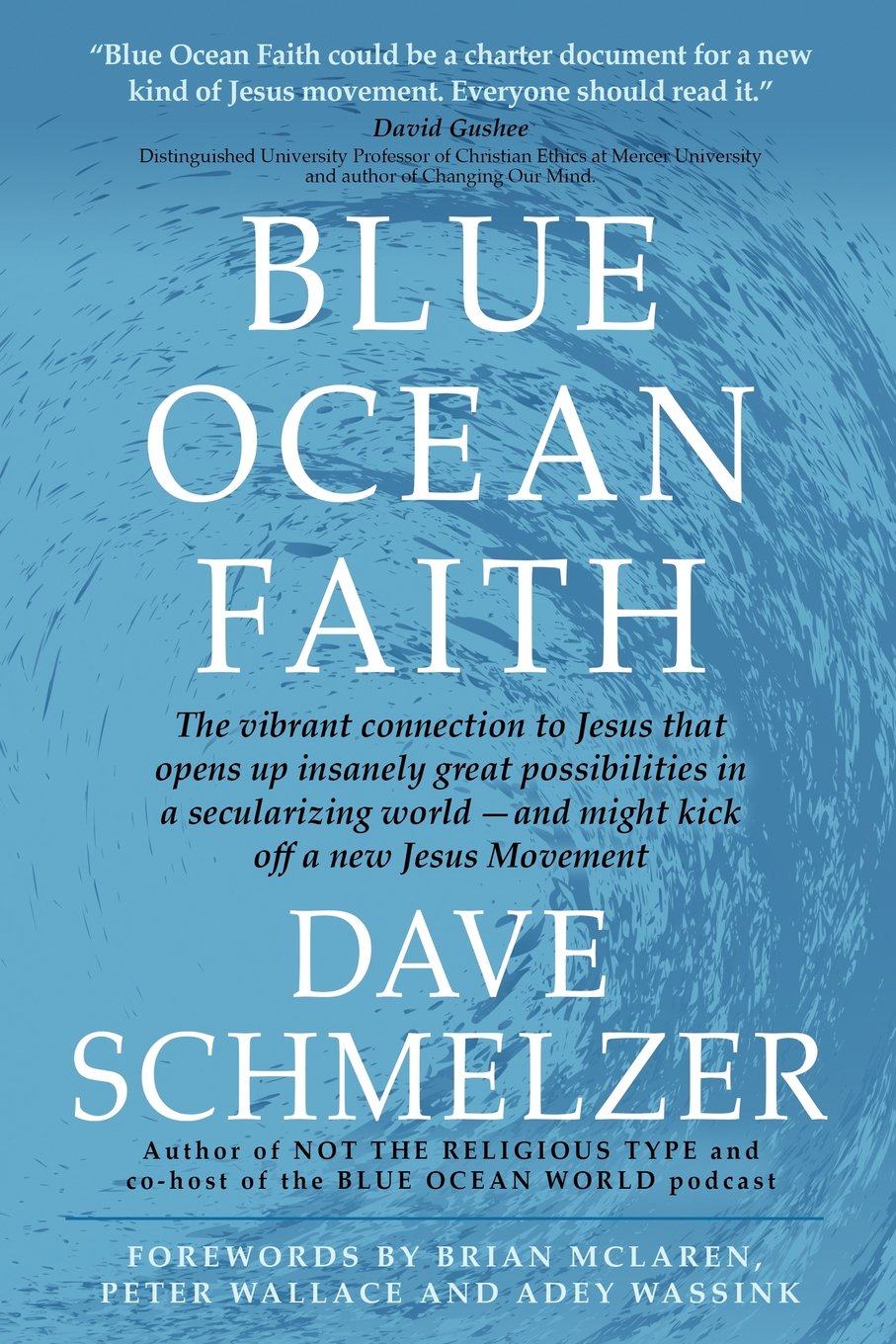
Click HERE to get Blue Ocean Faith on Amazon
Part 2: Centered Set is HERE

Wednesday, March 1, 2017

A Review of Blue Ocean Faith

Dave Schmelzer has just published his book Blue Ocean Faith: The vibrant connection to Jesus that opens up insanely great possibilities in a secularizing world - and might kick off a new Jesus Movement and I have to say that I was thrilled when my copy arrived. I have been following the progress of the Blue Ocean Faith movement and hovering around it's edges for at least seven years or so now (you can find some of my musings on it HERE, I am graciously permitted to contribute to the Blue Ocean Companion Third Way Newsletter periodically, and have had one piece accepted by Blue Ocean's online magazine Hello Horatio - maybe I will get a chance to be on their podcast as well one day) and I have spent quite a few of them waiting for something like this. Blue Ocean Faith sets out, and expounds upon the the vision of Jesus-following which is at the core of their movement and, quite frankly, which has had a tremendous impact on my own life. Frankly, I am an unapologetic fan of Blue Ocean spirituality. So, while I was very much looking forward to this book, my anticipation did not come without plenty of anxiety: this project mattered to me so I was especially invested in having it go well.

I am not disappointed.

Per the book (and the movement's website) Blue Ocean Faith contains six theological distinctives:

  1. A "Solus Jesus" framework
  2. "Centered Set" as their primary metaphor
  3. Child-like faith as the path to spiritual development
  4. A "Third Way" approach to controversial issues
  5. Ecumenism
  6. Joyful engagement with culture.
There is a lot to be said about those distinctives—so much that I am very much inclined to take the time to work through each one in its own blog post—but the upshot is that this book outlines an essentially, and recognizably Christian faith which is,at the same time, a thing altogether different from those iterations of Christianity which are represented by American Evangelicalism, Anglicanism, Catholicism, Orthodoxy, Mainline Protestantism or any other contemporary iteration of Christianity. What Dave presents here is something "new" (a term he is probably far more willing to embrace that a good number of Christian authors and thinkers today). Certainly there is orthodoxy here—the book begins, continues, and ends with an unwavering obsession with following Jesus—but it is an orthodoxy empowered to detach from our prized Christian "subcultures" and able to rest among (if not quite conform to) the emerging cultures of the future: Christian, agnostic, spiritual, secular or otherwise.

The subtitle of the book is ambitious and I certainly don't know whether Blue Ocean Faith will ultimately succeed in its proposed ambition; I honestly can not presume to know what form Christian spirituality is going to take over the next few centuries. But after reading it, I am convinced that Blue Ocean faith has a chance.

Blue Ocean Faith  presents the reader with an approach to spirituality and life which is both profoundly meaningful, and winsome. Each chapter confronts you with a sense of joy and possibility. Beyond the distinctives above (which Schmelzer uses to organize the book) the major themes in this book are Schmelzer's deep commitment to Jesus Christ, and his abiding delight in the world he is in. In his own words about the origins of the "Blue Ocean conversation":
We found ourselves having increasingly robust conversations with a lot of churches in very non-churchgoing parts of the world. This was the consistent feedback we were getting: their best sales-pitch to everyone, non-churchgoers and churchgoers alike, was that the actual, living , communicative Jesus was awesome. "There was no shadow of turning in him" —it was all good news.
Image result for thumbs up
Schmelzer seems to think
that Jesus really likes you.
Though Schmelzer does not at all shy away from the real suffering and pain that life has to offer (and he certainly never falls into the trap of suggesting that suffering represents some sort of "failure" on the part of a person), his refrain is that Jesus is good, and that the message of Jesus is "good news".

In terms of the writing and style, Blue Ocean Faith is an eminently readable and easily digestible book (if you have made it this far into the review, you will have absolutely no problem with the book itself—Dave writes with an easy, conversational, style I can only dream of). The organization is clear, each chapter builds on the one before without becoming at all repetitive, and the logic of the concept builds neatly—each one of those distinctives harmonizes with the others.

I would cheerfully recommend this book to just about anyone, but I think that in a lot of ways this book will be appreciated by the spiritually homeless, by ex-evangelicals who have been hurt by the church, by spiritually curious secular and agnostic folk, and by all of those restless young Christians who find themselves searching for a Jesus-obsessed community which is committed to diversity, inclusion, political nuance (neither beholden to politics nor removed from reality), and being comprehensible to anyone. It is the sort of book that, having read, you will want to buy for your friends; I have already ordered a second copy for one friend and will likely order several more.

Note

You can find my reflections on the first "distinctive" of Blue Ocean Faith linked below:
Part 1: Solus Jesus HERE.
Part 2: Centered Set HERE
Part 3: Childlike Faith HERE