Search This Blog

Showing posts with label LGB. Show all posts

Friday, August 14, 2020

A Lost Argument From St. Thomas Aquinas on Same Sex Marriage

This manuscript (which I have taken the liberty of translating to the best of my ability) is one I stumbled across at, of all places, Moody Library at Houston Baptist University. Across the page were scrawled the words "Can't let this get out".

Details among the marginalia as well as certain syntactical peculiarities lead me to believe this to be one of several missing articles from St. Thomas Aquinas' "Summa Theologica". Even the briefest of scans will make clear the reasons that this article has been so scandalously disappeared from the annals of philosophy and theology.


Article 1. Whether marriage between two persons of the same sex is commended by God.

Objection 1. It seems that the marriage of two persons of the same sex is not commended by God for God explicitly commends marriage between two persons of opposite sex saying “Therefore does a man leave his father and his mother and cling to his wife” (Genesis 2:23)  and this commendation is reiterated by Our Lord who said “For this cause a man shall leave father and mother and shall be joined fast to his wife” (Matthew 19:5) and was repeated too by Apostle who also said “For this reason a man shall leave his father and mother, and shall cling to his wife” (Ephesians 5:31).


Objection 2. Further, our forebears whose marriage was the first marriage were commanded to "be fruitful and multiply" (Genesis 1:28), and this command is understood to be applied to the whole of the human race, being descendants and therefore inheritors of that original command. But a marriage formed only by members of the same sex would be, by nature, incapable of honoring this command.


Objection 3. Further, the Apostle has explicitly condemned the sexual union of two members of the same sex saying of women “Thus God delivered them to the passions of disgrace; for even their females exchanged natural use for what is contrary to nature,” (Romans 1:27) and of men “And the males also, in the same way, abandoning natural use with the female, burned in their longing for one another, males performing shameful acts among males, and receiving in turn within themselves the requital benefiting their deviancy.” (Romans 1:27). And as a coupling from which sexual union is absent cannot be understood to be a marriage, there can be no marriage between members of the same sex.


On the contrary when people are joined in marriage they become one flesh (Genesis 2:24).


I answer that King David was married to multiple women, becoming one flesh with them. And we know that when two, though they seem disparate, are each equal to some third, they must also be one each with the other; for the Philosopher tells us that “when A belongs to B and C and is affirmed of nothing else, and B also belongs to all C, it is necessary that A and B should be convertible.” (Prior Analytics II,22,68) So if Ahinoam, Abigail, Maachah, Haggith, Abital, Eglah, Bath-Shua (1 Chronicles 3:1-6)  and Michal also, who was barren, were each wives of King David and thus one flesh with him, they must also have been one flesh one with another. And inasmuch as becoming one flesh is marriage, Michal and Abigail were married one to another. Further we know that this relationship (of Abigail to her wife Michal or to any of her other wives) was not condemned by God for God sent the prophet Nathan to rebuke the King when David committed sin of a sexual and marital nature but God did not condemn King David for his becoming one flesh (and thereby joining in marriage one to another) with his wives, and we know that God does condemn that which is sexually immoral or adulterous for the writer of Hebrews tells us “Let marriage be honored by all, and the marriage bed undefiled” (Hebrews 13:4); for "God will judge the whoring and adulterous", and God did not judge the marriage union of Michal and Abigail or of any of David’s wives who did not commit adultery. Finally, in His own commentary on the uniting together of one flesh, our Lord informs us that the unification is one spiritually enacted by God, saying “So that they are no longer two, but one flesh. What therefore God joined together let no man separate” (Matthew 19:6) so that we are forbidden from separating that union—be it between members of the same or divers sexes—which the Lord has established, either in our proclamations or by action of man.


Reply to Objection 1. The Philosopher states that the predication of truth to one proposition is not, in itself, the denial of truth as predicate of another statement so long as the two statements are not logically opposite (De Interpretatione 7). When the Holy Scriptures affirm that “a man shall leave his father and mother and be united to his wife” (Genesis 2:23; Matthew 19:5; Ephesians 5:31) said affirmation is not contrary to but merely subcontrary to the possible statement that “a woman shall leave her father and mother and be united to her wife”. Conversely to affirm that a one flesh union may be established between two of the same sex is necessarily subcontrary, and not contrary to, the proposition that a one flesh union may be established between two of divers sexes. Thus in affirming one flesh union between persons of divers sexes neither Moses, nor Our Lord, nor the Apostle deny the possibility of one flesh unions between members of the same sex


Reply to Objection 2. The book of the prophet Samuel confirms Michal as a wife of David (1 Samuel 25:44) and we know that Michal is finally barren for the Holy Scripture tells us “Michal daughter of Saul had no children till her dying day.” Thus the fact of barrenness in a marriage can neither prevent nor annul the mystic one-flesh union. Furthermore, we know that God has supplied, by grace, a means for those who are barren to fulfill the command of Genesis to be fruitful and multiply for the prophet Isaiah proclaims “Of the eunuchs who keep My sabbath, and choose what I desire and hold fast to My covenant, I will give them in My house, and within My walls a marker and a name better than sons and daughters, an everlasting name will I give them that shall not be cut off” (Isaiah 56:4-5). But that which is better cannot be inferior to that which is worse so that the keeping and following of God’s will must be sufficient to fulfill the command that we should be fruitful and multiply. And this is commensurate with Our Lord’s declaration that all the law and the prophets depend on the two commandments that we are to love the Lord our God with all our heart and with all our soul and with all our reason and that we are to love our neighbor as ourselves (Matthew 22:37-40) and with the Apostles insistence that the second command: “You shall love your neighbor as yourself” sums up the Law. And that upon which a thing is dependent cannot be lesser than that on which depends upon it—on the contrary the dependent is the inferior. So by keeping the Law of God, by Loving God with all heart, soul, and reason, and by loving neighbor as themselves, couples which are by nature or by circumstance barren in terms of children are, in the eyes of God supremely fruitful in the multiplication of God’s love thereby fulfilling the commandment set to the first marriage. Further a marriage may nevertheless establish a union of one flesh and be blessed by God without sexual union for the Apostle admonishes the Corinthians “Do not deprive one another, except by common consent for an appropriate period, so that you might have leisure for prayer, and then come together again so that the Accuser might not test you through your inconstancy. Now I say this as a lenient concession, not as ordinance. I want all human beings to be just like me” (1 Corinthians 7:5-7) making clear that the command not to deprive one another is contingent on the inability of the couple to resist the Accuser in the absence of sexual intercourse one with another. But to those marriages in which is given the gift of celibacy to both members, so that they have leisure for prayer, what a grace is given by God and what joy to the Apostle.


Reply to Objection 3. To condemn one or more particular instances of an act is not thereby to condemn all instances of said act. When the Apostle condemns those unions of men with men and women with women, it is clear that he is condemning that which is contrary to nature and is resultant of adoring and worshipping creation rather than the Creator only (Romans 1:25). Further we know that God through the Apostle did not intend this condemnation to be universal in nature for further in the same discourse and as an example of the same surrendering by God to reprobation we see that some are defiant of parents (Romans 1:30). Yet Perpetua is commended by God with visions and comfort despite defiance of her father saying in her own account:


'Then, when it came my turn, my father appeared with my son, dragged me from the step, and said: ‘Perform the sacrifice--have pity on your baby!’ 

Hilarionus the governor, who had received his judicial powers as the successor of the late proconsul Minucius Timinianus, said to me: ‘Have pity on your father’s grey head; have pity on your infant son. Offer the sacrifice for the welfare of the emperors.’

‘I will not’, I retorted.

Are you a Christian?’ said Hilarianus.

And I said: ‘Yes I am.’


So we know that those actions described by the Apostle are not here, best understood as universal but as particular condemnations fitting only to particular circumstances as a result of particular and wilful blindness to the glory of God.


Further, we know that sexual intercourse in marriage is commended to us as a tactic for resisting the impassioned tempers and sexual incontinence foisted on us by our passions and by the Accuser, for the Apostle clearly tells us “But if they cannot remain continent, let them marry; for it is better to marry than to be afire” (1 Corinthians 7:9). But what help would this instruction be to those who are, in their own natures, attracted to members of their own sex rather than to those of a divers sex if marriage were limited to a union between those of divers sexes? It would be useless, and as we know that words from the mouth of God do not return empty but accomplish that which God desires (Isaiah 55:11) it is clear that this word--that it is better to marry than to be afire--is an exhortation establishing marriage as a refuge built for members of the same sex as much as for members of divers sexes.


Note that this work is psuedopigraphical in its entirety, having been composed by me and by me alone. While the argument I express in this piece is in earnest, it amused me to see if I could write it in the style of the Summa Theologica in some rough and ready way.

For More of my Writing on LGBTQ+ Identities and Faith

I have a series in defense of Lesbian, Gay, and Bisexual relationships using standard Evangelical interpretive techniques and looking at the standard "cobber passages":

Thursday, September 14, 2017

What is "Unnatural": My Defense of LGB Relationships Part 5


Note, this post is Part 5 in a series (which starts HERE) on my Christian defense of LGB relationships and sex, however it is my hope that this piece in particular can also stand alone as a response to what I believe is the larger impetus behind much of the Evangelical (and Roman Catholic) church's rejection of LGB sex.

For my series in defense of the identities of transgender folk click HERE 


Introduction

"It's just unnatural."
It is fascinating to me that this is what much of the discussion over the sex lives of LGB folk so often seems to come down to. In the case of most non academic and theological types the discussion can get there pretty quickly, when it comes to discussions with people who do focus on academic and theological arguments, it can take a little while but if you stick around long enough, work through the "clobber passages", the exegetical discussion, and the examination of hermeneutical principles(1) you will get to this point eventually as well, albeit with a significantly different emphasis.

In the case of the non academic "regular person" the phrase "unnatural" seems to mean basically something that is "weird and makes me uncomfortable". It isn't particularly complicated, a straightforward smattering of socially acquired homophobia or unease with deviations from what the person thinks of as "the norm". That doesn't justify it—it is still deadly to the LGBT folks who regularly suffer hate crimes and discrimination here and around the world—it just accounts for it. However, in the mouth of an academic or theologian, the phrase unnatural or maybe counter to natural law means something very different and actually forms the foundation on which all of the other interpretations of the bible and exegetical conclusions often turn out to have been built. It all goes back to "Natural Law", Thomas Aquinas, and Aristotle.

Some Background


Feel free to read past this is you are familiar with Aristotelian and Thomist theories of Natural Law and sexual ethics.

I wanted to point out the separate ways the term natural is used when talking about LGB (and T) folks in order to say that I am not going to be talking about the non academic or theological use of the term—that use is about feelings and what people are exposed to so the proper response doesn't have a lot to do with formal arguments, it has a lot more to do with experience and actively engaging with people. What I want to focus on in this piece, is the argument that academics, theologians, and philosophers are making when they say that homosexuality is unnatural or that it is contrary to natural law(2).

Natural Law Theory is a way of thinking that dates back to the famous Catholic philosopher St. Thomas Aquinas who, in turn, built much of his thinking about this subject on the work of the Greek philosopher Aristotle. In brief, natural law theory argues that we can know how a person ought to behave based on our knowledge of what humans exist for. In pretty much the same way that a good knife is a knife that cuts well, and a good light bulb is one that provides illumination, a good human is one who humans well. The theory that Aristotle put forward starts by asking why we do things generally and then rather elegantly moves to the observation that if we keep asking "but why do you do that?" we end up working our way to the answer "in order to flourish (3)". From there Aristotle wants to ask what flourishing looks like for a human person and his conclusion is that flourishing for humans means something like "doing human-specific things as well as possible".

For Aristotle, the method you should use to figure out the particular flourishing of a being is to examine what characteristics or powers are unique to that being. So living things live (in contrast to inorganic things) and so to flourish as a living thing is to live; further, animals are distinct from plants in that they can move on their own, so moving well is part of flourishing for animals; skipping a bunch of stages here, humans are the reasoning animals, so for humans flourishing means reasoning well. With that said, reasoning for Aristotle could (if we are generous) include what we think of as emotion and relationship (4). Ultimately then, for Aristotle Natural Law would say that a person ought to do those things which are particular to them as well as they can without violating the doing of things that are particular to their other, broader, identities (human, mammal, animal, living-thing, existing-thing).

But when most Western Christian people talk about Natural Law they are generally talking about the version of the theory that St. Thomas Aquinas adapted from Aristotle, or at least they think they are. St. Thomas was willing to look to more sources that merely reason and his environment when it came to determining what a thing (or person) is for. For Aquinas the Bible, and Church tradition also get a voice (5). So when Aquinas thought about human sexuality, he thought about it in terms of its purpose—at least he sort of did. If we back out a little, Aquinas (following Aristotle and the general attitude of the church in his day) understood sex and sexual arousal to be an unfortunate development. Aristotle criticized sexual attraction and sexual intercourse for interfering with clear thinking. Aquinas focuses mostly on this same aspect of it when he categorizes sex as an activity (and a drive) which can be put to some good uses, and is not therefore wholly bad, but ultimately comes up short in comparison to total celibacy. Sex for him isn't quite evil but is a compromised sort of good, specifically it is something which can only be made good when it is put to the right uses within the right context. (6)

It is worth taking a minute to notice that this view is in pretty stark contrast to the way most western Protestants (conservative or otherwise) tend to have taught about sex. In western Protestantism, sex is generally thought to be fundamentally good, but subject to being used wrongly. The results are similar (both groups conclude that sex should only take place within marriage) but the orientations towards it are mirror images. Where Aquinas sees sex as a redeemable thing which is otherwise unfortunate, western Protestants have historically seen sex an inherently good thing which can be corrupted by wrong use. It is important to keep this in mind when thinking about contemporary Evangelical use of Natural Law theory.
This image is brought to you as a reminder that LGB folks
can and do raise children

For Aquinas then, sex can be redeemed by putting it to two specifically good uses, both of which he thought supported the purposes of marriage. So of course, we need to look at what Aquinas thought was the purpose of marriage. In broad terms, Aquinas thought that marriage could be good if it served the purposes of providing a context for fully rearing children, and of providing other-serving-fidelity between the spouses (7). Correspondingly, sexual intercourse becomes a good, in Aquinas' thinking, when it serves the purpose of raising healthy children and of uniting spouses in intimate fidelity. The procreation mandate is "according to natural law" in Aquinas's view because it is good for humanity to extend as a macro level application of the fact that it is good for people to keep living (8). The intimate fidelity mandate is a little harder to for Aquinas to pin to any distinct natural law reasoning and Aquinas sort of punts to some circularity (sex is only good within marital fidelity and marital fidelity is good because it provides a context wherein sex can be good) but seems to be derived from the observation that sex does, in fact, help/cause partners to form a bond with one another. From there Aquinas argues that sex should be oriented towards bringing the spouses together as a couple and toward providing pleasure for one another. He sums this up with the word fides but to make sure it stays clear, I will use fidelity/intimacy.

In summary, Aquinas taught that in order for a given sex act to not be sinful it had to be oriented towards raising healthy children and towards increasing the fidelity/intimacy of the married couple.

Evangelical Culture-War Modifications to Natural Law Theory


Insofar as contemporary biblical scholars and theologians are referencing the sexual ethics of natural law they are referencing this. It is a rigorously Roman Catholic view of sexual ethics, closed to non-procreative sex acts, to all birth control, and to any sexual intercourse or expression outside of marriage(9). It is, quite notably, not a particularly western Protestant view of sexual ethics(10). In fact, most western Protestants (and most notably Evangelicals) have been accepting of birth control and of marriages wherein the couple chooses not to have children for between 50 and 90 years depending on the denomination. This move was facilitated theologically by two distinct steps: First, during the Protestant reformation, the reformers shifted from a view of sex as basically-bad-but-able-to-be-redeemed-by-marriage to the view that sex is basically-good-but-is-corrupted-when-it-happens-outside-of-marriage. This didn't change their view of birth control as such but it did position them to make the second shift during the middle of the 20th century (and if that seems recent, keep in mind that birth control wasn't really available in the US until 1938 and the pill didn't show up until 1960; in that context western Protestants were early adopters, not holdouts) when they justified the use of birth control on the theological grounds that sex was a good thing within marriage and served the fidelity/intimacy purpose.

This is actually a really big deal because Western Protestants on the whole have not held to Natural Law theory when it comes to sexual ethics (they have used other ethical models—predominantly variations on utilitarianism, Kantian deontological ethics, and divine command theory—to think about sexuality). It is hard to read their recent attempts to recover Natural Law Theory as anything but an after-the-fact desire to shore up their disapproval of same-sex marriage. Fundamentally, traditional Natural Law Theory sees sex as something which has to be justified whereas Protestants traditionally see sex as something to be celebrated.

This is Al Mohler
There is actually pretty solid evidence for this after-the-fact response by Evangelicals (11).  Up until the prospect of same-sex marriage became a significant likelihood within the US, the legitimacy of birth control was all but assumed by most public Evangelical (and Western Protestant) theologians and ethicists (12). There were concerns and debates over birth control but they were centered around the question of abortion and generally started from the assumption (or explicit argument) that all birth control forms which work by preventing conception are perfectly legitimate within a Christian marriage. But it was only when the US started what turned out to be final push towards legalizing same sex marriage that, Al Mohler of the Southern Baptist Theological Seminary and self-appointed spokesperson for conservative Evangelical sexual ethics, published an article (which he later recapitulated in his culture-war book against LGBT Christians) questioning Christian acceptance of birth control and explicitly arguing that
In reality, the Pill allowed a near-total abandonment of Christian sexual morality in the larger culture. Once the sex act was severed from the likelihood of childbearing, the traditional structure of sexual morality collapsed.
or as he put it in his 2015 book/culture-war-manifesto We Cannot Be Silent (13)
 In more recent years, many evangelicals have begun to reconsider the morality of birth control and contraception and, on the positives side, have come to affirm the unconditional goodness of the gift of children. Even when evangelicals do not accept the Catholic admonition that each and every act of marital sex must be equally open to the gift of children, at the very least, evangelicals must affirm that every marriage must be open to the gift of children and that , should pregnancy occur, it is to be seen as an unconditional gift rather than as an imposition. (emphasis in the original) 
He did not (and does not) try to shift fully to the Thomist Natural Law view that each and every sex act must be open to procreation but tries to carve out a position wherein the marriage itself is "open to procreation" in principle. I would submit that he has to land there because the broader protestant understanding of sex (that it is a good thing to be celebrated within marriage) doesn't really leave space for the full Natural Law approach—in fact I suspect that it would be something of a catastrophe for Southern Baptists if the people studying in their seminaries all read Thomas Aquinas. Mohler seems to be trying to tie Evangelical theologies of sex back to Natural Law without erasing the distinctions between Roman Catholic and Evangelical views of the subject. The problem is that this isn't a particularly coherent approach; Mohler and his fellow conservative evangelicals want to use a Thomist purpose based Natural Law approach to ethics without actually accepting all of the logical implications of that view. Instead they dismiss the full Thomist implications of Natural Law theory as "too Catholic" without providing an explanation of how they still support their modified position. Complex and detailed systems like Aquinas' Natural Law Theory can't be modified on a whim; any modifications have to be justified in a way that demonstrates how the overall modification still fits with (doesn't contradict) the theory as a whole. Conservative Evangelicals have not provided the necessary careful justification of their modifications and until they do, this appropriation of Natural Law should be treated as incoherent (14). As it stands, people in the Mohler position have to somehow argue either that procreation is the purpose of marriage but not of sex, or that marriage must be judged by how well it fulfills the purposes they assign it but that sex should not be held to this standard—either argument would seem to be a really big theological/philosophical lift and I don't see how they would/will manage.

Bubblegum Rejoinder


In any case, my response to both of these positions (the Roman Catholic Thomist argument and the conservative Evangelical culture-war modification) is that they are wrong in shifting from the claim that "procreation is a purpose of marriage/sex" to the conclusion "procreation is an irreducible purpose of marriage/sex". In the first case, a defensible claim is being made. But that first statement simply isn't the same thing as the second. As someone who is reasonably fond of Natural Law theory on the whole, I don't have any problem with an ethical methodology which works to figure out what things are for and uses those conclusions to work on thinking about how those things should and shouldn't be employed, so I don't have a particular problem with saying that marriage/sex exists for the purpose of child rearing/procreation among other things. You see, both groups recognize that while procreation/child rearing is a purpose of marriage/sex, it is not the only purpose. Intimacy/fidelity (in the Roman Catholic version) or intimacy and mutual delight (in the Evangelical culture-war modification) are also recognized as a vital purpose of marriage/sex. That being the case, a given sex act, or a full marriage which serves to create or enhance intimacy/fidelity between spouses is fulfilling one of its purposes. Put another way, while it is true that procreation/child rearing is a purpose of sex/marriage, it is also true that intimacy, fidelity, and mutual delight is a purpose of sex/marriage. What is happening is that these theories are sneaking in an assumed premise, that things which have more than one purpose but do not fulfill all of them are sinful  Or in other words, we need to apply this argument to the act of chewing in order to know whether or not bubblegum is sinful.

Now, we know that chewing exists for two purposes: chewing (more broadly mastication) exists as one stage in the digestion process, and chewing exists to bring out the taste and pleasure of food. So one purpose of chewing is the nourishment of the body. The second purpose of chewing is enjoyment of the good world God has made. Most examples of chewing that we voluntarily engage in are able to fulfill both of these purposes. We eat things that taste good. However there are some things we choose to chew which serve only the first purpose, they may even contravene the second purpose (kale for instance, nourishes the body but tastes bad). Other things we choose to chew fulfill the second purpose but not the first. This is where bubblegum comes in. Bubblegum does not serve to nourish the body at all (in fact our mothers will collectively remind us that moving it to further stages of digestion is a bad idea); it does, however, serve to provide taste and pleasure. If the Roman Catholic and Evangelical culture-war modification assumed premise—that it is sinful for a thing to fulfill only one of multiple purposes—is correct, then it must be sinful to chew bubblegum. And as this is ridiculous in the case of chewing bubblegum, it is also ridiculous in the case of sex and marriage.

If same-sex sex/marriage is able to fulfill the purpose of fidelity/intimacy and mutual delight, then same-sex sex/marriage is able to fulfill the purpose of marriage by the standards of Natural Law theory if they are consistently applied, the Christian who wants to object to them will have to find other grounds.

The Academic Evangelical Use of Natural

There is still another use of the term Natural in connection to arguments over LGB sex and relationships which I have seen employed by evangelical academics who are more theologically moderate than their conservative culture-war modification counterparts. While they use the phrase Natural Law and the term natural they don't seem to be referencing Aquinas or Aristotle but what they take to be Paul's understanding of natural.

The clearest example I have encountered of this was by Scot McKnight in his book A Fellowship of Differents (15). The argument is that, in Romans 1, Paul's use of natural (the Greek word in question is phusis φύσις) represents the idea of a created design which was intended to be perpetuated and not deviated from so that any deviation from said design would have been wrong. When people take this approach they often do not directly reference Natural Law Theory and usually stay away from directly associating questions of procreation with the concept of natural. Instead the focus is on the Genesis account of creation (a concern I have addressed HERE) and on what is usually referred to euphemistically as the "physical complementarity" (McKnight uses the phrase "anatomical design" which could suggest an oblique reference to Natural Law "purpose" thinking) of male and female bodies i.e. the fact that a penis can be inserted into a vagina. In effect this approach seems to want to understand the word natural (phusis) to mean something like "the way it was made" or "the way it was designed".

There are two distinct problems with this view, and either would be fatal to the position. The first problem is that such a definition of natural is wildly anachronistic. It is the way a modern, post enlightenment person might use the word natural but it is not at all the way 1st century Greeks and Romans would have used the term phusis. C.S. Lewis has actually provided a careful etymological and philological analysis of the history and meaning of the term in Studies in Words. He explains that in the first century, the most common usage of the term phusis was to talk about things developing in an un-interfered-with way. If something developed on its own, without being messed with by an outside influence, that meant it developed according to its phusis, its nature. We actually still use the term nature  this way when we say that a particular food is natural. We mean that the food in question wasn't altered by humans.

The second problem with the "moderate" evangelical usage of natural is that it doesn't reflect the way Paul actually uses the term in Romans 1. Paul is clearly using unnatural to denote "interfered with" and not "contrary to anatomical design" in Romans 1 since he is specifically talking about behaviors people engage in as the result of a cause, namely denying God. In fact, the example he gives as unnatural in verse 26 is a first example of the full list which follows in verses 28-30 (16). The first example and the rest of the list are connected by the phrase "and just as" in verse 28 which indicates that Paul is going to give further examples of the effects of denying God. All of these actions are characterized with a word which Paul treats as synonymous with his verse 26 use of unnatural: unjust/unrighteous (adokimon/ἀδόκιμον). This is the un-doing of the righteousness/justice (dikaosune) (17) which Jesus calls us to in the sermon on the mount (Matthew 5:10). It is the impact of people warping or interfering with the way of being they would by nature have otherwise inhabited. Thus, what Paul is clearly not talking about is a person who, of themselves and their own healthy development, developed into a person who is attracted to those of their own sex. He is instead working off of the contemporary dominant understanding of most homosexual activity which was understood to be an outcome of hyper-sexuality and unbridled lust (18). McKnight's interpretation of natural as "different from some original design" or "nonconforming to anatomical design" just isn't based in 1st century usage of the term; nor is it compatible with Paul's actual usage of the term in the passage in question.

Conclusion

So I think it is pretty clear that while the term unnatural has had (and I am sure will continue to have) a significant impact on the way Christians think and write about homosexuality. Despite the fact that, as I have tried to show, the word does not in fact condemn or in any way count against the real attractions and relationships of LGB people who marry and are intimate in as loving and beloved-honoring ways as their heterosexual counterparts, its use against them and their relationships has led to incredible harm and pain. To tell a person that they themselves, or that their most intimate one-flesh, unions are not only unnatural but are especially sinful because of it, is to dehumanize and devalue them. The unconscionable outcome of this thinking has been all too predictable. From the Church's historic persecution and sometimes torture of people who engaged in LG sex, to the dire mental health impact on LGB youth who are raised in non-inclusive communities, the designation unnatural together with its Old Testament derived counterpart abomination (19) has enabled and even encouraged a homophobia and dehumanization of the LGB community for which the Church must repent.
He will reply, 'Truly I tell you, whatever you did not do for
one of the least of these, you did not do for me.

Footnotes:

(1) I don't mean to be flippant, I think those discussions are important.
(2) To those of my readers who are part of the LGBTQ community and have had this term leveled at you and used to degrade, deride, and dehumanize you, I want to say that I am sorry and that I hope my exploration and attempted rebuttal of the use of this term in connection to your lives and relationships can be helpful in a way that justifies the pain of this conversation and term.
(3) Aristotle's term was eudaimonia or "good-soul-ed-ness".
(4) Aristotle did have a significant hyper-cognitive bias but that need not interfere here.
(5) Though he did really like to take it back to merely observing nature and reasoning whenever he could.
(6) I am working, largely from the Summa Theologica Questions 49153, and 154
(7) Aquinas' third justification for marriage was that, at as a sacrament it has an intrinsic good, but he conceded that non-church marriage could still be good if they fulfilled the other two requirements, so I will focus exclusively on those.
(8) This is the reasoning by which Aquinas is able to shift from sex having to always be procreative to sex having to always be "open to procreation". The procreative purpose of sex (or at least of marriage since Aquinas doesn't do much to distinguish "marriage" from "the context of legitimized sex) does not end at conception but continues on to include the full healthy rearing of a child.
(9) Aquinas does work out a way to excuse nocturnal emissions (it isn't sin if you didn't mean to do it, so don't worry about it unless you went to bed fantasizing about something arousing—then it would be sin)
(10) Anglicans were the first major Christian group to give the official OK to birth control in 1930
(11) I shift my focus here from Western Protestants to American Evangelicals largely because it is Evangelicalism which has presented to most strident opposition to LGB relationships from within the larger Western Protestant community. Mainline and other Protestants have taken a somewhat different approach, in some cases standing in partial or full support of LGB relationships.
(12) For a good overview of pre-culture war Evangelical sexual ethics I would recommend Stanley Grenz' Sexual Ethics: An Evangelical Perspective.
(13) Mohler Published the book in October of 2015; the US Supreme Court legalized same-sex marriage in June of 2016.
(14) If anyone is aware of such a justification please link to it in comments and I will look forward to interacting with it and updating this post.
(15) I have responded to McKnight's argument directly over at the Third Way Newsletter so a portion of this post will recapitulate the arguments I made there.
(16) It is worth noting that this puts "disobedient to parents" (verse 30) on the same moral footing as the activity Paul discusses in verse 26.
(17) For my thoughts on this incredibly rich word, you can read THIS PIECE
(18) I have covered this in PART 2 of this series but Sarah Ruden also does an excellent job demonstrating it in her book Paul Among the People.
(19) Part 3 of this series contains my analysis of the OT texts and one of the many ways in which they have been misunderstood and misapplied.

Tuesday, May 9, 2017

Blue Ocean Reflections Part 4: Religious Squabbles and the Third Way


This is the fourth post in a six part series. You can find Part 1, Solus Jesus is HERE, Part 2, Centered Set HERE, and Part 3, Childlike Faith HERE.

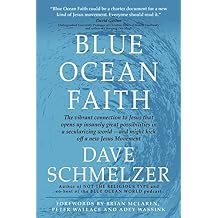
The Blue Ocean Reflections series consists of my personal interaction and history with the six "distinctives" of the Blue Ocean Faith movement as laid out in the book of the same name (you can find my review of the book HERE). Throughout the series I intend to talk about my own history and journey of faith and to offer some thoughts on how what I have come to believe impacts my understanding of the world. As such this series is likely to have a heavy focus on theology, philosophy, and politics. But since my formal education has been as broad as I could make it, my reflections are apt to be fairly wide-ranging as well.


"There are people who take the bible seriously, who also believe that it is OK to be gay."
I realize that it probably sounds hopelessly naif, but I honestly did not realize this was true until I heard Dave Schmelzer explain it at a Blue Ocean conference (I had downloaded the talks) in 2010. Writing six years later, I find this almost embarrassing but the fact remains. Now to be clear, Schmelzer did not enunciate the whole Third Way concept at that meeting; the idea as it is now applied to LGBTQ+ folks was developed a little later on by Ken Wilson and popularized when he turned it into the book A Letter to my Congregation. Back in 2009-2010, if my memories are correct, Schmelzer and the other Blue Ocean folks were in the process of trying to work out what their approach was going to be when it came to the hot button issues of the church. But for me, the real power of taking a Third Way perspective on church controversies became real, the afternoon I listened to that talk for the first time—if was the day I began to understand that being correct is not actually the final goal of faith in Jesus.

This section of Blue Ocean Faith actually contains two of the concepts which I have come to associate with Blue Ocean thinking. Chapter 5, Religious Squabbles Are the Worst (But There's an Antidote!) works out both with the Third Way approach to controversial issues, and also Schmelzer's application of M. Scott Peck's stage theory of spiritual growth (which, I understand, Peck developed in Further Along The Road Less Traveled). This works out pretty well as the stages theory does a good job of explaining why many (particularly religious) people have a hard time with anything like practically applied Third Way thinking, but it also means that I have a lot to reflect on in this post. So please please bear with me.

Stage Theory

Schmelzer's understanding and use of Peck's stage theory works best as a descriptive approach to understanding how a person's approach to, and understanding of, the project of religion or spirituality develops over time, with the additional observation that many people get "stuck" at one stage or another. It has some resonances with spiral dynamics theory as well. Rather than trying to summarize a summary, let me just quote the descriptive paragraphs from BOF:
Stage 1 you might call "criminal." 
It corresponds with being a toddler. Toddlers don't entirely know where the end and you begin, and so they're prone to being grabby and self-focused...Peck suggests two institutions that interact with this stage: jain and the boardroom (or any other position of power. Jail serves Stage 1 people, because it provides clear boundaries—the bars of the cell if nothing else. High-functioning Stage 1 people can also become the kind of effective narcissists that get power because you and I don't realize that they're criminals doing everything for their own gain. Think Bernie Madoff. Or Stalin.
Stage 2 you might call "rules-based."  
Now we're six or seven and we want to obey Mommy and Daddy's rules. Peck suggests two institutions which serve and promote Stage 2. First is the military, which is famously excellent at transitioning young people out of Stage 1 and into Stage 2, at teaching them discipline and honor and making the productive citizens. Second—of greater interest for our purposes—are churches. Peck argues that churches (and mosques, synagogues and other places of worship) famously teach people right from wrong, good from bad. He's at pains not to judge this, pointing out that Stage 2 creates the backbone of most societies. It creates the good people who volunteer, pay taxes, obey the law and raise great kids. 
Stage 3 you might call "rebellions." This corresponds with being a teenager. Suddenly the Stage 3 person is asking, "Who died and made all those Stage 2 rules the rules?" They become skeptics. If the Stage 3 young person is surrounded by a Stage 2 community, they might feel suffocated. Where's the open questioning? Are all these Stage 2 "truths" just shallow grabs for power? Peck says the institution that best promotes Stage 3 is the university. For one thing, universities are filled with kids in this age range, and often their stated mission is quite Stage 3—to get students to question everything they've been taught.... 
What Stage 3 doesn't realize is that its skepticism might not be the final word, that there might actually be answers to its questions, but answers that look quite different than the answers proposed by Stage 2.   
Stage 4 you might call "mystical." 
Stage 4, in Peck's view, isn't the end of the process. At the earliest, we hit this stage in our early 20s, and then we spend the rest of our lives walking out the implications of this. In Stage 4 we realize that many of the things that we were taught in Stage 2 do, in fact, seem true, but in a more expansive perspective than we'd previously understood... 
One way to think about this is that Stage 2 is dominated by answers. If the key is to be a good person and to get things right, we need to know what is and isn't right. In a Christian world, it might take some work to know what you need ot know about the Bible. You might need to read not just the Bible, but the current favorite Christian thinker of your friends. But, after you've done this, you're good. Maybe you won't know everything, but you'll have the answers you need. 
Stage 4, though, is dominated by questions. You've realized that reality is way bigger than you are, and that the way to navigate its vastness is relational. You are the sheep listening to and following the good shepherd. This will make Stage 4 Christians seem slippery to Stage 2 Christians. They seem to use the same language, but they mean different things with it.
It can be a long road but every step is good.

I have found this tremendously helpful (and, for the record, I tend to see myself as probably somewhere in Stage 3 with Stage 4 aspirations) when it comes to thinking about my own spiritual journey. Stage 3 began to break into my Stage 2 thinking around the time I graduated from Bible College, but the process was fairly gradual for me and I don't think I really gave up on Stage 2—that is, on the bedrock belief that there were answers out there for all of my questions and that all I had to do was learn and understand them—until my mid-late 20s. Fortunately for me (and I credit a lot of center-set dynamics, the Truth seeking/always questioning culture of my grad school, and some wonderful spiritual mentors who were not afraid of my questions) the transition from Stage 2 to Stage 3 did not entail any particular need to walk away from Jesus. I certainly despaired of the institutional church for a while, but Jesus was always "there with me" and was entirely happy to hear my questions, absorb my frustrations, and sit with me in my fears and doubts.

But stage theory helped me to make sense of what was going on with myself and with the Christian world around me. It gave me a grid with which to process things, and it has proved to be pretty robust at that job since I first started using it. The shift, from baseline selfishness to a reliance on rules and answers to structure life and existence to an awareness of the damage caused by those rules and answers and an attendant rejection of rules and answers as such and then beyond into a slowly-unveiling appreciation of the Truth in which at least some of those old rules were grounded but which is bigger than they seem to envision, resonates really well with what I have observed in the world of Christianity.

One of Schmelzer's most on-point observations in this chapter is that much of the contemporary "culture war" in the US, and particularly the conversation and tension between American White Evangelicalism and the Progressive Christian conversation seems to represent a Stage 2 vs Stage 3 conflict which periodically seems to shunt various folks into Stage 4.

As my relationship with Jesus has grown, as I have gotten to know him better and better, and as that has led me farther and farther outside the generally accepted bounded set of American Evangelicalism, I have experienced so much of what Schmelzer talks about here. I remember when I was in Bible college, I generally understood the "business of Christians" to be to learn the answers about Jesus, a task well suited to Peck's "Stage 2" and I genuinely believed that there were straightforward answers out there for me to find. To borrow another metaphor Schmelzer uses in the book. I thought that Truth was something I would eventually be able to comprehend, to fit in my own head. As time went on and my Bible College professors, then the books they recommended, then the books the authors of those books recommended, failed to answer my questions—or more accurately, as the answers they provided failed to satisfy my growing questions—I began to worry that the answers just weren't out there.

One wry observation that Schmelzer makes in the book is that, when introduced to the concept, Stage 3 Christians have a bit of a tendency to identify as Stage 4. He is probably right about that but it makes it hard for anyone to say that they actually are in Stage 4. That may be fairly accurate though, one of the hallmarks of the mystical approach to truth and God is an awareness of ones own limitations which would tend to prevent folks in that stage from having any particular sense of having "arrived", I suspect that a lot of mystical stage 4 people think of themselves as somewhere on the border between the rebellious stage 3 and the mystical stage 4. I certainly do and I am happy to leave it up to those who know me to decide whether that is accurate or indicates that I am actually fairly far gone in mysticism (my penchant for getting into internet debates likely counts against me here).

The Stage theory approach works really well for understanding a lot of the Blue Ocean project itself as well. If you think back to the previous sections (Solus Jesus, Centered Set, and Childlike Faith), all of them smack of this mystical/relational approach to God. They rely on the premises that reality is bigger than we can ever really comprehend and that there is a loving relationship available to guide us through it. Reality is both fundamentally wondrous, dangerous, and good. It reminds me a good bit of the classic line about Aslan from The Lion the Witch and the Wardrobe:

Aslan is a lion- the Lion, the great Lion." "Ooh" said Susan. "I'd thought he was a man. Is he-quite safe? I shall feel rather nervous about meeting a lion"..."Safe?" said Mr Beaver ..."Who said anything about safe? 'Course he isn't safe. But he's good. He's the King, I tell you.

This fundamental assumption that we cannot and need not "know all the things", that reality and Truth are just too great for us, and that Jesus is there to walk with us, is what—in my mind—grounds Blue Ocean thinking, it is the thread that holds all six distinctives together. It is also what I think drives a lot of Evangelical Christians (who represent the "rules and truth" stage 2 group with which I most identify) so crazy. Blue Ocean thinking delights in questions and the exploration of God without feeling the burden of needing answers (though answers can be pleasant and delightful enough when the come around) while a lot of Evangelicalism experiences an almost chronic anxiety in the presence of unanswered questions about reality, and religious cynicism experiences a mirror anxiety in the presence of confident answers. My experience from within both of these latter groups has been almost a deep frustration with the very idea that one could be at peace with questions or with answers. Maybe that is why Blue Ocean Faith feels so much like being able to breath again.

The Third Way (Handling those "Squabbles")


OK, so the Third Way is my jam. The essence of what Blue Oceaners call the "Third Way Approach
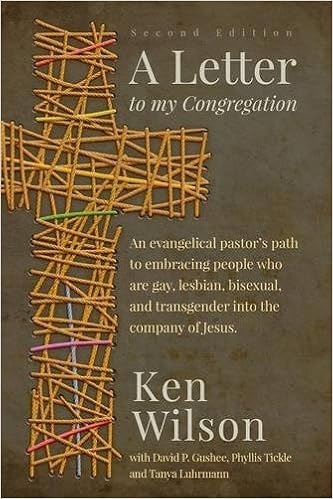
to Debatable Matters" is that Paul's advice to the Roman Church about how they ought to navigate their theological disputes over the observance of special "holy" days and the eating of meat which had been sacrificed to idols, can and should be applied to debatable matters in the church (universal and local) today. As I mentioned above, the Third Way was first enunciated and fully developed by the Blue Ocean Ann Arbor pastor Ken Wilson back when he (together with quite a few of the Blue Ocean group's other pastors) was a member of the Vineyard movement. Wilson first presented the idea in paper for at a Society of Vineyard Scholars conference as an approach to arguments over the level of participation the Vineyard ought to allow to LGB individuals. He later developed his ideas into a book A Letter to My Congregation  and it is his more fully developed version which Schmelzer cites as a Blue Ocean Distinctive in his book.

The Third Way approach begins by identifying its own scope. Riffing on the work of Roger E.Olson, the Third Way breaks religious claims into three potential categories: dogma, doctrine, and opinion. Dogma is defined as the basic beliefs of Christian faith, essentially those propositions without which we are talking about something which probably isn't Christianity. Schmelzer identifies the Apostle's and Nicene creeds as good candidate for this category. Doctrine would be those propositions which would seem to necessarily derive from dogma, usually by only one or two steps; most of the theology that people get really heated about online falls into this category. Then opinion is everything left over; it is the category for those propositions which we might hold but don't feel to be at all critical to our overall understanding of the nature of reality. Within this taxonomy, Third Way is an approach to differences over doctrine

The Third Way approach is an approach to what Ken Wilson has called disputable matters. He, and Schmelzer in Blue Ocean Faith, define disputable matters as 1) doctrine; 2) bringing two biblical truths into tension; 3) disagreed upon by otherwise faithfully Jesus-following people. 

Once we have decided that we are involved in a debate over doctrine (and keep in mind that debates over the theology of LGB sex have been the experimentum crucis for the theory) the Third Way approach is to look at which "side" in the debate is arguing for greater liberty of conscience and behavior and which is arguing for a greater degree of holiness or constraint. In Romans, Paul identified one "side"—the one which holds to more laws and have a more tender conscience—as the weak and the other—those with more liberty of conscience—as the strong, and within that framework, each group has a responsibility to the other. In Dave's words:
  • By all means hold the belief that you hold and never violate your conscience
  • Shun contempt and judgement and trust God to judge wisely
  • Make clear to yourself and others that you understand that your belief is not dogma and that reasonable, faithful people disagree with you.
  • Do not exclude anyone from full participation in the community over disputable matters—so long as they also abide by these four principles.
This has meant that Blue Ocean churches are functionally "open and affirming" in that they will not prevent an LGBTQ+ person from participation in the full life of the church, they perform same-sex weddings and have ordained LGBTQ+ clergy. However, they aren't technically "open and affirming" since, to quote Schmelzer (working from Ken Wilson) again:
...the "affirming" part of "open and affirming" seems to go against Paul's command here not to judge. To "affirm" someone, in this context, often means something like to "grant them moral approval." I have to meet them and ask myself, "As best as I can figure out, do I morally approve or disapprove of this person?" Then I decide, "I approve!" Along with Paul here, Jesus profoundly commands us not to judge anyone. The issue in Third Way is not passing judgment positively or negatively on anyone, it's to include all people who hope to follow Jesus as the disputable matter works itself out.
The upshot of all of this for me has been a long term commitment to, on the one hand, hold and advocate for my beliefs on this and other subjects as strongly as I know how (feel free to check out my defense of LGB relationships HERE and my defense of the gender identities of transgender persons HERE if you are curious) while remaining in relationship and spiritual community with people who disagree with me.

So far as I can tell the Third Way is really the only viable way forward for the Church as a whole, but I want to acknowledge that it isn't easy at all and, frankly, still needs a lot of working out. I still have questions about what it looks like to take a Third Way approach when there are people who have suffered spiritual and emotional abuse at the hands of those who are the weak (it is interesting to note how often the weak have power over the strong).

Some Resources

  • For those who are interested, Ken Wilson and Emily Swan maintain a blog series dedicated to thinking about the Third Way over at The Third Way Newsletter, they have even allowed me to contribute periodically.
  • Anyone with questions about Transgender folk and theology would be really well served to check out Austen Lionheart's YouTube channel Transgender and Christian
Click HERE to check out A Letter to My Congregation on Amazon


Product Details
Click HERE to get Blue Ocean Faith on Amazon

Wednesday, February 22, 2017

The Indirect Texts: My Defense of LGB Relationships Part 4

Note this is Part 4 in a series which beings HERE.

Then the Lord God made the rib He had taken from the man into a woman and brought her to the man. And the man said:

     This one, at last, is bone of my bone
     and flesh of my flesh;
     this one will be called "woman"
     for she was taken from man.

This is why a man leaves his father and mother and bonds with his wife, and they become one flesh. Both the man and his wife were naked, yet felt no shame. (HCSB Genesis 2:22-25)

For my series in defense of the identities of transgender folk click HERE
My post in defense of Intersex persons is HERE

The Creation Account

When moving from the direct references to gay sex in the bible to the—potentiallyindirect references, the majority of arguments with which I am familiar nearly all end up pointing back to this passage, together with the two gospel accounts of Jesus quoting it (Matthew 19:1-9 and Mark 10:1-12). The reasoning then goes as follows: In the first description of marriage which we have in the bible, and which Jesus particularly references as exemplary in some way [more on just how it is exemplary in a bit], the marriage is heterosexual. Furthermore, the heterosexuality of the marriage is particularly spotlighted by the fact that it immediately follows the account of the creation of Eve from Adam and that God's creation of both men and women is highlighted by Jesus when he cites the passage. This is taken to imply that God designed marriage as an exclusively heterosexual institution.

The first problem with this reasoning is the way it slips in that word exclusively. Nobody that I know of denies that the biblical account of the first marriage is heterosexual or that this implies God's approval of heterosexual union. But the simple claim that God approves of straight marriages does not, it itself, imply that God disapproves of same-sex marriages. In order to draw that conclusion, the arguer would have to supply further evidence. Think about it like this: If I were to tell you that yesterday I made a great sandwich by spreading peanut butter and blackberry jam on whole grain bread, you could, very reasonably, conclude that I believe a sandwich can be made by combining peanut butter and jam on whole grain bread. But it would be ridiculous for you to conclude that I do not believe that ham and cheese (with a little mayo and mustard) on white bread can also be a sandwich; or that I don't believe in the legitimacy of peanut butter only sandwiches. We do not say that the only "real" light bulbs are incandescent just because the first commercial light bulbs were, or that republican democracy is an illegitimate form of government because the bible only recognizes variations on theocracy and monarchy. We don't do that because that just isn't how language works.

An affirmation of one thing is not in itself a denial of anything else, even when that account is of the thing's origin.

So too, the biblical affirmation of heterosexual marriage is not in itself a denial of the possibility of homosexual marriage - language just doesn't work that way.

Furthermore, the fact that Jesus referenced the Genesis account—even the fact that he references the participation of both men and women in marriage—when talking about marriage does not imply a denial of the legitimacy of same-sex marriage. Humans have a tendency to read answers to our questions into texts or accounts that aren't actually addressing those questions. We like having our questions answered and, as Christians, we are really motivated to find as many answers to our questions as we can in the Bible. Unfortunately, the result of this—very understandable—desire is that we tend to create answers where they don't exist. In the Matthew and Mark passages, Jesus is answering a question about divorce and was, naturally, referencing the common contemporary form of marriage in his answer. Good teachers generally avoid trying to answer questions with elaborate and comprehensive accounts of the full range of tangential possibilities related to the subject - when possible they answer the question on the terms it was asked, and where not, they demonstrate the misunderstandings contained in the question itself. If someone had asked Jesus whether or not it was OK for siblings to fight, he might very well have referenced Cain and Able, but that would not have indicated that Jesus didn't believe in the legitimacy of sisters.

The upshot is that the creation narrative, and other biblical references to the creation narrative, do not actually speak to same sex marriage or homosexuality one way or the other. They are neither affirming or condemning. However, I would suggest that when we look at what the Bible has to say about the role of sex in a Christian's life, there are some legitimate conclusions which can be drawn concerning LGB relationships.

Specifically, in 1 Cornithians 7, Paul is writing to the Church in Corinth about (among other things) what they should be doing with their sexuality and romantic/pair-bonding relationships and his general advice is generally that marriage (committed other-valuing relationships) exists—among other reasons—for the sake of satisfying sexual desire. He recommends singleness (and presumably chastity) where possible but says in verse 9 that if someone doesn't feel able to control their sexual desire, that they ought to marry, since "it is better to marry than to burn". Now the fact of the matter is that Lesbian and Gay folks will not generally find heterosexual marriage to be much of a help in alleviating sexual desire— a bit like trying to slake your thirst with a big glass of sand. So if we want to insist (as many conservative Protestants do) that the Bible is applicable to all persons, the logical conclusion is that LGB folk are blessed by God when they choose to satisfy their sexual desires in marriage to a member of their own sex.

Porneia

A second common objection to the legitimacy of homosexuality is the Bible's uniformly negative language about "sexual immorality". The English phrase is a common translation of the Greek word porneia (the older translation was "fornication"). There is no question in my mind that porneia is a thing that God sees as damaging to people who engage in it and is, therefore, not commensurate with the Way of Jesus—Christians should avoid it. The vital question though is whether or not gay sex in the context of a same-sex relationship would qualify as porneia.

The problem with answering that question is that, in the NT "porneia" is a general umbrella term. In fact, I would argue (for once) that "sexual immorality" is actually a pretty good translation of it. There are two distinct methods a careful Bible interpreter can take when it comes to examining umbrella terms like porneia: the list method or the principle method. The list method would recommend making a list of all the actions which would have been considered items under the "umbrella", thereby using the one term porneia as a simple short hand for a long list of sexual activities we shouldn't do. The principle method would recommend comparing all of the items on the contemporary list, discerning what it was that they were understood to have in common, and then identifying that principle as the thing being discussed when the NT uses the term porneia.

Maybe an example would be helpful. Let's take use the English word family. If I were to say that we should be kind to our family, a list model interpretation would interpret that statement by carefully investigating who I consider to be my family and the nature of my relationship to those people (wife, sons, mother, father, brothers, sister, in-laws, aunts, uncles etc...), they would then conclude that Bill wants people to be kind to those who have those relationships (wife, sons, ect...). But a principle method interpretation would look at the common thread in all of those relationships and would conclude that by family I mean anyone whose relationship with me contains that particular thread.

The consequences of choosing a list method or a principle method of interpretation are really significant. The list method guarantees certainty and stability—once the list is set it can't really be altered except by new scholarship or data indicating that a particular item ought to be added or removed—but it comes at the price of flexibility and risks missing the point entirely. In my example above, a list method interpreter would not be able to account for adoption or godparents, list method interpretation would not incorporate that friend who has lived next door our entire lives, the "aunt Bernice" who is no blood relation but is unquestionably family. The principle method of interpretation is entirely open to those possibilities. It lacks the clear and comfortably defined boundaries of the list method—we never get to be entirely sure that we are applying the principle perfectly—but it is able to incorporate a broader range of meaning and, in my own experience, gets us far closer to the core intentions of the communicator in many instances.

For the record, there is a lot of really good research out there working out the list of sexual acts that were included in early Judeo-Christian uses of the term porneia and that is important work. Both list method and principle method people need that work to be done. This list method interpreters need it in order to figure out which particular sexual acts the Bible is condemning as damaging to persons therefore and upsetting to God, while the principle method interpreters need it in order to figure out what type or character of sexual activity the Bible is condemning as damaging to persons and therefore upsetting to God. Unfortunately for all of us who like easy answers, the fact is that most scholars will tell you that porneia is a really difficult word, that its meaning tended to shift, not just over time, but from culture to culture(1), and as a result there isn't really any total consensus on which actions the various authors of the New Testament would have been referencing when they chose to use the word.

In fact, porneia has been suggested to refer to a broad a range of activity as: bestiality, adultery, adulterous rape, exogamy (marrying outside one's group), pederasty, prostitution (male and female), solicitation of prostitutes, extramarital sex, any sex that violates the Leviticus prohibitions (including heterosexual sex when the woman is menstruating), and masturbation. Scholars do not generally agree on the list and the approach they take to determining which items ought to be on it is generally conditioned by their overall theology of sexuality.

I would suggest that we ought to take a principle model approach to interpreting this word. If we do I would suggest that the common thread which emerges from the scholarship on the term would be "sexual activity which does not honor the full humanity of the other" or maybe "sexual activity which uses rather than partners with the other". This would be very much in line with Jesus' declaration that all of the law (including the forbidding of porneia) can be summarized by the aphorism "Love the Lord your God with all your heart, soul, mind, and strength; and love your neighbor as yourself".

So I agree with Christians throughout the centuries that porneia is a common temptation and the source of great damage to many people and that it ought to be avoided. I agree that one of the important roles of marriage—not the only role—is to provide a context for practicing sex which honors and serves the beloved. I would, however, further argue by pointing to the many Christian same-sex couples who are in loving and committed marriages, that same-sex marriages are able to fulfill that role in the lives of LGB people just as much as heterosexual marriages are bale to fulfill it in the lives of straight and heterosexually coupled bisexual people.


PART 5: Natural Law HERE

Notes

- Well, I didn't quite make it. I had hoped to cover the philosophical question of natural law in this post as well as porneia and the creation account but it has already gotten longer than I anticipated. As a result I will put my thoughts on natural law in a fifth post for the series.

- A lot of research went into this post and, in addition to my general reading, some of it came from various journals so I have included a list of papers and resources on the topic of porneia below for those of you who would like to check my work (which I would very much encourage you to do). This is not a complete list of all the sources which have formed my opinion but it should be enough to give you a taste of the scholarship. I would encourage everyone to do their own additional research and reading (I will probably end up writing an ancillary post for this series with recommended readings on the subject).

-As always I welcome your comments and critique in comments so long as you keep things civilized

Research Material

  1. Harper, Kyle. "Porneia: The Making of a Christian Sexual Norm." Journal of Biblical Literature, Vol 131, No. 2 (2012) pp. 363-383 http://www.jstor.org/stabel/23488230
  2. Malina, Bruce. "Does Porneia Mean Fornication?" Novum Testamentum, Vol. 14, Fasc 1 (Jan., 1972) pp.10-17 http://www.jstor.org/stable/1560033
  3. Jensen, Joseph. "Does Porneia Mean Fornication? A Critique of Bruce Malina." Novum Testamentum, Vol. 20, Fasc. 3 (Jul., 1978), pp.161-184 http://www.jstor.org/stable/1560427
  4. Schroeder, Caroline, "Prophecy and Proneia in Shenoute's Letters: The Rhetoric of Sexuality in a Late Antique Egyptian Monastery." Journal of Near Eastern Studies Vol. 65, No. 2 (April 2006), pp. 81-97 http://www.jstor.org/stable/10.1086/504984


(1) for Greeks it usually just meant prostitution whereas for people with a Hebrew/Jewish background it was the preferred interpetation of the Hebrew word zhn which was used as a catch all term for disapproved of sexual activity.