Search This Blog

Showing posts with label Viking Wisdom. Show all posts

Sunday, February 2, 2020

Characteristics of the Unwise - Wisdom of the Vikings Part 13

Worry
The unwise man
is awake all night
worries over and again.
When morning rises
he is restless still,
his burden as before.

Face Value
The unwise man
assumes that only
friends laugh to his face.
At the table with the wise
he cannot tell
what they say behind his back


Note: This is part 13 in an ongoing series (the series starts HERE) bringing together the Hávamál (a collection of Norse wisdom poetry) and the still-evolving rules and mores of the Internet, particularly as they are developing in the realm of social media.


Because humans are a social species, we all have a tendency to create a sort of mask of false-self which we use to interact with our world. We "prepare a face to meet the faces that ]we] meet". Of course this makes vulnerability, relationship, and connection far more difficult to achieve and plenty has been said about it already—if you are interested I would recommend the work of Brene Brown. Certainly the Vikings are not a culture with which we generally associate vulnerability. The same ought to be said of social media and internet culture. 

Living in the context of a functional anarchy and without the protections of a state, reputation was more important for the survival of a medieval Icelander than it is for most of us today. As a social species, we are fundamentally dependent on one another and threat of social isolation is ultimately existential. People literally die as a result—both direct and indirect—of social isolation. The psychological upshot of this human dynamic is to reinforce the urge to guard our reputations closely, to put great effort into defending our names and characters. 

All of that is natural and the degree to which it is true in modern off-line meat-space society is intensified by an order of magnitude in the contexts of medieval Iceland and the social internet. 

And yet, the best option—at the end of the day the only workable option—is the massively counter-intuitive choice to embrace authenticity and vulnerability. As the wise among the Vikings remind us, it is the unwise who "is awake at night over and over again". Bring to mind that person who is so afraid of being seen to have been wrong that she cannot ever concede a point in a discussion, or that friend who can never graciously accept a single barb as his expense. Have you noticed that they seem to become almost tone deaf online? Have you noticed those people (the unwise) who think they are "winning" when to every reader they are only making greater and greater fools of themselves?
At the table with the wisehe cannot tellwhat they say behind his back.
So take a breath. Be willing to be seen. Admit when you are wrong. Be quiet when you could talk sometimes. And be willing to walk away when you need to. Don't stay up too late replaying a discussion, trying to formulate the perfect answer. When morning comes you will still be restless.

Wednesday, March 22, 2017

On the Vulnerability of Wise Vikings - Wisdom of the Vikings Part 12

Moderation

The cattle know
when to come home
from the grazing ground.
A man of lean wisdom
will never learn
what his stomach can store.


Happiness

He is unhappy
and ill-tempered
who meets all with mockery.
What he doesn't know,
but needs to,
are his own familiar faults.


Note: This is part 12 in an ongoing series (the series starts HERE) bringing together the Hávamál (a collection of Norse wisdom poetry) and the still-evolving rules and mores of the Internet, particularly as they are developing in the realm of social media.


As we have moved through the wisdom of the Hávamál it has become more and more apparent that virtue ethics, rather than a particular set of ethics rules, are the functional framework. The aphoristic poems don't so much tell the reader what action they ought to take in each and every situation as they lay out conditions under which particular virtues prove necessary. In that way they highlight those virtues which were most necessary to flourishing in a medieval (Viking) Icelandic society and are (by my hypothesis) also critical for online participation.

In these two poems, I would suggest that it is the virtue of vulnerability, or at least the virtue of an internal vulnerability which is being highlighted. In the first we get the pastoral image of a grazing cow, which knows when to stop eating and come in, applied to a man of "lean wisdom" who will "never learn what his stomach can store". In the second we get a reflection on the idea that an unwillingness to know your own faults can steal your happiness; or maybe it would be better to say that until we recognize our own faults, we will not be able to be happy. In both cases, we find that flourishing emerges from a lack of self-knowledge. 

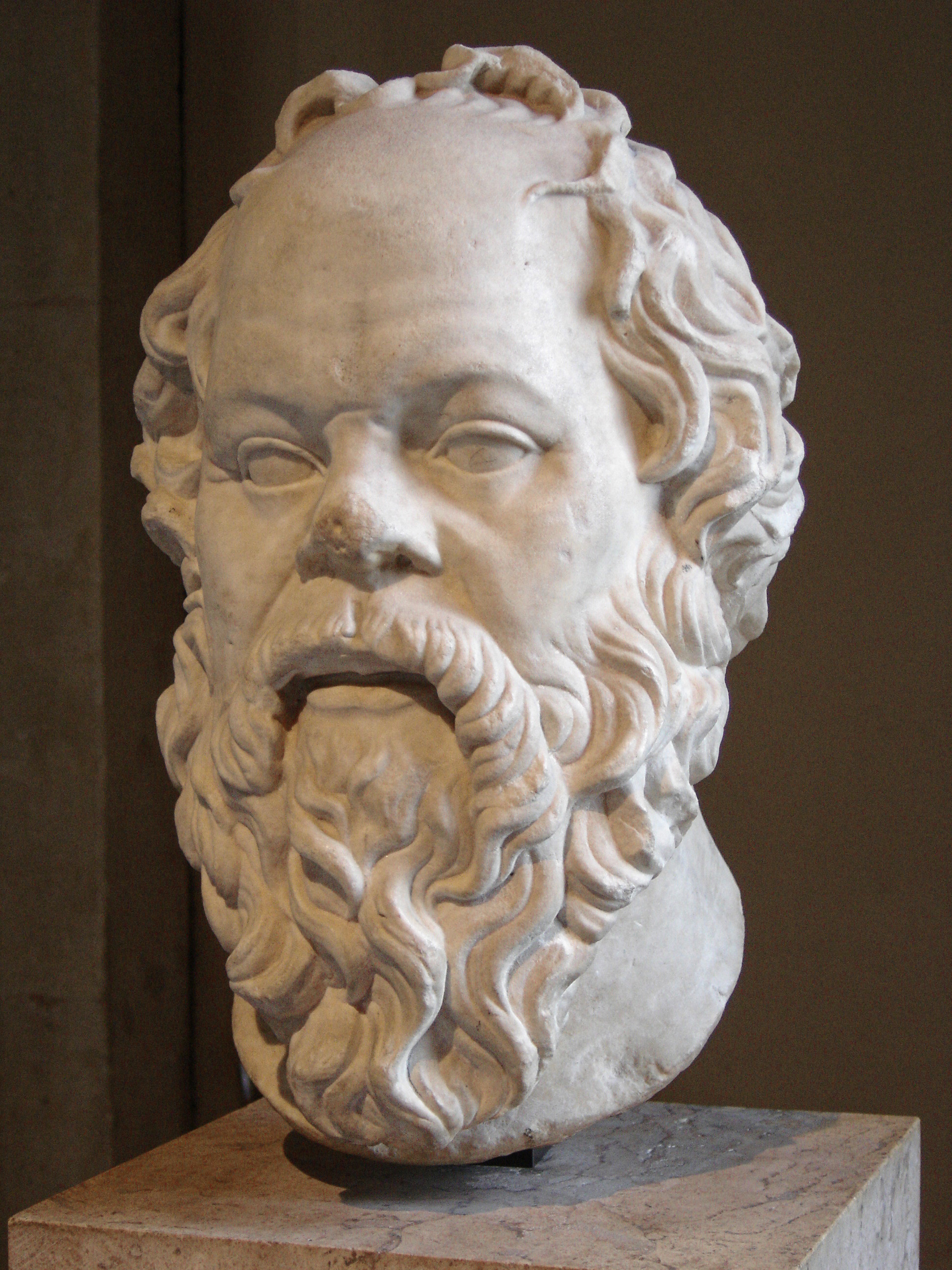
Image result for socrates
Socrates
Notably, this is a bit of wisdom which the Vikings have in common with Socrates and the Greek philosophical tradition. The aphorism "Know Yourself" (γνῶθι σεαυτόν) is said to have been etched over the doors of the temple of Apollo at Dephi—the structure which housed the Delphic Oracle. For Socrates the aphorism formed much of his motivation for engaging in philosophy and was also (if we are to believe The Apology) the clue to solving his ultimate riddle. The charge to seek out self-knowledge is a well established bit of wisdom. 

And yet, it often seems to be lacking in our online engagement. There seems to be no end to the stories and studies on the way in which social media in particular, but cyberspace generally, has been isolating us in to ever-more polarized echo chambers. Generally the danger these stories and studies are working to point out is that closing ourselves off from dissenting opinion and an attendant decreased capacity for empathy with those outside our echo chambers, and that is a legitimate and weighty concern. At the same time, though I think it is also critical to highlight the way in which existing in an echo-chamber robs us of opportunities for self-knowledge. My Dad regularly points out that "It takes a non-parochial fish to know that it is wet", in other words, it is often hardest to see the very thing we are most surrounded by. In fact, the greatest opportunities we have to discover our own condition is the experience of encountering other conditions. Those experiences are what give us the opportunity to contrast our own "normal" with someone else's "normal". The best chance that fish has of recognizing its own wetness is if it begins to encounter air bubbles.

So too, when we find ourselves spending our time online, immersed in mono-cultural echo chambers, it becomes incredibly difficult for us to recognize our thoughts and approaches as anything but "the way things are" and, since we tend to seek out the most comfortable possible environments, we are particularly unlikely to be confronted with our own faults and weaknesses. The phenomenon of socio-cultural isolation and grouping isn't just bad for society as a whole, it stunts our growth as individuals (think about how much easier it is to think of yourself as a "rugged individualist" when everyone you encounter has your back anyway).
A new environment can be...challenging

But what does all of this have to do with vulnerability as a virtue (and for those of you who aren't sold on the idea that vulnerability isn't a virtue at all, I have included Brene Brown's excellent TED talk on the subject below)? As I understand it, vulnerability is a hybrid virtue combining love and courage. Vulnerability means loving the other (or the self) enough to risk being hurt while courage is the capacity to do what needs to be done. In this case we are being called to be vulnerable with our own selves. This critical virtue means first seeking out enough of an experience of the world that we are able to recognize ourselves, not as default humans, but as particular and unique beings (be like the cow and don't stop eating before you are full) and we have to take a good long look at that self which our experience has illuminated and risk the pain of seeing our own failings. In his essay On Forgiveness, CS Lewis points out:
Real forgiveness means looking steadily at the sin, the sin that is left over without any excuse, after all allowances have been made, and seeing it in all its horror, dirt, meanness, and malice, and nevertheless being wholly reconciled to the man who has done it.
I would suggest that that forgiveness critical when "the man" is myself. And it is vulnerability which empowers that forgiveness.

Resources:

Image result for politecho
If you are looking for ways to break out of—or at least recognize—your echo chamber, I ran into this tool from PolitEcho the other day which analyzes your FB feed and lets you know more about your political bubble. You might find it useful.


Brene Brown's talk on Vulnerability, she has also written a number of books on the subject:


Tuesday, March 14, 2017

Manners are Essential to Community - The Wisdom of the Vikings Part 11

Good Manners
A man should drink
in moderation
be sensible or silent.
None will find 
fault with your manners
though you retire in good time.

Self-Discipline
The glutton does not 
guard himself
eats till he's ill.
Wiser men
only mock
a fool's fat belly.

Note: This is part 11 in an ongoing series (the series starts HERE) bringing together the Hávamál (a collection of Norse wisdom poetry) and the still-evolving rules and mores of the Internet, particularly as they are developing in the realm of social media.

I characterize the Viking wisdom which emerges from these two poems as follows: "The internet is a community, not merely a platform and you ignore that to you own peril".

Image result for drunk viking
Is this really what you want the world to see?
Participation in online community requires listening as well as talking. Really successful "interneters" listen and engage rather than merely shouting and declaiming though there can certainly be a place for both of those things. I think there is a particular tendency to believe that in our own spaces (our blogs, our tweets, our Facebook walls) we have some sort of licence to be more rude than we would be in someone else's space. It is common to see people posting remarkably offensive things in their spaces and then defending those posts as unassailable due to a sort of perceived "right of self expression" or "freedom of speech". Of course, it is entirely true that they have a right to post what they like (remember that my basic working theory here is that online spaces are anarchic to nearly the same degree that Medieval Iceland was, if in its own way), but I believe that they are missing three important truths when they act this way.

First, they seem to be laboring under the misconception that civility exists as a discipline rather than as a virtue (I am, for the moment, ignoring those artists and philosophers who use shock value to communicate a point--they are another case altogether). In The Four Loves C.S. Lewis explained this well saying:
If you asked any of these insufferable people--they are not all parents of course--why they behaved that way at home, they would reply, 'Oh, hang it all, one comes home to relax.  A chap can't be always on his best behaviour.  If a man can't be himself in his own house, where can he?  Of course we don't want Company Manners at home.  We're a happy family.  We can say anything to one another here.  No one minds.  We all understand.'

Once again it is so nearly true yet so fatally wrong.  Affection is an affair of old clothes, and easy, of the unguarded moment, of liberties which would be ill-bred if we took them with strangers.  But old clothes are one thing;  to wear the same shirt till it stank would be another...
Affection at its best practices a courtesy which is incomparably more subtle, sensitive and deep than the public kind.  In public a ritual would do.  At home you must have the reality which that ritual represented, or else the deafening triumphs of the greatest egoist present...
We can say anything to one another.'  The truth behind this is that Affection at its best wishes neither to wound nor to humiliate nor to domineer.
The enforced rules of civil society—rules which are unenforceable online—are there to impel those of us who have not yet acquired the virtues of civility to act as though we had nonetheless. At the end of the day, it is specifically in your own space that you will most often practice the civil virtues of moderation and sensibility exactly insofar as you posses them. And I think that people realize this on a fairly gut level. When we encounter someone who is rude, brash, and foolish in their own space, we are far more likely to be leery of their participation in other spaces.

Second, the "fool" here, fails to realized that, online, even their "own" spaces are never really private. What is said online is said publicly. The advent of screenshots makes this particularly the case. In the case of the two largest social media platforms, comments, graphics, and memes posted on ones own "wall" (I use the term generically) are, absent particular privacy settings, going to be put directly into the feeds of other people who will then unavoidably react. Of course they may choose to react privately and not to comment, but that is no less a reaction. So it is basically untrue to believe that most online spaces are really "private" unless particular care is taken to ensure that the audience is limited and particular. Moreover, it has been my experience that the vast majority of people who hide behind the "it's my private space" claim have not actually engaged any privacy settings and seem to be intent on broadcasting the foolishness to as much of the internet as possible—they want the clicks.

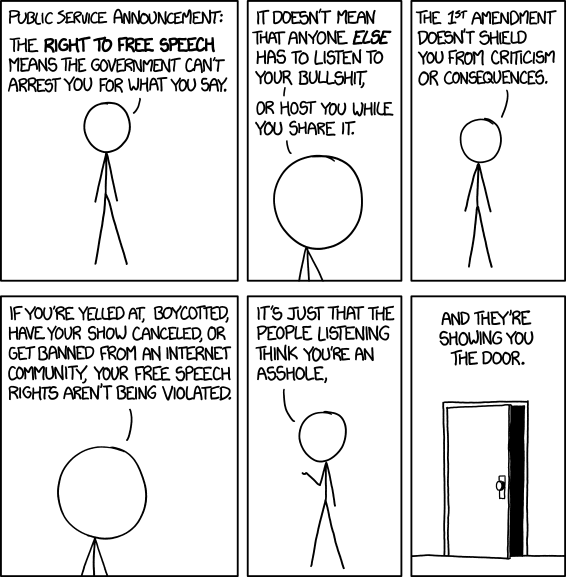
Finally, the defense commits the over-common mistake of conflating the freedom to say something with some sort of freedom from repercussions. Randall Munroe of XKCD put this most clearly.
Free Speech
Taken from XKCD.com
The fact is that the freedom to spew foolishness does not, in any way, guarantee a protection from other people's reactions. In the anarchic environment of the internet (where rights are negative but almost never positive) it couldn't. You can be blocked, you can be screen-shot, you can be publicly ridiculed by those with more wit and intelligence than yourself. Your freedom to be publicly foolish, in no way prevents me from drawing the public's attention to your foolishness or from blocking your voice in my own sphere.

Click to get the Hávamál on Amazon


Click HERE for Part 12: Vulnerability 

Tuesday, February 14, 2017

Joyful Dignity - The Wisdom of the Vikings Part 8

Responsibility

A King's son should be thoughtful
thorough and silent
brave in battle.
A man should be happy
and in good humor
to his dying day

This is part 8 in an ongoing series (the series starts HERE) bringing together the Hávamál (a collection of Norse wisdom poetry) and the still-evolving rules and mores of the Internet, particularly as they are developing in the realm of social media.

In any tense—let us say combative—situation, strong emotions can be galling. The classic iteration is the "sore loser" though many of us have been just as irritated by "sore winners" on occasion. In either case, outbursts which are generally contrary to the mood of the community or the environment are not well received. It is people who have enough control over their own displays of emotion who have the upper hand in a competitive, social environment.

Medieval Iceland they rejected kingship in general, though they had a clear memory of the institution, so I would suggest that the "King's son" in this poem is a placeholder for the same social archetype that it serves in our own democratic republican society - the natural, noble leader. So this advice should not be read as restricted to an irrelevant nobility, but as prescriptive advice for anyone who aspires to a leadership position in society. These are qualities—the virtues—one ought to cultivate in the pursuit of that goal. 

This is not going to go well
Within that context, this poem amounts to a recommendation of the virtue of temperance. We don't discuss this virtue much anymore (most people who have encountered the word at all are only familiar with the definition derived from the abolition of alcohol in the early 20th century United States) . In classical understanding, "temperance" amounted roughly to being in control of one's reactions. Emotionally this meant both not making impassioned decisions or proclamations without first considering the consequences and not being utterly devoid of emotion. Its opposites are both dramatic emotionalism on the one hand, and utter stoicism on the other. The temperate person has emotions but is not ruled by them. 

Viking leaders would then be expected to be restrained in the heat of combat (in contrast the berserker), but able to thoroughly engage in the joys of life. This person is not just relate-ably human, but a genuinely pleasant human to be around. 

Neither is this
It strikes me that there isn't really enough of this online, but the advice certainly rings true when we encounter someone who possesses this virtue. Intemperate folks of both varieties abound online. People who react emotionally and immediately, sharing poorly sourced, over-hyped "news stories" without doing their due diligence, and folks who freak out in the comments section and play right into the hands of trolls represent one form of intemperance (and probably the first type to spring to mind); but just as ineffective as social media leaders are contributors who are all bland facts, numbers, and analysis who seem blithely unaware of the humanity and real costs of the information they are trading in. Both of these types are failing to exhibit temperance. 

So what makes a good leader both in medieval Iceland and in contemporary online communities? People who have emotions, but are not slaves to them. We follow and admire the people who are able to project their humanity without losing control of it (or when they do lose control it is for reasons we can empathize with). It is that person in the forums who seems to really care about the issue and is also well informed. The person who posts about important issues and also shares photos of their dog. 

I have posted some examples below. Let me know what you think:

Hank Green of Vlogbrothers (and a whole lot of other stuff)


His brother John Green of Vlogbrothers (these guys are everywhere)

Click HERE for Part 9
Click to get the Hávamál on Amazon


Sunday, February 12, 2017

Dangerous Drink - Wisdom of the Vikings Part 7


Alertness

Better weight
than wisdom
a traveller cannot carry.
A clear head
is good company.
Drink is a dangerous friend.


Drinking

Ale
has too often
been praised by poets.
The longer you drink
the less sense
your mind makes of things.


This is part 7 in an ongoing series (the series starts HERE) bringing together the Hávamál (a collection of Norse wisdom poetry) and the still-evolving rules and mores of the Internet, particularly as they are developing in the realm of social media.


These two poems contain the abundantly clear (yet far to oft' ignored) advice that it is not wise to consume too much alcohol. It may well be worthwhile spending time reiterating this message (and I suspect that "don't drink and tweet" is necessary advice for many) but I want to focus instead on the principle which, I think, made this advice especially important for medieval Icelanders; advice which, I suspect, is nearly as important for those engaging in digital society. 

In the largely anarchic society of medieval Iceland hospitality and courtesy were incredibly important values. In any society where arguments can become feuds which can, in turn, become near civil wars, it is of the utmost importance not to get the ball rolling in the first place. If Sven insults Olaf, and Olaf feels the need to revenge himself on Sven such that he himself has to be put back in place by Sven and his friends, there is no easy way to stop the process once it has begun. So the easiest, and best, answer is to stop really vitriolic personal arguments before they begin.


But this dynamic is necessarily in tension with the need to establish a reputation as a good and powerful individual since being perceived to be dangerous is one of the most effective preventative actions an individual or small community can take to forestall unwanted conflict. The tension between the need to be courteous and the need to appear dangerous, leads to something of a tightrope walk wherein each word, objection, or boast has to be carefully calculated to elicit just the right response from one's company, particularly when that company is not part of your own close-knit community.

Alcohol, for all of its virtues, is not conducive to tightrope walking. I suspect that the deeper point being made in these passages is that drink is something best reserved for moments of celebration and among close friends, where it is safe to be unguarded. It would have been the height of foolishness (and too often was) for a Viking to let her guard down and start boasting and insulting around company which might take offense. 

Get the Havamal on Amazon
So, too, in the age of the internet and social media, we are well advised to remember that publicly made comments are, well, public. That unless we know that our thoughts are going to be restricted to the friends and companions who really love and understand us, we would do well not to let ourselves become "giddy" or "punch drunk" in our reactions and comments. Think to the many and increasing stories of people whose lives and livelihoods have been materially damaged as a result of their unguarded language or comments. In an environment where the crowd, rather than the state, exacts vengeance, it is important not to engage when something (drink for sure but also passion, excitement, anger etc...) might be clouding our judgement.


PART 8