Search This Blog

Showing posts with label Political Polarization. Show all posts

Friday, February 22, 2019

How I Analyze Political Candidates

In the wake of 2016 and with the presidential campaigns for 2020 already ramping up, I want to spend some time proposing a model for analyzing political candidates. One big reflection I had on the sort of discourse and debate I found myself engaged in in 2015 and 2016 is that it suffered from a lack of clarity around concepts of integrity, ideological purity, and pragmatism. I suspect that you have encountered plenty of this sort of frustrating ambiguity and that it gave rise to quite a few frustrating discussions in your own experience as well. Now I am, admittedly, a big believer in clarifying terms, premises, and assumptions in almost any discussion—I labor under the belief that most arguments would be far simpler and less vitriolic if people were clearer about what precisely they mean and what premises they are working from—but I hope that you will either find this compelling or will do me the very great favor of showing me (in comments) where you think it fails.


The Defacto Model

I propose that this is the model people use when we do not want to reflect or engage much with the election process. Campaigning and debates sort of happen around us for a while and then, on voting day, we vote for the candidate we happen like most. In this model there isn't a lot of conversation to be had because like is pretty subjective, and because we tend to feel attacked when someone criticizes what we like. People who use this model could hardly be described as critical voters; they might or might not be informed but they are not really engaged in critical and careful decision making in a meaningful way. Ultimately, propaganda and in-group identification will probably have the greatest impact on how they vote.

The Nuanced Defacto Model


This represents something of an improvement and sometimes an increased degree of cynicism over the defacto model. Voters who use this model are able to recognize that no candidate is perfect (a claim you will likely hear them make incessantly) and are often willing to vote for candidates in the "meh" range so long as that candidate's opponent is in their "no" range. These voters vote against a candidate at least as often as they vote for one. When they vote they often do so out of a sense of civic duty or out of group identification (the candidate may be "meh" but either they support the party or all of their friends vote) but they can occasionally become energized voters when the encounter a candidate in their "yes" range.

The Moral Integrity Model


This step brings us closer the model which I am proposing (though I still want to add some more complexity). Here the question you would ask about a candidate is not "do I like them" but "am I morally comfortable with this candidate?" In this model a person's response to that question can range from "no" through "I can vote for the candidate but I  have reservations about them" up through an enthusiastic "yes". I have built a range into each of these three categories to allow for the uniqueness of persons. I can heartily affirm two different candidates and still find one to be better than the other.

The really important addition to this model is what I have labeled the line of integrity which divides the reservations range from the no range. That line is critical to the way I think about candidates and its placement is always at the top of the no range. In this model, to ask someone to vote for a candidate who exists below the line of integrity is to ask that person to violate their actual conscience (note that a person's actual conscience may be different from their stated or public conscience and that sometimes they might not be aware of the difference). A lot of the cross-talk argument in the center and on the left had to do with misunderstanding the line of integrity and/or misdiagnosing its location. For now I will restrict myself to saying that everyone who is not a psychopath or sociopath has a line of integrity somewhere insofar as they would not vote for a candidate who advocates unabashed genocide no matter how much they agree with that candidate on other dimensions or how much they dislike with the candidate's major opponent. 

Voters who use some version of this model are more likely to develop some degree of resistance to the most common form of propaganda and will sometimes break from their peer-groups when voting. Because there are candidates whom these voters consciously cannot support, they are somewhat more likely to have voted for 3rd party candidates, or to have been conscientious non-voters in some elections (it will depend on who is on the ballot). Most notably these are the voters who are most likely to vote against their typical party or ideological affiliations in situations where a candidate is the subject of scandal just because scandals are the sort of thing that can plunge a candidate below the voter's line of integrity. Of course that line will be in different places for different people; its placement is subjective to each individual voter since individual voters will have differing levels of tolerance for (for instance) graft, bribery, theft, or sex scandals. A politician who has cheated on their spouse will likely thereby fall below some voters' line of line of integrity but certainly not all. Further an individual voter's line of integrity will vary both in terms of sensitivity, but also by the dimension involved—remember that we are not talking about the candidate's morality, we are talking about the moral comfort of the voter with the various aspects or dimensions of a given candidate.

With this model we can identify the snarls which lead to some tangled political arguments. If a candidate falls just below Wanda's line of integrity but just above Bob's line, then Wanda and Bob will agree that the candidate is "problematic" and will likely agree about the candidates failings but if they do not recognize the existence and roll of the line (or the fact that they have analyzed the candidate differently in relationship to the line) they will not see eye to eye on whether or not it is possible to still vote for the candidate.

And now that I have mentioned that there are multiple dimensions to any given candidate, let's move on the the "final form' of this model.

The Dimensions of Moral Integrity Model

Just to keep things simple I have only included four dimensions in this illustration but there are actually as many as the individual voter happens to notice or care about. Notably absent from this illustration yet relevant to recent US elections for instance would be Immigration and The Environment but there really isn't any functional limit on the number of dimensions available. The final—and vital—addition to the model here is the recognition that a candidate may well be excellent in one dimension but fall below the line of integrity in another dimension. This complicates both our analysis of candidates, and a voter's capacity to reason clearly about a given candidate. Specifically, I think this this helps to untangle a lot of messy political arguments. When two people argue about whether a candidate is imperfect-but-still-viable or "too problematic" (the most common term I have encountered on the left to imply that the candidate has dropped below the line of integrity) the snarl in their communication may reside in the fact that they locate the candidate on different sides of the line, or that they are judging the candidate on different dimensions. This is further complicated by the fact that each dimension is weighted differently for each person. My "NO" threshold on economics (and economic justice) may be lower than yours while your "NO" threshold is lower than mine on foreign policy. 

Let me emphasize that the line of integrity is likely significantly lower than we are generally happy to admit. That is to say that we are generally willing to tolerate more that we would like to say and that this becomes most clear when a candidate who we really like turns out to be significantly "problematic" in one realm. The Democratic ambivalence around Gillibrand's calls for Al Franken to resign would be an example of this. For some voters Franken's behavior fell below their real line of integrity in the issue of sexual assault and harassment; for others it fell above their real line but below their public line. This, of course, resulted in their feeling very ambivalent about the call for him to resign. They do not want to be seen as people for whom his behavior is above the line, but they are also not really convinced that his behavior merited his resignation. 

The space between the red and the grey line is ripe for political miscommunication and misunderstanding, often because we ourselves are often not quite sure about that area. We often convince ourselves that our public line is our real line and only discover the difference when someone action, position, or behavior falls between them. Even then we only make that discovery when we are brutally honest with ourselves—self justification is one hell of a drug.

Of course the big problem with all of this is that the moral impetus we feel regarding issues below the line is entirely different from the impetus we feel about those above the line. Below-the-line-of-integrity discussions are different in kind from above-the-line-of-integrity discussions.

The essential difference between the two kinds of discussion boils down to the role of pragmatism in our political decision making. Above the line, pragmatism is an important and even moral factor. We all recognized that we will rarely, if ever, get a candidate with whom we agree perfectly on every issue and who has a sterling record—there are no perfect candidates—and so pragmatism or questions of "electability" are worthwhile so long as the candidate stays above the line. This is true both within a given political party and in the general election. I suspect that a great many of the people who yearn publicly for "a return to the days when Republicans and Democrats could disagree and still respect one another's politics" do so, at least in part, because in their estimation both Republican and Democratic candidates exist exclusively above the line whereas people who are utterly flummoxed by that notion see candidates from the opposition party as falling below the line in one or more places. Conversations across the line of integrity will always fail just because support which is deemed possible by one party is actually impossible for the other.

That is not to say that it is impossible to have meaningful conversations about political candidates with someone who differs with you about where those candidates stand in relation to the line. It only means that you need to have a different kind of conversation in those situations. At that point, to be meaningful, the conversation needs to be about the facts—"does the candidate really think/say/do that?"—or about the placement of the line itself—"should/shouldn't X really be disqualifying?".

Maybe some examples will help to clarify all of this.

Some Examples


Please note that for all of these examples I will be assuming that the locations on the chart represent your assessment of a hypothetical candidate.


SAMPLE A The Acceptable Candidate
I take this to be the chart for a fairly standard "no candidate is perfect" type of candidate. The candidate here is great on civil rights and you really respect their character. Their economics aren't perfect (you have some significant disagreements with them) and they are frankly far more hawkish/dovish than you are. You likely would not have supported this candidate in the primaries but you will probably be a strong supporter in the general election. As a side note, this is also what nostalgic moderate Democrat baby boomers like to imagine "the opposition candidate" charted in "the good old days when we were less divided".


SAMPLE B The Baffling No-Go
This candidate is precisely the sort of candidate that is likely to get you into fights with your own friends on social media. Here is a candidate whose foreign policy views you simply cannot countenance. Likely your whole social circle will not be thrilled with the candidate but, if they (and you) agree that the major opposition candidate is even worse then unless they understand your line of integrity, they won't understand why you just can't vote for this "lesser of two evils". This problem will be particularly compounded if you are able to honestly recognize that the candidate is a person of good character who honestly holds to the foreign policy beliefs which you find so unconscionable. This, chart, I suspect represents the way McCain supporters felt about Obama (or at least, it represents the way McCain himself spoke about Obama).


SAMPLE C(1) The Dictator Comparisons
This sample should be fairly straightforward but it has one feature which I think is relevant to our political moment. This is my best mock-up of the way I think most moderate Democrats would have charted Trump. In itself I doubt that there is much surprise here but with a few tweaks I think it can shed some light on one particular frustration.

SAMPLE C(2) The Reluctant Trump Voter

 This, I think, represents the situation of the Reluctant Trump Voter®. This person seems to have almost identical views with the moderate Democrat (your milage may vary) and their public line of integrity is in about the same place as the moderate Democrat. Yes they don't see Trump in quite as negative a light as the moderate Democrat but he clearly falls below their public line of integrity. However, because he remains above their real line of integrity they were still able to justify voting for him since he opposed Clinton*. We saw this most clearly in the evolving reactions to the Access Hollywood tape. The contents of the revelation thrust Trump below most Republicans' public line of integrity which left them publicly denouncing him and looking desperately for an alternative or option. However, because his behavior was still above their real line, they effected an about face at the flimsiest of excuses (the "locker room talk" contextualization, his tepid apology, accounts of his later salvation experience) the strength of the pretext didn't matter much so long as it allowed them to retain the appearance of their public line. This is also why I think it is important to note the Republicans who never went back to Trump after Access Hollywood. Their failure to return is an indication that, for them, the tape represented a real line.


Finally I want to end with a quick look at two hypothetical left leaning Americans in 2016, one of which would have almost certainly voted for Clinton, the other of which would not.


The Reluctant Clinton Voter®

This person is clearly a Bernie supporter, who would have voted for him in the primaries and was likely rather upset when he lost. They may even have blamed Clinton for bankrolling the DNC and ensuring that Sanders never really got a fair shake. Nevertheless, they would have seen Clinton as a tragically necessary compromise of their ideals and would have voted for her "as a way to stop Trump" and possibly consoled themselves with the virtue of supporting the first woman candidate in a major political party (though they were probably wishing she had been Warren).

The #NeverClinton #NeverTrump Voter

Notice that this is another Sanders supporter. The difference with the Reluctant Clinton Voter® is only that for this person, Clinton fell below the line of integrity when it came to foreign policy (maybe all the Benghazi talk worked on them, maybe they are a strong dove and see her as part of "the Blob"). This is a likely Johnson or Stein voter or a principled non-voter. This is also the person whom the Reluctant Clinton Voter likely railed at in the aftermath of the 2016 election. Unless they clarified their differences viz. the line of integrity on foreign policy, both of these voters probably left the conversation without making any headway and incredibly frustrated with one another. This voter likely saw the Reluctant Clinton Voter as lacking in integrity (after all, they admitted that her foreign policy positions are problematic) and the Reluctant Clinton Voter likely saw this person as too precious and concerned to care about the real harm that Trump is going to do to oppressed minority people and the the country's norms and institutions. This, despite the fact that the two of them agree perfectly on everything about Trump. If we were to lower their real lines of integrity and add public lines of integrity, the confusion might become even more clear.

Conclusion

I hope that you find this to be useful tool in modeling the way people make minimum-viable political and electoral decisions. Please don't hesitate to hit me up in comments if you have suggestions, critiques, or questions about how I could improve or modify this.

*I have explicitly chosen to ignore the roll that party and ideological association and attendant in-group/out-group effects have on our estimation of a candidate by simply presenting the estimations as final and not exploring the reasons we have for locating a given candidate at a given spot on the chart. Those reasons are real and the proper subject of healthy and passionate political, sociological, and religious debates. For the purposes of this analytic model, however, they may be simply taken as givens.


Wednesday, March 22, 2017

On the Vulnerability of Wise Vikings - Wisdom of the Vikings Part 12

Moderation

The cattle know
when to come home
from the grazing ground.
A man of lean wisdom
will never learn
what his stomach can store.


Happiness

He is unhappy
and ill-tempered
who meets all with mockery.
What he doesn't know,
but needs to,
are his own familiar faults.


Note: This is part 12 in an ongoing series (the series starts HERE) bringing together the Hávamál (a collection of Norse wisdom poetry) and the still-evolving rules and mores of the Internet, particularly as they are developing in the realm of social media.


As we have moved through the wisdom of the Hávamál it has become more and more apparent that virtue ethics, rather than a particular set of ethics rules, are the functional framework. The aphoristic poems don't so much tell the reader what action they ought to take in each and every situation as they lay out conditions under which particular virtues prove necessary. In that way they highlight those virtues which were most necessary to flourishing in a medieval (Viking) Icelandic society and are (by my hypothesis) also critical for online participation.

In these two poems, I would suggest that it is the virtue of vulnerability, or at least the virtue of an internal vulnerability which is being highlighted. In the first we get the pastoral image of a grazing cow, which knows when to stop eating and come in, applied to a man of "lean wisdom" who will "never learn what his stomach can store". In the second we get a reflection on the idea that an unwillingness to know your own faults can steal your happiness; or maybe it would be better to say that until we recognize our own faults, we will not be able to be happy. In both cases, we find that flourishing emerges from a lack of self-knowledge. 

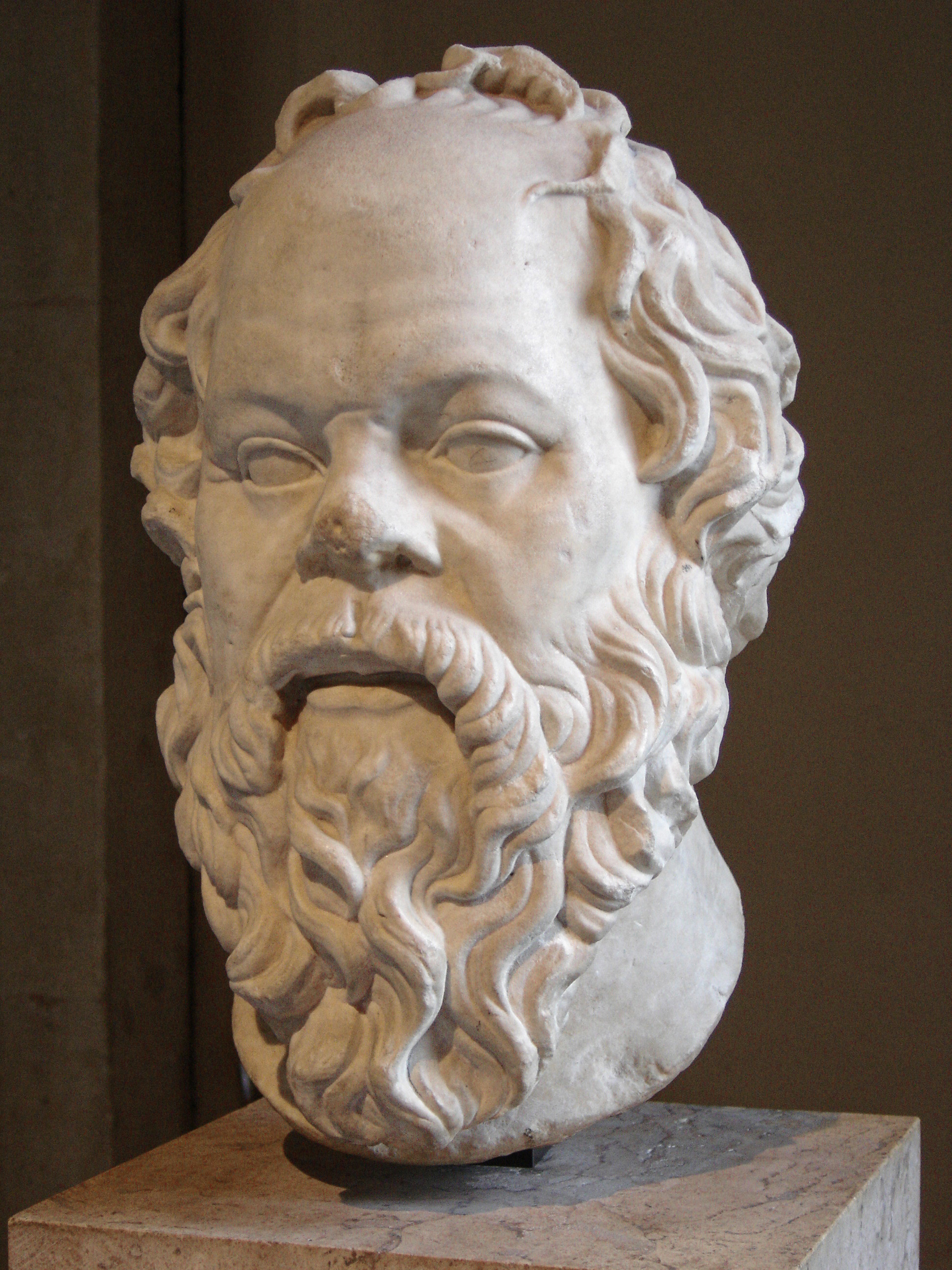
Image result for socrates
Socrates
Notably, this is a bit of wisdom which the Vikings have in common with Socrates and the Greek philosophical tradition. The aphorism "Know Yourself" (γνῶθι σεαυτόν) is said to have been etched over the doors of the temple of Apollo at Dephi—the structure which housed the Delphic Oracle. For Socrates the aphorism formed much of his motivation for engaging in philosophy and was also (if we are to believe The Apology) the clue to solving his ultimate riddle. The charge to seek out self-knowledge is a well established bit of wisdom. 

And yet, it often seems to be lacking in our online engagement. There seems to be no end to the stories and studies on the way in which social media in particular, but cyberspace generally, has been isolating us in to ever-more polarized echo chambers. Generally the danger these stories and studies are working to point out is that closing ourselves off from dissenting opinion and an attendant decreased capacity for empathy with those outside our echo chambers, and that is a legitimate and weighty concern. At the same time, though I think it is also critical to highlight the way in which existing in an echo-chamber robs us of opportunities for self-knowledge. My Dad regularly points out that "It takes a non-parochial fish to know that it is wet", in other words, it is often hardest to see the very thing we are most surrounded by. In fact, the greatest opportunities we have to discover our own condition is the experience of encountering other conditions. Those experiences are what give us the opportunity to contrast our own "normal" with someone else's "normal". The best chance that fish has of recognizing its own wetness is if it begins to encounter air bubbles.

So too, when we find ourselves spending our time online, immersed in mono-cultural echo chambers, it becomes incredibly difficult for us to recognize our thoughts and approaches as anything but "the way things are" and, since we tend to seek out the most comfortable possible environments, we are particularly unlikely to be confronted with our own faults and weaknesses. The phenomenon of socio-cultural isolation and grouping isn't just bad for society as a whole, it stunts our growth as individuals (think about how much easier it is to think of yourself as a "rugged individualist" when everyone you encounter has your back anyway).
A new environment can be...challenging

But what does all of this have to do with vulnerability as a virtue (and for those of you who aren't sold on the idea that vulnerability isn't a virtue at all, I have included Brene Brown's excellent TED talk on the subject below)? As I understand it, vulnerability is a hybrid virtue combining love and courage. Vulnerability means loving the other (or the self) enough to risk being hurt while courage is the capacity to do what needs to be done. In this case we are being called to be vulnerable with our own selves. This critical virtue means first seeking out enough of an experience of the world that we are able to recognize ourselves, not as default humans, but as particular and unique beings (be like the cow and don't stop eating before you are full) and we have to take a good long look at that self which our experience has illuminated and risk the pain of seeing our own failings. In his essay On Forgiveness, CS Lewis points out:
Real forgiveness means looking steadily at the sin, the sin that is left over without any excuse, after all allowances have been made, and seeing it in all its horror, dirt, meanness, and malice, and nevertheless being wholly reconciled to the man who has done it.
I would suggest that that forgiveness critical when "the man" is myself. And it is vulnerability which empowers that forgiveness.

Resources:

Image result for politecho
If you are looking for ways to break out of—or at least recognize—your echo chamber, I ran into this tool from PolitEcho the other day which analyzes your FB feed and lets you know more about your political bubble. You might find it useful.


Brene Brown's talk on Vulnerability, she has also written a number of books on the subject: