Search This Blog

Showing posts with label Virtue Ethics. Show all posts

Monday, November 20, 2017

Dancing Back Into Elfland


Imagine a forest. Make it a good forest. Actually imagine a forest you can’t really imagine because the real world is always surprising you; the real world is a source of wonder and of encountering that which is beyond our own selves. It contains danger, and pain, and beauty, and grandeur. So imagine a forest you can’t quite imagine — a forest haunted by wonder.

Now imagine that you are traveling through that forest. How do you want to do it? What is, in your mind, the best possible way to be traveling in a forest? Do you want a man-made highway running through it? Do you want a car to drive on that road? Maybe a hiking path? Or do you even really want to get out of the forest? Maybe you are happy with a trail? Or how about just a guide — someone who really knows this forest and who can make your time here worth while.


Now imagine a life. Make it a good life. Actually imagine a life you can’t really imagine because real life is always a surprise; real life is a source of wonder and of encountering that which is beyond our own selves. It contains danger, and pain, and beauty, and grandeur. So imagine a life you can’t quite imagine — a life haunted by wonder.

Now imagine that you are living that life. How do you want to do it? What is, in your mind, the best possible way of living through a life? Do you want man-made structures cutting though it to make it easier to navigate? Do you want a way to insulate yourself from the extremes of the life? Maybe some rules for how get through it? Or do you even really want to get out of the life? Maybe you are happy with some general guidelines for living it? Or how about just a guide — someone intimately acquainted with suffering and joy, with living itself and can make your time in the life worthwhile.

This comparison begins to get at what I think my favorite poem in the DaoDeJing is getting at. Poem 38 reads in part as follows:
A truly good man is not aware of his goodness,And is therefore good.A foolish man tries to be good,And is therefore not good. Therefore when Tao is lost, there is goodness.When goodness is lost, there is kindness.When kindness is lost, there is justice.When justice is lost, there is ritual.Now ritual is the husk of faith and loyalty, the beginning of confusion.Knowledge of the future is only a flowery trapping of the Tao.It is the beginning of folly.
This echoes one of the best quotes from C.S. Lewis’ Mere Christianity:
…though Christianity seems at the first to be all about morality, all about duties and rules and guilt and virtue, yet it leads you on, out of all that, into something beyond. One has a glimpse of a country where they do not talk of those things, except perhaps as a joke. Every one there is filled full with what we should call goodness as a mirror is filled with light. But they do not call it goodness. They do not call it anything. They are not thinking of it. They are too busy looking at the source from which it comes.
And the same sentiment appears in the Mystic Muslim Poet Rumi:
Beyond good and bad, there is a field, I’ll meet you there.
Aristotle made similar points when he talked about morality, calling it not at act, but a habit. Of course each of these thinkers had different ideas about how to achieve this state of goodness, but the thing they all seem to agree on — to have discovered — is that the good life, the right life, is an un-reflective sort of thing. That is, they saw that living well is not about a technique. It is wandering in a forest, not getting through the forest. Specifically, for each of these folks, any ethical system is a degradation from the whole point of things. Ethical systems are, at best, a concession to our brokenness.

I find that DaoDeJing breaks it down most clearly, starting with the the first step down from right-being (the Tao/Dao). The poem presents, in roughly narrative form, a brief taxonomy of ethical systems, all of which have had their own moments in history.

Non-Ethics and Flourishing


The Tao

As a Christian, I would characterize being with the Tao/Dao as being with Christ. It is following the suffering King, the Prince of Peace, and Lord of Joy in the dance of life. To follow Jesus is to give up on the notion of where we are going and to focus instead in who we are with. It is a matter of being rather than a matter of getting somewhere. This is existence characterized by relationship and love, it is being in the forest; nobody knows what it leads to, we only know that it is right it is flourishing.


Virtue Ethics

Therefore when Tao is lost, there is goodness.

The loss of un-reflective, flourishing existence, is goodness. A preoccupation with becoming like the sort of person who just is un-reflectively good. This is the ethics enunciated by Aristotle and St. Thomas Aquinas, it is a system built, not out of an intimate knowledge of the Tao, but of a careful observation of those who do. To characterize this shift in Biblical terms, it is the fall, an attempt to systematize and know what is beyond knowledge. It is a diminution because it is an attempt to squeeze the infinitude of possibilities of being into our finite minds. It is the centipede’s dilemma: we stop dancing in order to work out how we were doing it and find that we cannot start again. So we begin to study other dancers and awkwardly ape their movements.


Kantian Ethics

When goodness is lost, there is kindness.

When that proves unsustainable, when we discover that we do not have the mental or moral fortitude to make ourselves into good persons, we resort and therefore diminish to kindness. Kindness — treating people correctly, as people — is also characteristic of un-reflectively good people but it is not a rule it is something they simply are. This is the ethics of people who know what flourishing looks like and are trying to discipline themselves towards it. Imagine someone who is trying to behave in a kind way, not because kindness is a natural reaction for them but because they know that they ought to be, it feels a little uncomfortable doesn’t it?


Divine Command Theory — the Rules


When kindness is lost, there is justice.

When people trying to be kind to one another fails to hold society together we resort of laws (what Laozi characterizes as justice though I don’t particularly like that definition of the word). We make rules prohibiting harmful behavior and then we institutionalize ways in which to harm the people who break those rules. At this level we get the many ethical systems which insist on rigid set of rules (or the principles from which those rules ought to be derived). This is also the level on which our whole system of human rights operates — it is the level below which we have tried to guarantee we will not go. This is where most religions live and operate in discomfort together with other less religious secular systems and the classically liberal understanding of human rights.

Utilitarianism, Objectivism

When justice is lost, there is ritual.
If we take the concept of ritual out of a classical Chinese context and put it in a contemporary Western one we get something like social norms or manners. When basic allegiance to human rights and laws fails to guarantee social coherence or human flourishing, we resort to being polite to one another. The whole idea here is that we need to just not hurt anybody. Think about the number of calls there have been recently for a return to civility or decorum. The yearning for norms which are enforced by social acceptance rather than institutional violence seems to be the last gasp of a society trying to hold together as a benefit to its own members. When it fails, there isn’t much left; all of our barriers to evil have been broken. We are no longer un-reflectively good, we are not trying to emulate goodness, virtue holds insufficient attraction for us, our laws have become brutal and unjust, and social acceptance has become tyrannical and stifling.


The Narrative

It is worth pointing out that this downward progression can also be characterized as forward movement. Each system is built, in some ways, on a recognition of the failures of the types of system above it. Virtue ethics begins with the recognition that there is flourishing and that we aren’t doing it. Justice ethics recognizes that those who try and fail to be virtuous without structural and institutional constraints tend to end up making things worse for everyone (think about the misogyny of the Roman empire’s ultimate conflation of virtue with masculinity) so, giving up on making people better, we bring in rules backed by the threat of violence in order to establish a sort of lowest common denominator in our relationships with one another (and sometimes, but far to rarely, the rest of the world). But those power structures and systems always seem to end up disenfranchising and ultimately marginalizing and oppressing people so we dismantle them, we deconstruct them, and we narrow the scope of our concern to harm and fairness. At this point we are probably having some trouble enunciating any justification for those to concerns (instead the easy thing to do is to become appalled with anyone who would dare to question them) but we are clinging to them with intense focus. This is also a movement forward, the concerns at each stage were real and serious concerns; with the failure of each previous stage the scope of our moral universe narrowed but also intensified, it is a process of “Maybe we can’t do all of it but we will at least manage this area of greatest concern”. But the thing is doomed, it must eventually fall to pieces as the debates about negative and positive rights emerge, as harm is accepted for the sake of preventing more or different harm to those more worthy of protection.

And then we are back where we started, or at a Looking Glass Land image of where we started. The systems have failed, the destination has evaporated or proved impossibly distant. There is only a lost wandering in the woods. We did not know good and evil, then we learned it, and now we have lost it again. It was always beyond us, the question is what comes next. We were, then we thought we knew but did not know, now we begin to know that we do not know.

Now if only we could stop trying to get somewhere and just be, we might begin to dance again

Wednesday, March 22, 2017

On the Vulnerability of Wise Vikings - Wisdom of the Vikings Part 12

Moderation

The cattle know
when to come home
from the grazing ground.
A man of lean wisdom
will never learn
what his stomach can store.


Happiness

He is unhappy
and ill-tempered
who meets all with mockery.
What he doesn't know,
but needs to,
are his own familiar faults.


Note: This is part 12 in an ongoing series (the series starts HERE) bringing together the Hávamál (a collection of Norse wisdom poetry) and the still-evolving rules and mores of the Internet, particularly as they are developing in the realm of social media.


As we have moved through the wisdom of the Hávamál it has become more and more apparent that virtue ethics, rather than a particular set of ethics rules, are the functional framework. The aphoristic poems don't so much tell the reader what action they ought to take in each and every situation as they lay out conditions under which particular virtues prove necessary. In that way they highlight those virtues which were most necessary to flourishing in a medieval (Viking) Icelandic society and are (by my hypothesis) also critical for online participation.

In these two poems, I would suggest that it is the virtue of vulnerability, or at least the virtue of an internal vulnerability which is being highlighted. In the first we get the pastoral image of a grazing cow, which knows when to stop eating and come in, applied to a man of "lean wisdom" who will "never learn what his stomach can store". In the second we get a reflection on the idea that an unwillingness to know your own faults can steal your happiness; or maybe it would be better to say that until we recognize our own faults, we will not be able to be happy. In both cases, we find that flourishing emerges from a lack of self-knowledge. 

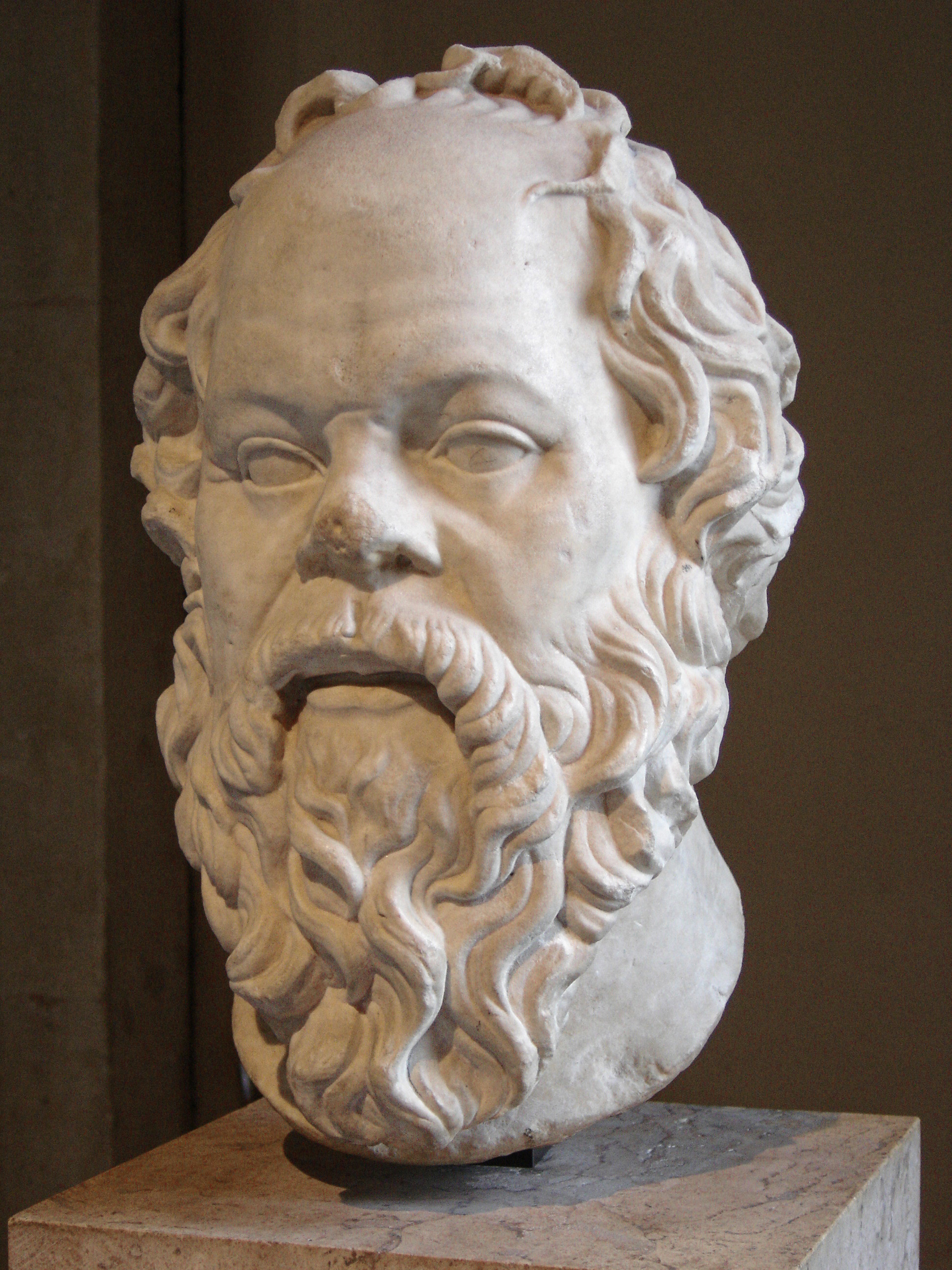
Image result for socrates
Socrates
Notably, this is a bit of wisdom which the Vikings have in common with Socrates and the Greek philosophical tradition. The aphorism "Know Yourself" (γνῶθι σεαυτόν) is said to have been etched over the doors of the temple of Apollo at Dephi—the structure which housed the Delphic Oracle. For Socrates the aphorism formed much of his motivation for engaging in philosophy and was also (if we are to believe The Apology) the clue to solving his ultimate riddle. The charge to seek out self-knowledge is a well established bit of wisdom. 

And yet, it often seems to be lacking in our online engagement. There seems to be no end to the stories and studies on the way in which social media in particular, but cyberspace generally, has been isolating us in to ever-more polarized echo chambers. Generally the danger these stories and studies are working to point out is that closing ourselves off from dissenting opinion and an attendant decreased capacity for empathy with those outside our echo chambers, and that is a legitimate and weighty concern. At the same time, though I think it is also critical to highlight the way in which existing in an echo-chamber robs us of opportunities for self-knowledge. My Dad regularly points out that "It takes a non-parochial fish to know that it is wet", in other words, it is often hardest to see the very thing we are most surrounded by. In fact, the greatest opportunities we have to discover our own condition is the experience of encountering other conditions. Those experiences are what give us the opportunity to contrast our own "normal" with someone else's "normal". The best chance that fish has of recognizing its own wetness is if it begins to encounter air bubbles.

So too, when we find ourselves spending our time online, immersed in mono-cultural echo chambers, it becomes incredibly difficult for us to recognize our thoughts and approaches as anything but "the way things are" and, since we tend to seek out the most comfortable possible environments, we are particularly unlikely to be confronted with our own faults and weaknesses. The phenomenon of socio-cultural isolation and grouping isn't just bad for society as a whole, it stunts our growth as individuals (think about how much easier it is to think of yourself as a "rugged individualist" when everyone you encounter has your back anyway).
A new environment can be...challenging

But what does all of this have to do with vulnerability as a virtue (and for those of you who aren't sold on the idea that vulnerability isn't a virtue at all, I have included Brene Brown's excellent TED talk on the subject below)? As I understand it, vulnerability is a hybrid virtue combining love and courage. Vulnerability means loving the other (or the self) enough to risk being hurt while courage is the capacity to do what needs to be done. In this case we are being called to be vulnerable with our own selves. This critical virtue means first seeking out enough of an experience of the world that we are able to recognize ourselves, not as default humans, but as particular and unique beings (be like the cow and don't stop eating before you are full) and we have to take a good long look at that self which our experience has illuminated and risk the pain of seeing our own failings. In his essay On Forgiveness, CS Lewis points out:
Real forgiveness means looking steadily at the sin, the sin that is left over without any excuse, after all allowances have been made, and seeing it in all its horror, dirt, meanness, and malice, and nevertheless being wholly reconciled to the man who has done it.
I would suggest that that forgiveness critical when "the man" is myself. And it is vulnerability which empowers that forgiveness.

Resources:

Image result for politecho
If you are looking for ways to break out of—or at least recognize—your echo chamber, I ran into this tool from PolitEcho the other day which analyzes your FB feed and lets you know more about your political bubble. You might find it useful.


Brene Brown's talk on Vulnerability, she has also written a number of books on the subject:


Monday, February 20, 2017

Some Perspective - The Wisdom of the Vikings Part 9

Image result for old vikingSelf-Deceit

Only fools
hope to live forever
by escaping enemies.
Age promises
no peace
though the spear spares them.


Note: This is part 9 in an ongoing series (the series starts HERE) bringing together the Hávamál (a collection of Norse wisdom poetry) and the still-evolving rules and mores of the Internet, particularly as they are developing in the realm of social media.
The last several posts in this series have focused on the various forms of discretion which were vital for medieval Iceland and are important the great multitude who inhabit the internet. Today's poem, in contrast, highlights the importance of engagement. As something of a side note: as I have been working through the Hávamál I have begun to notice a heavy favoring of Aristotelian style virtue ethics and a reliance on a concept similar to his "golden mean". I'll link a  Crash Course Philosophy video, which explains the concept nicely, at the bottom for those of you who are interested in following along.

Poor Randall Munroe gets ripped off a lot. 
In this poem, the sentiment, far from advocating caution and reticence, is more along the lines of carpe diem. In an age of great uncertainty and physical danger, particularly danger from neighbors who might respond to offence with a swinging axe and a warcry, this pair of aphorisms are reminding the reader that a life lived in fear, driven by a desire to avoid all conflict is ultimately empty and self-extinguishing. "Age promises no peace though the spear spares them" would make a tragically damning eulogy. Certainly "timid" is not the sort of adjective we are inclined to associate with Viking culture, and that for a good reason. Having reminded the reader that discretion is the better part of valor, the Hávamál now continues with an insistence that action, too, is often necessary. The Viking who failed to defend her honor, or to stand up for those in her care, was likely to come to just as bad an end as the Viking who failed to think before she boasted. 

This balance between caution and indiscretion turn out to be a vital one for those of us who choose to participate on social media as well. While we are often very well advised to write, read, and delete our comments or combative post/tweet/blog, we are nearly as often morally required to take a stand. As someone who engages fairly frequently in social media "conversations" which turn hostile more frequently than I would like, I want to attest to the fact that I often receive private messages or in person comments from friends and even strangers, thanking me for standing up for them when they felt bullied or dehumanized online. 

Be the hero we need
According to Aristotle, "courage" is the virtue between the vices of cowardice and foolhardy brashness. Sound familiar? Reading this poem in context with those which come before it. We are well served to remember that while there is certainly a time for holding our tongue and letting silence be the voice of peace, there is equally a time for calling out hatred, ridicule, and vitriol. And in fact, I would suggest (at the risk of fanning the flamewars) that in our current climate, you are more likely to hear people calling for "peace" when some vocal and defiant speech is what is actually required than you are to hear people calling for contention when things are calm. Bystanders generally prefer not to have their boats rocked after all and it is far easier for people who are not devalued by misinformation and hateful rhetoric to call for calm, than it is for them to risk looking like troublemakers by calling out smarmy screes and flat out lies. 

In future posts I will try to address some of the thorny questions around developing the discernment to know one situation from another (given the fact that medieval Icelanders' lives literally hung on this ability, it is likely that we will run into it again) but in the meantime I want to end be encouraging you to think about the motives behind your decisions to comment as well as your decisions to "just scroll past and avoid feeding the troll" and remember that sometimes the only course of action is to jump in and try choking the troll with your own body... or words and reputation as the case may be.