Search This Blog

Showing posts with label Socrates. Show all posts

Friday, January 5, 2018

Book Review: According to Folly

35055333Imagine that Socrates, Peter Kreeft, and Jostein Gaarder sat down to write a book together. They might come up with something a little like Daniel Heck's According to Folly—at least, there are elements of this book which one can imagine each of them contributing. This book is in the form of an imagined series of conversations which a self-identified Fool has with a Conservative, a Liberal, and a Skeptic. On it's surface that premise is engaging enough in a straightforward "up the Moderates, and boo to polarization" sort of way; it is a premise which could be fairly compelling in the right hands or would, more likely, descend into nearly suffocating insufferability if executed poorly. Fortunately the book moves well beyond that surface premise by drilling down into the particularity of the author.

In According to Folly, the respective Fool, Conservative, Liberal, and Skeptic are not the generic stereotypes of those ideologies as found in the contemporary Unites States—a move which would have doomed the project in the hands of any but the wisest and most well informed social critics. Instead Heck has written the characters as his Conservative, his Liberal, and his Skeptic (I will have more to say about the Fool below). The characters do not, therefore, employ the sort of straw man arguments one might expect. Instead they embody (one suspects) both the strongest and weakest of the arguments Heck has experienced in his own life. This is a critical move. The job of presenting the actual total arguments made by each of these camps would have been well beyond the abilities of any (almost any?) single author. What we get in this book instead is both much narrower and far more enlightening. Heck uses the person of the fool to socratically interrogate his own essential experience of these types.

Image result for socrates
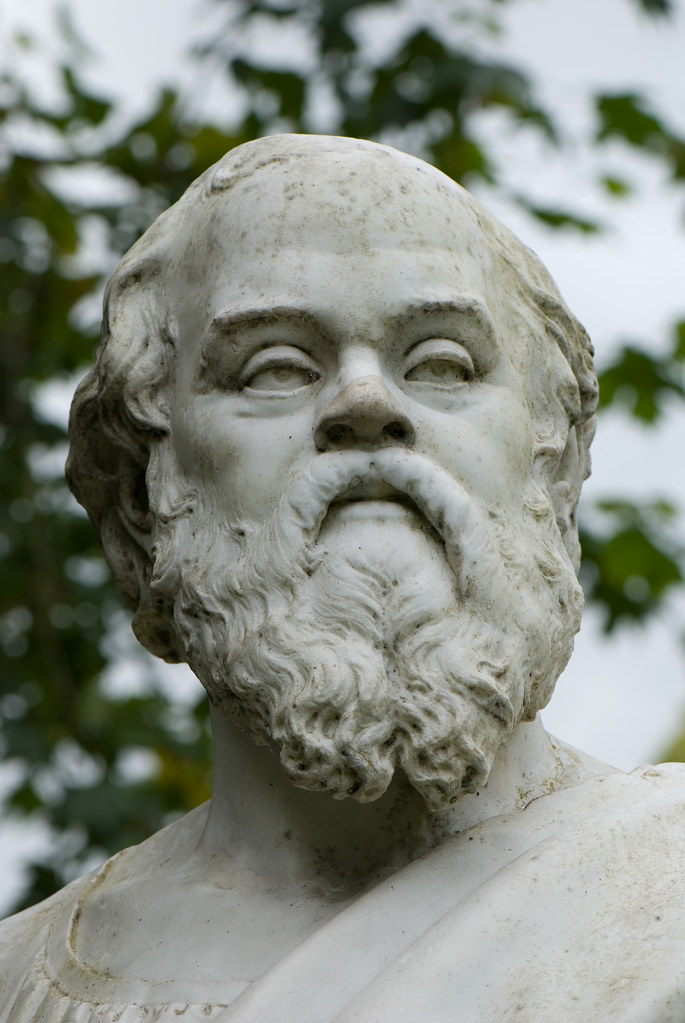
Socrates
It is the person of the Fool who brings the most value to the book and sets the whole project in line. The character is not—quite—a stand-in for the author himself. In fact Heck does write himself into the narrative in several Gaarderian moments in the book. Instead, the Fool identifies himself as, sequentially, the Conservative's Fool, the Liberal's Fool, and the Skeptic's Fool. My understanding of him was as a sort of Socrates character with a little of the edge taken off and a little of Jesus added in. Like Socrates, the Fool is dedicated to determining the "logic" of his successive interlocutors, and like Socrates his method is to first work out the "rules of their game" and then to rigorously apply those rules to their thinking. Heck's Conservative is therefore confronted with the her own hermeneutic principles used in a way which lead to very different conclusions than those she is comfortable accepting. The same process is then employed with and against the Liberal and the Skeptic. The fool departs from direct Socratic interrogation though in two critical ways. First, Heck's Fool comes across as genuinely desiring to learn from each of his interlocutors. He really wants to get at the best of what they have to offer, is often thrilled when he finds insights of value, and is discouraged when the process fails. Second, the Fool treats his interlocutors like real friends rather than as opponents. Whatever you ultimately think of the book, you are almost guaranteed to like the Fool.

It would be cliche'd to say that Conservatives, Liberals, and (Modernist) Skeptics will each love 2/3s of this book and hate the third which focuses on them; and while it  may be true in some cases, I suspect that it is least true of the best of them. In fact I suspect that it is the wisest of our Conservatives, Liberals, and Skeptics who will enjoy this book the most. The temperament I believe least likely to appreciate this work is the person so committed to the rightness of his conclusions that he cannot bear to examine his own reasoning. It is the weak, rather than the strong and committed ideologue who will chafe, as this is a book which burns down straw men only so that the stronger ideas they hid can be revealed. C.S. Lewis wrote in his preface to Mere Christianity that
It is at her centre, where her truest children dwell, that each communion is really closest to every other in spirit, if not in doctrine. And this suggests that at the centre of each there is something, or a Someone, who against all divergences of belief, all differences of temperament, all memories of mutual persecution, speaks with the same voice.
According to Folly adds further evidence to support his thesis.

Wednesday, March 22, 2017

On the Vulnerability of Wise Vikings - Wisdom of the Vikings Part 12

Moderation

The cattle know
when to come home
from the grazing ground.
A man of lean wisdom
will never learn
what his stomach can store.


Happiness

He is unhappy
and ill-tempered
who meets all with mockery.
What he doesn't know,
but needs to,
are his own familiar faults.


Note: This is part 12 in an ongoing series (the series starts HERE) bringing together the Hávamál (a collection of Norse wisdom poetry) and the still-evolving rules and mores of the Internet, particularly as they are developing in the realm of social media.


As we have moved through the wisdom of the Hávamál it has become more and more apparent that virtue ethics, rather than a particular set of ethics rules, are the functional framework. The aphoristic poems don't so much tell the reader what action they ought to take in each and every situation as they lay out conditions under which particular virtues prove necessary. In that way they highlight those virtues which were most necessary to flourishing in a medieval (Viking) Icelandic society and are (by my hypothesis) also critical for online participation.

In these two poems, I would suggest that it is the virtue of vulnerability, or at least the virtue of an internal vulnerability which is being highlighted. In the first we get the pastoral image of a grazing cow, which knows when to stop eating and come in, applied to a man of "lean wisdom" who will "never learn what his stomach can store". In the second we get a reflection on the idea that an unwillingness to know your own faults can steal your happiness; or maybe it would be better to say that until we recognize our own faults, we will not be able to be happy. In both cases, we find that flourishing emerges from a lack of self-knowledge. 

Image result for socrates
Socrates
Notably, this is a bit of wisdom which the Vikings have in common with Socrates and the Greek philosophical tradition. The aphorism "Know Yourself" (γνῶθι σεαυτόν) is said to have been etched over the doors of the temple of Apollo at Dephi—the structure which housed the Delphic Oracle. For Socrates the aphorism formed much of his motivation for engaging in philosophy and was also (if we are to believe The Apology) the clue to solving his ultimate riddle. The charge to seek out self-knowledge is a well established bit of wisdom. 

And yet, it often seems to be lacking in our online engagement. There seems to be no end to the stories and studies on the way in which social media in particular, but cyberspace generally, has been isolating us in to ever-more polarized echo chambers. Generally the danger these stories and studies are working to point out is that closing ourselves off from dissenting opinion and an attendant decreased capacity for empathy with those outside our echo chambers, and that is a legitimate and weighty concern. At the same time, though I think it is also critical to highlight the way in which existing in an echo-chamber robs us of opportunities for self-knowledge. My Dad regularly points out that "It takes a non-parochial fish to know that it is wet", in other words, it is often hardest to see the very thing we are most surrounded by. In fact, the greatest opportunities we have to discover our own condition is the experience of encountering other conditions. Those experiences are what give us the opportunity to contrast our own "normal" with someone else's "normal". The best chance that fish has of recognizing its own wetness is if it begins to encounter air bubbles.

So too, when we find ourselves spending our time online, immersed in mono-cultural echo chambers, it becomes incredibly difficult for us to recognize our thoughts and approaches as anything but "the way things are" and, since we tend to seek out the most comfortable possible environments, we are particularly unlikely to be confronted with our own faults and weaknesses. The phenomenon of socio-cultural isolation and grouping isn't just bad for society as a whole, it stunts our growth as individuals (think about how much easier it is to think of yourself as a "rugged individualist" when everyone you encounter has your back anyway).
A new environment can be...challenging

But what does all of this have to do with vulnerability as a virtue (and for those of you who aren't sold on the idea that vulnerability isn't a virtue at all, I have included Brene Brown's excellent TED talk on the subject below)? As I understand it, vulnerability is a hybrid virtue combining love and courage. Vulnerability means loving the other (or the self) enough to risk being hurt while courage is the capacity to do what needs to be done. In this case we are being called to be vulnerable with our own selves. This critical virtue means first seeking out enough of an experience of the world that we are able to recognize ourselves, not as default humans, but as particular and unique beings (be like the cow and don't stop eating before you are full) and we have to take a good long look at that self which our experience has illuminated and risk the pain of seeing our own failings. In his essay On Forgiveness, CS Lewis points out:
Real forgiveness means looking steadily at the sin, the sin that is left over without any excuse, after all allowances have been made, and seeing it in all its horror, dirt, meanness, and malice, and nevertheless being wholly reconciled to the man who has done it.
I would suggest that that forgiveness critical when "the man" is myself. And it is vulnerability which empowers that forgiveness.

Resources:

Image result for politecho
If you are looking for ways to break out of—or at least recognize—your echo chamber, I ran into this tool from PolitEcho the other day which analyzes your FB feed and lets you know more about your political bubble. You might find it useful.


Brene Brown's talk on Vulnerability, she has also written a number of books on the subject:


Thursday, April 19, 2012

The Justice of Horton

Do you think that there is a way that things are supposed to be?  I don't mean a belief in the "best of all possible worlds" that Voltaire liked to make fun of, I mean a sort of basic sense that some things are just right and that sometimes a situation is just wrong?
This is an elephant on a tree


One of my favorite children's books is Horton Hatches the Egg by Dr. Seuss (one of my favorite children's authors). In Horton our hero, Horton the Elephant, agrees to "egg sit" for a lazy bird (Mayzie) who promptly takes off and vacations on the beach for several months leaving Horton on her nest. We see him suffer through increasingly unpleasant trials beginning with bad weather and going on to abandonment by his friends, abduction (along with the egg, nest, and tree) by hunters and finally abject humiliation. Throughout it all Horton says to himself "I meant what I said and I said what I meant; an elephant's faithful one hundred percent" and sticks to his commitment. Then, (spoiler alert) at the climax, Mayzie stumbles upon him and the egg hatches. Seeing that it is hatching, Mayzie tries to re-claim her egg but when it breaks open, out flies... you guessed it... an elephant-bird! And Horton get to go home with a child while Mayzie pouts in a corner and everyone exclaims that "It should be, it should be, it SHOULD be like that!" - A sentiment with which I heartily concur. It should be like that.

Hard work should be rewarded, bad people should get their comeuppance, children should outlive their parents, the good should thrive. And all of that and so much more; all of the should be like is what I mean by the word "justice".
I think that the idea of justice has been misunderstood for a while now, especially in American culture. It is not so much that we have gotten it completely wrong as that we have narrowed it too much. Most people I talk to want to use "justice" as a synonym for "fairness" or, if they see a distinction, they will treat justice as a more powerful or deeper version of fairness. Thus someone might say "It wasn't only fair, it was just". But while fairness is often a part of justice, it is by no means the whole of it. To be fair is merely to treat everyone equally, to be just is to treat each person and every thing the way that person or thing should be treated. And that treatment will only be fair (though technically "fair" has experienced its own unfortunate devolution over the last several hundred years) if it treats them all equally.
Totally didn't see this coming

Here is where the practical problem comes into play: it is only possible to be just if you have some idea of how thing ought to be. To be just is to say "this should be like that" and to then go about trying to make it so. Neither a determinist (who thinks that all things already are as they have to be), a modernist/non-supernaturalist (who has no grounds for claiming that there is any such thing as should be only what, in fact, is) nor a post-modernist (who doesn't think anyone has a right to talk about what should be for anyone else and besides how sure are they that there really is a this or a that  anyway) can be just.

Now please don't misunderstand me, I am not saying that those folks can't be virtuous, kind, fair or egalitarian. They are often all of those things. In fact, they are often very just - I would point especially to the social gospel of the liberal Christian, modernist movement of the last century and the "social justice" movement so popular among contemporary post-moderns as wonderful and encouraging examples of people loving justice. What I am saying is that those worldviews give them no grounds for believing in or even really understanding justice. To the extent that they have it, they have it by tradition, by uncritical conscience or by divine Grace.
  But it takes a pre-modern (eastern or western) to get justice.
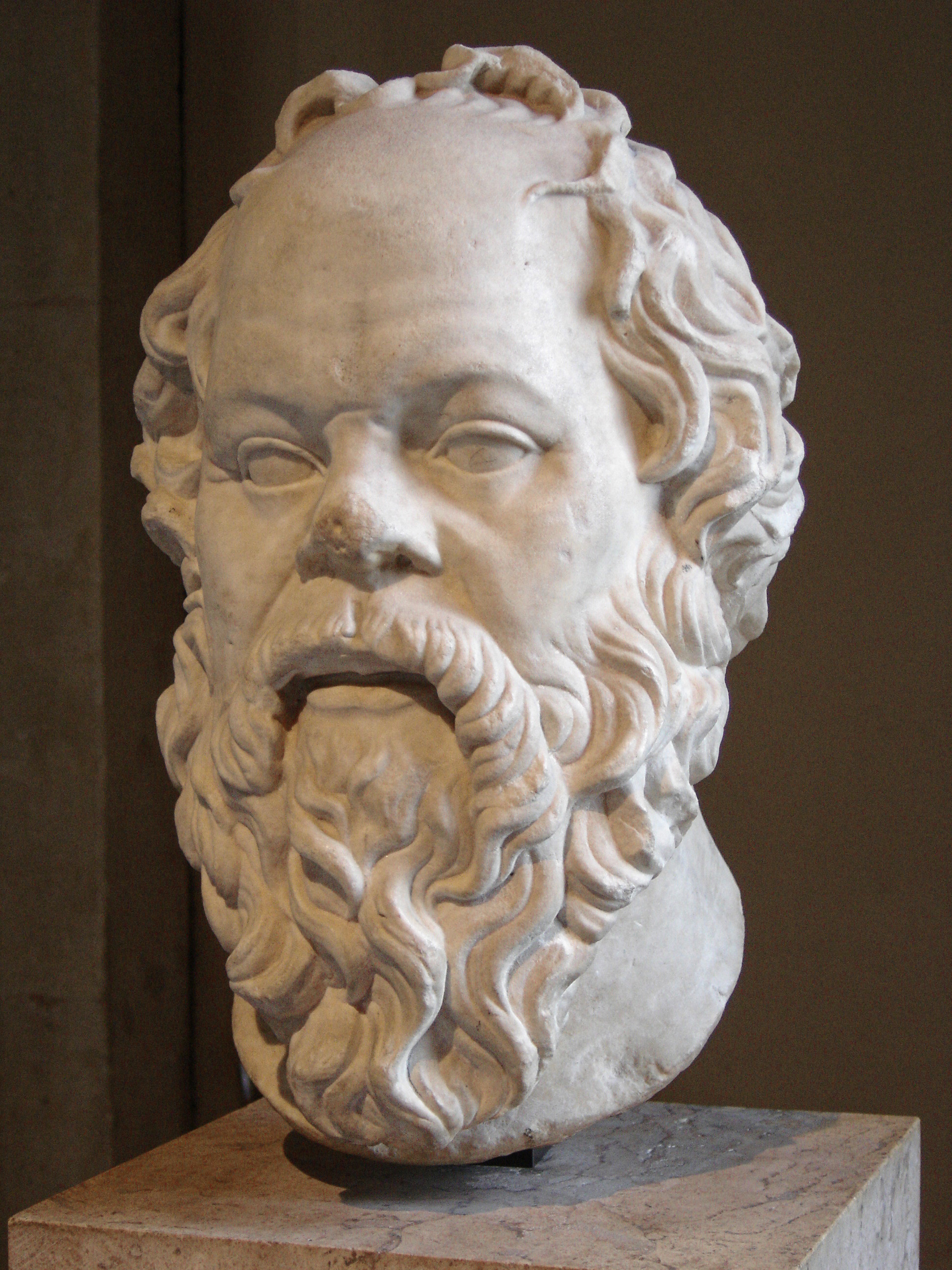
Socrates

A little history: the basic concept of justice in the west seems to have originated with Socrates. Plato's most famous book The Republic is entirely concerned with the question "what is justice" (the Greek word was dikaiosune). After quickly demolishing arguments that justice is "the will of the strong over the weak" (a view that stayed pretty well dead until Nietzsche came along) and the slightly stronger claim that it is "doing right by friends and harm to enemies", Socrates spends most of the book defending the idea that to be just is to act and become in accordance with the way things are, or put another way, to love the good and conform to it. (He then has a lot of ideas about how that can be accomplished and a really unfortunate extended-analogy about the soul and the city-state which has given rise to some misconceptions about his political views; but I won't get into all that right now). But from then, right up until the enlightenment, the idea that justice was conforming to the way things should be was the dominant understanding of the west.

Over in the east, Lao Tzu seems to have independently come up with the same basic idea. He was able to speak much more simply about "life in conformity with the Tao". Confucius then watered it down a bit by trying to get really practical by providing elaborate descriptions of what different 'tao-conforming' lives would look like. In both cases, eastern and western pre-modernism seems to have independently agreed that justice requires first an understanding of how things should be and then an attempt to conform oneself to that understanding.

Lao Tzu
Finally, in the contemporary world, justice is most clearly talked about by natural law and virtue ethicist (who are mostly going back to the pre-modern thinkers). Most notable would be CS Lewis who showed, rather convincingly, in The Abolition of Man that belief in the natural law, the Tao, is necessary for humanity to remain human. The love of that Tao and the attempt to conform to it is justice.

But why is justice so important? Well, a sense of justice implies a vision of how things should be, and without that, I can't help but think that there will be a great deal of drifting about without any real direction. Quite practically, it is justice that tells me that I cannot do just anything to accomplish a good goal, for a world in which one problem is fixed and I have been corrupted by a terrible act (even in the service of a good goal) is not the way things should be. It is justice that tells me things can be better and it is justice that urges me to make them better. It is by justice that I recognize injustice. Justice is the eye of the conscience; what I do blindly by conscience is illuminated by justice.
Justice is  Badass 

Monday, August 8, 2011

What a Flimsy Reality!

There is another way of writing about my topic today. In almost any other format it is a better way. I plan to talk about my suspicions about the nature of the non-material world. In another context I would do this by documenting the original publisher of the germ of every thought and observation I use to build my conclusion. I would provide comprehensive footnotes and I would address the primary objections that occur to me (I would also cite the originators of those objections). I would do that if I were writing a lecture or a formal paper. But this is a "heaven and earth questions" blog post. As such, I try to structure my writing as a conversation; partly because I think that make it a more engaging read for most people, and partly because I am way too lazy to implement the full scholarly rigor that an academic paper or lecture would require. Whether this is a good or bad thing, I have noticed one advantage that has risen out of it. This format allows me to write up and thereby work through ideas before I have them entirely worked through - it works as a great half step on the way to an academic paper.

More preamble! - this topic is, in some ways, focusing on one aspect of a larger topic I have been working on trying to develop a different way of understanding pre-modernism, modernism and post-modernism. The more I research and read, the more I find myself in agreement with what I understand to be a pre-modern mind set toward philosophy and theology. I do want to make a distinction between the descriptive (the model in itself) and the prescriptive (my sympathy for one approach as the model would describe it). This post will be focusing on certain implications I draw from the pre-modern outlook as I understand it through the (new?) model. Also it could just be a poor attempt to justify some sort of odd contemporary neo-platonism.

As I have said in another post, I believe that pre-modern thinkers began with metaphysics. That is to say, they began with statements and arguments about what life, the universe and everything are really like. So far as I can tell, nearly everyone who did this was influenced by Plato's theory of the forms which (in a bare bones way that will certainly not cut the mustard if you ever find yourself in my PHIL101 class) basically claims that there is a world behind the physical world of our senses in which the essences or patterns or archetypes or abstractions exist. Something my students have a lot of trouble getting is that this "world of the forms" is more real than the physical world.

I am sympathetic to the difficulty. First, we are conditioned to think of the objects of our senses as the most real things there are. Even metaphysical relativists who like to go around talking about "my reality" and "your reality" - an absurd notion so far as I can see - tend to at least treat the physical world as a fundamentally shared, base line reality. On top of this, every time we run into a world "on top of" or "behind" the physical in literature or the media, it is nearly always presented as shadowy and/or ethereal; we get the sense that it is less real.


The only exception that springs to mind is C.S. Lewis The Great Divorce, which portrays people in purgatory/heaven as looking and functioning somewhat like ghosts because their environment is more real than they are. So he sort of inverts the popular portrayal. This sort of thing comes out in a few of his other works (notably his angels in the space trilogy and especially the ecstatic cosmic dance scene in Perelandra) But then, Lewis described himself as a pre-modern (De Descriptione Temporum) and seems to have been something of platonist as well.

But if I am going  to explain Plato, much less recommend co-opting part of his worldview, you need to understand that the world of forms genuinely is more real, it has more being, than the physical world. If it helps, you might try following Lewis' approach and imagine the physical world as ghostly in comparison to the world of the forms. Once you have this settled in your head, you will be in a much better position to understand the pre-modern approach.


Things in this world are merely things of seeming. Of course there is some reality to the world of seeming, things really do seem this way or that way. But if we can begin to think and talk about the world of being -  a world which this one reflects - then we can begin to get at understanding. Thus, "what is a human?" is a far more interesting question than "how does the blood circulate?"; "what is justice?" is far more profound than "did she hit him without cause?".


Furthermore, the greater reality of the world of forms is actually a really great thing for all of us. Anything which has a soul, has a connection to the world of forms and (to mix my philosophers and bring in our old buddy Aristotle) pretty much everything that lives or has lived has a soul of some sort. In fact, everything that has any being at all is thereby anchored in the world of the forms from which the seeming of existence gets its start (Plato would have said "emanates"). Basically, everything physical that you think of as real is based on its greater reality in the world of forms. Although the aspects of it that we tend to focus on are probably not its more "form-ish" aspects. 


Now I take this understanding of two worlds and I am inclined to modify it by denying the separation (that's not new people have been doing it at least since Augustine). I do not think that there are so much two worlds as that there is one world, many aspects of which we are not in the habit of experiencing. We pretty much orient ourselves around our senses. But that doesn't mean that there aren't aspects of reality that our senses just aren't designed to pick up. And if those aspects of reality are more profound, are more fundamental to our identities and being than the physical aspects we are so preoccupied with then it might just be worth thinking about them. 

This is one reason I have been so sympathetic to the pre-modern understanding of life, the universe and everything recently. Rather that assuming that our senses give us as much reality as there is and trying to be content with that (modernism) or assuming that what our senses give us isn't even real so that ultimately there is no real reality (postmodernism) I find myself much more persuaded by the idea that our senses communicate some of reality but that there is so much more to it. Maybe there are more things in heaven and on earth than are dreamt of in our philosophies.

P.S. I decided to make this a purely philosophical post. Next week I intend to post on what I see as the religious/spiritual implications of all this.