Search This Blog

Friday, October 21, 2011

Variations on a Theme by Shakespeare, Lewis and Kreeft

2019 Update: I am still wrestling with the core concepts I explored in this piece. If you want to read more about my thoughts on post modernism, modernism, and pre modernism you can find some of that HERE.

I was playing with different topics today and it occurred to me that I have not yet explained this blog's title. I have hinted at it and I think I may have even used it somewhere (though I can't find the post off hand) but I haven't ever posted on why I call it "Heaven and Earth Questions". In Hamlet when Horatio sees the ghost he is confounded more because ghosts don't fit into his understanding of the world, than because of any normal fear of ghosts. Hamlet responds with : "There are more things in heaven and earth. Horatio, than are dreamt of in  your philosophies." I read Hamlet quite a few times with out ever noticing that line. In fact, the line was pointed out to me by Dr. Kreeft in one of his lectures (he uses the line quite a bit and at this point I have no idea which lecture I heard it in first so let me just give him general credit).

Dr. Kreeft's point, building off of C.S. Lewis' work on the character and weaknesses of modernism as well as his own work, is that there are really only three possible relationships between an individuals epistemology (the study of what is know and how it can be know) and ontology (the study of being or of what is). Either there are more things in heaven and earth (in reality) than are dreamt of in their philosophy (their epistemology), there are the same number of things in heaven and earth than are dreamt of in their philosophy, or there are fewer things in heaven and earth than are dreamt of in their philosophy. Crudely speaking - and I am already anticipating a few grumpy notes from post-modernists out there- the post-modernist holds that there are fewer things; the modernist, that there are the same number of things; and the pre-modernist, that there are more things in heaven and earth. 
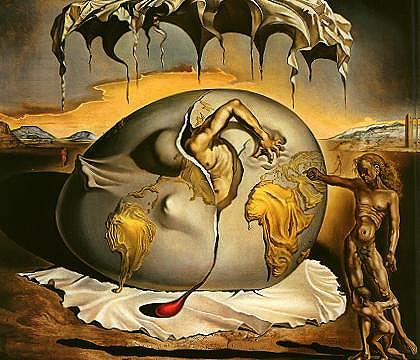

For the post-modern, reality is a really tricky concept (and possibly an entirely meaningless word) to begin with. The post-modern approach tends to downplay reality as unknowable and therefore unreal. For many, many reasons, they have abandoned anything like a correspondence theory of truth (truth is when a proposition corresponds to reality) and then operate out of a desire to establish ones own "working" reality which they seem to simultaneously think must also be a fundamental illusion. However it plays out it will work out to a belief that reality, to the extent that it is a meaningful word, is smaller than the conceptions of each individual.


The modernist holds on to that initially exciting yet ultimately deadening idea that human achievement will one day be able to explain absolutely every aspect of reality and offer something like a scientific proof to verify those explanations. You hear lines like "if science can't prove it then it doesn't exist" from them. Here in America we have a very common religious form of this modernism which claims instead "if the Bible doesn't prove or affirm it then it isn't real". Both are modernist by this model. The claim boils down to the belief that human reason is capable of explaining or describing every aspect of being; that there are exactly as many things in heaven and earth as are dreamed of in philosophy. Thus prior to meeting the ghost, Horatio is a sort of proto-modernist.


But the pre-modern believes that there are more things in Heaven and Earth than are dreamt of in his philosophy; that reason works but isn't comprehensive. The pre-modern believes there is more to the world than what we can figure our. This does not mean (as I find many athiest apologists have construed it) that the pre-modernist gives up on trying to understand or that they believe that reality can't be known. "It is the glory of God to conceal a thing; but the honour of kings is to search out a matter." (KJV) Instead, the pre-modernist believes that there is always going to be more to know, that reality is fuller, more complex, more meaningful, more beautiful than we can comprehend - there will always be more to discover.

That is why I named the blog "More things in Heaven and on Earth". By now you must know that I am, or at least am trying to become, a pre-modern. Thus the title reflects my belief in infinite depth and breadth of the universe, of reality, of the cosmos, of the question and of the answers. There is bottomless joy in the search for truth because the truth is always being found and will never be exhausted.

Wednesday, October 12, 2011

And the Geeks Shall Inherit the Earth

About three quarters of the way through one of my notebooks is a reminder that "science fiction and philosophy would be a good blog post". I remembered to write this without it.


I am completely and unrepentantly partisan in favor or genre fiction. A friend asked me the other day why genre fiction gets such a bad rap in literary circles and as I launched into an answering diatribe it occurred to me that I am not precisely balanced on the subject. And I am alright with that. There are enough people out there fighting for the sanctity of "realist prose", and enough of them still occupy positions of power in various prestigious universities that I am able to feel as though I am still supporting the underdog in my defense of genre. Granted we are seeing more and more "sci-fi and fantasy" courses in English departments and I even know - oh frabjous day -  an instructor at the Naval Academy who was teaching a course on modern graphic novels (these are really long comic books like Watchmen and Persepolis for those of you who are not quite as immersed in geek culture).

Nevertheless, the wizened guardians of the literary canon are still debating The Lord of the Rings and Asimov's Foundation series. Let them bicker, history is on our side (well, mine anyway). But just in case it isn't; or in case I haven't made enough grumpy retorts to a nebulous literati, let me explain why and how I think that science fiction is the most philosophical of all genres (including realistic fiction).


Philosophers are huge fans of hypotheticals. Generally there is some attempt to make a hypothetical sound more impressive or intellectually worthy by calling it a "thought experiment" - this might also help with funding humanities departments - but ultimately the game is to imagine an unreal situation with it's own sets of rules for the purpose of playing out a theory to see how it might work in the absence of real world complications. And I think that this is a wonderful thing; hypotheticals give us all the opportunity to test something without having to worry about irrelevant details. A while ago I mentioned an ethical dilemma involving a train and several groups of people. The point is to imagine a situation in which someone's morality comes to the fore in a clear way. It does not matter that the situation is incredibly improbable, what matters is that it is a test case for at least two different ethical systems.


In science fiction, the author gets to do the same thing. What better way to explore philosophical anthropology than to imagine a world in which artificial intelligence is on a par with or even surpasses our own (Aasimov's Robot books)? If you want to expound a pre-modern cosmology in a way that modern thinkers will be able to understand how could you improve on a contemporary professor being shanghaied into a trip to mars (C.S. Lewis' Out of the Silent Planet)? Is there a more effective laboratory for investigation into the implications of a  perfect signifier-signified relationship than a novel wherein the enemy alien's doomsday device is an entirely accurate language (Samuel R. Delaney's Babel 17)? And how could there be a more thorough thought experiment into the cosmological implications if Plato's theory of the forms and their impact on multi-verse theory than a book about intellectual monks under attack from a world more distantly emanated the good (Neal  Stephenson's Anathem)? I could go on; and on and on and on.
 

Science fiction gives a writer the ability to imagine the specific set of circumstances which would most clearly demonstrate their own innate philosophies and world views. Of course when that is all they use the novel for (in fact when anyone uses a novel for much of anything other than as a medium for good story), they tend not to write very good books. But what if the author is a philosopher? What if they are writing not in order to preach a philosophy but to tell the excellent stories their philosophies inevitably produce? Some authors certainly are mere preachers - though sometimes they preach well - and some are tremendous story tellers and not very good philosophers (I would but Heinlein into this category). But some authors are genuinely both. Philosophers with a knack for recognizing a good story and the skill and craft to tell it well. It is probably going too far to call them philosopher poets but that would point in the right direction. That is why I find science fiction so intriguing, beguiling, thrilling and ecstatic.

Also laser guns, robots, space ships and aliens.

Thursday, October 6, 2011

The Golden Mask

So this post is one of those "being vulnerable because I am doing something I don't do well" deals. Having a friend who actually is an excellent poet and a circle of friends who write this stuff on a semi regular basis turns out not to have made my brief attempts in the arena any easier. Ah well, I'd better just take the plunge:

The Golden Mask


I tell a tale to turn from unknown truth; too long known
and seek instead a kindergarten color wheel.
Your palette is too subtle; your pastels strained my eye
I never could connect with grays and browns
and purples faded, washed in detail, tassels, minutia,
death.

Instead I long for fairy queens and war,
for melodies, trombones and marching bands.
The cross, the stone, the bread, the cup, the fish
smother my soul with a nuanced earthquake devoid of Flame.

But quiet winds, drifted from English pipes
to children's minds are lightning from the sun,
and dragons and ships and warriors and crowns.
a whispered wardrobe starts a carousel.

Such simple themes must overwhelm my eyes
with red and blue and brassy green and gold
And that fierce name by which I loved Him first
is Love and Death and Joy without renoun.

"My King is coming, riding on a fawn;
I could not love Thee till I loved Aslan"

By - me


Be gentle.

Thursday, September 22, 2011

Really Think A Lot of Yourself, Don'tcha?


  My last post spawned a number of conversations (on and off line) which have lead me to question one of my standard operating assumptions about the modern, western anthropology. I remember growing up and being told that while we Christians believe that man is basically evil, those foolish non-Christians believe that man is basically good; that we start with different assumptions and that the other people’s assumption was clearly ridiculous and most likely a product of wishful thinking. That is not the operating assumption. Instead, I have assumed for the last several years that nearly everyone (except Presbyterians) believes that people are, by nature, somewhat good and somewhat evil. Granted not many of us would use those terms, but I thought that most people would say that the majority of the population have some goodness and some badness in them.
  
  I’m not certain I was right about that.  I’m sure there are many reasons but by limited and entirely anecdotal evidence would seem to suggest that many people of all sorts of religious and philosophical persuasions actually believe (or at least claim to believe) that the mass of men are fundamentally good. Most of the reasoning I found behind this goes back to either cultural or general ethical subjectivism. The claim seems to be that we judge other’s actions to be bad because we have different ethical standards (which are arbitrarily ingrained in us thanks to culture and our parents), but that at the end of the day each person generally lives consistently with their own ethical or moral views.

   But this leaves me with something of a dilemma. You see, I don’t live up to my own ethical or moral views. I see myself as rather appallingly bad, and (per my last post) infinitely good. Generally we treat good and evil as being mutually exclusive such that a thing can be good only to the degree that it is not evil and evil only to the extent that it is not good. And this approach makes sense since the two are contraries. But we tend to then conclude that a person’s soul could be plotted on a sort of morality number line. We tend to think of others and ourselves as this good or that evil. But I don’t believe that it actually works that way.

  Instead I think that the human soul is incredibly good. It is glorious beyond anything we can currently comprehend. And it has also gone very wrong. I tend to picture my own soul as something like a diamond with pits and stains and scarring on it. The pits and scratches can be ground off, the stains can be cleaned. Evil is not an equal of good after all, as C.S. Lewis reminds us, and (I think) Augustine first pointed out, evil is a parasite on good; it cannot exist in the absence of good. So the soul is good but has become very bad. And now the task at hand is how can we be fixed?

  Does this resonate with any of you? Is there anyone else out there who is simultaneously aware that you are glorious and good beyond understanding and simultaneously twisted, warped and wretched? What do you think of mankind? Are we basically good or basically evil? Or are those no longer meaningful terms to you?

Monday, September 12, 2011

Impossible Love?

  I have been thinking about self-esteem a good bit over the last several years, largely because I am perplexed by it. The whole concept of having good self esteem confuses me in that I haven't ever been able to really empathize with the way contemporary authors, thinkers and pop-psychologists seem to want to talk about it. Then, when the topic came up on Not the Religious Type, I decided to see if writing about it would clear some things up for me. This is what I came up with:
  The problem for me is that the very idea of good self-esteem seems like an attempt at willful self deception in order to be happy. The reasoning seems to go like this:
1. People want to be happy.
 2. People who see themselves as bad or deficient are not happy about their badness or deficiencies. 
3. Therefore low self-esteem causes unhappiness. 
4. So if we want people to be happy we need to give them higher self-esteem. 
5. We should, therefore, convince unhappy people to see themselves as very good/beautiful/talented/intelligent - basically as possessing the qualities they value people for having.

  You will have noticed that this is bad reasoning. Statement 3 is guilty of non causa, pro causa; it treats a common corellative of unhappiness as the cause of unhappiness. There is no compelling reason to conclude that seeing myself as very bad should cause me unhappiness. At least not unless I want to be good, and improvement is an impossibility. And we have no reason to think that improvement is impossible. As a Christian I believe that perfection is ultimately guaranteed. I get to be perfect some day, so why worry about how far from perfect I am right now? In fact, shouldn't my awareness of my current imperfection give me some happiness when I realize that my God (whom I love) loves me even the gross way I am? If I were perfect I would be able to say something like "well of course God loves me, who wouldn't love this" and I could say it without any arrogance or pride. If I were truly as glorious as I hope to one day be, then any scrupulously honest self appraisal would have to conclude with perfection. I don't think that that would (or will) diminish my appreciation of God's love but isn't that love even more apparent when I see that "while we were yet sinners, Christ died for us"?
 I think the pop-psychologists have missed this. What do they do with someone who is genuinely untalented, physically ugly (by their own societies standards), not especially talented at anything, generally unkind to everyone around them, and effectively lacking in anything we generally consider lovable? How do you tell someone to look in the mirror and find something wonderful about themselves when there is nothing especially wonderful about them, or at least nothing that falls under the modern rubric of value? I know, generally we haul out the myth of balance to avoid even thinking about this question but when you look yourself in the mirror, the myth will fall to pieces. 
 Or even if a person does have something this world values; say they are especially beautiful. Anyone who is honest with themselves can easily pick out a dozen flaws, imperfections and "unlovable" qualities in their character. The pop-psychologists tell us to pretend they aren't there. Even Christians tell me, "but that's not really me". Really? Then who is it? If I am not the one who has all those terrible thoughts about my closest friends, who is it who does? Sure, I hope to get beyond all that someday but today certainly isn't that day. Today I am spiteful, envious, lustful, discontent and selfish. Pretending otherwise can only last so long. All lies, even self-lies, collapse in the end. All self-esteem based on self-delusion is nothing but a house of cards under the hurricane of life. Simple reality must ultimately blow the pretty bandages off of all our festering wounds. 

  And then where will we be?

  But I don't think that happiness or, even more importantly, Joy has to be built on high self-esteem. I think that the more honest, more real, more true our self-image is, the stronger a foundation it will be for Joy, and even for happiness. When I can look at myself as myself and see first that I am infinitely valuable simply because I exist (a quality I share with everything and everyone else) and then that I am nonetheless weak, twisted, often evil and ugly - when i can see all of that and know that I am loved, then how could anything shake my joy?
 What worries me is that our culture, Christian and secular, seems to be losing it's ability to love through evil.  There is an old Christian platitude: Love the sinner, hate the sin. Some people like it, some people hate it. I have opinions but I don't think they matter much since I don't think the phrase means anything to us any more. Nobody loves sinners. At least, nobody loves sinners as sinners. When we make any attempt to love sinners we seem to invariably begin by pretending that they aren't sinners. We only love sinners as saints. Which is why relationships fall apart when reality inevitably forces us to see the sin. When we just can't ignore their faults any more, we have not tools, no practice, no experience and only one example in the priceless skill of loving the unlovable. 
  Jesus said that they will know we are his followers by the love that we have for one another. Doesn't that mean that our love needs to be a new kind of love? Doesn't that mean that our love has to be a love that is impossible to those who haven't decided to follow Him yet? Is it possible that He was talking about the kind of love that He has for us? Love that loves such a worm as I?
  

Tuesday, August 30, 2011

I Guess this Makes me a Patchwork Person

  I have a friend who is extremely Presbyterian. I have another friend who is extremely Objectivist. I am sort of jealous of them.  A while back I wrote a post about being a third-culture-kid and the impact that had on my views of culture in general. On that post Ben reflected on my take-what-I-like-and-leave-what-I-don't-like approach to culture and applied it to denominationalism and the search for a tradition. I am going to expand it a bit further and take a look at my approach to ism-ism (if I may coin the term) in general.

  Ben pointed out that it can be uncomfortable to not have a tradition with which to identify and I found myself sympathizing with him. First, because it is nearly always more comfortable to say "well what we believe is..." than to say "I believe...". There is strength in numbers, and that is not a bad thing, we are communal beings and it is natural and I think very proper to try and find our place in a greater family. Also it always feels a little arrogant to say "I believe this and I'm not really sure whether anyone else ever has". One seems to be saying "Nobody in the history of the world has been able to figure all of this stuff out until me; but now I understand".

  So I think that there are some very good reasons to want to find a tradition (philosophical or theological) to fit into.

 But I don't. I do have several terms or isms I will apply to myself but I tend to find that when I use them I have to do it with a lot of caveats: "I'm a capitalist, but I don't think that selfishness is a virtue or that it is better for rich people to get money than poor people, or that capitalism will necessarily make anyone happy" or "I'm think of myself as something of a Platonist but here are bunch of things I think Plato was wrong about" or "I'm basically a protestant but I'm not really sold on the protestant understanding of sola scriptura and I think that the Orthodox have a better understanding of the Eucharist than protestants, and I'm really very confused about what the Church is in a metaphysical sense but I kind of think that the Catholics have a better understanding of it than any protestant does". You see the problem? I can usually identify with some central premise or teaching of one ism or other but I haven't found one yet that I can swallow whole (with the possible exception of Mere Christianity as Lewis defines it - whether you are christian, atheist or other I bet you will be shocked if you go back through that book and look at how basic Lewis' definition is).

  And yet at the same time I don't pick and choose by fancy; at least I sincerely hope that I don't. I put a pretty high value on the law of non-contradiction and for as long as I have been trying to construct/discover/receive a complete worldview, I have insisted that no one part of it necessarily contradict any other part. Those of you who know me will know better than I whether I have been successful but I have always at least tried to reconcile any contradictions I saw in my own worldview and to reject one conclusion or the other when the reconciliation failed. Contradiction gives me a stomach ache.

  Let me try and describe the process: When I come across a bit of truth and recognize it as such, I go right ahead and believe it. This is a lot like trying on a new tie; I like the tie so I put it on, then I have to see whether it matches the rest of the suit. It may match my coat well enough but it may clash horribly with my shirt. Then I have to decide whether I like the tie or the shirt better. Say I decide for the tie. This means changing the shirt, but not any old shirt will do; it has to match the tie and not clash with the rest of the suit. Eventually I might find just such a shirt only to discover that the shirt comes with a pair of shoes which won't work with the belt.

  You begin to see? I am not complaining, as a general rule, I love the process. It's just that I might have
hoped by now to have found some tradition which contains or at least allows for everything I believe to be true and nothing that "clashes" with it. But I haven't.

  And I am beginning to be alright with that. I have said in the past that I believe that everything I believe is true. Not because I am arrogant (I probably am but it has nothing to do with this particular conviction) but because my answer to "What do you believe that isn't true?" has to be "Nothing, if I thought that something I believed was a lie then I wouldn't believe it would I". I understand the White Queen "believed as many as six impossible things before breakfast" but I have only been able to believe impossible things by accident.

  As a result I have found that I am pretty much stuck where I am. I zip through political theories, philosophies, theologies, religions and I grab gems of truth where I see them and throw out falsehoods when I become aware of them. After all, Jesus claims to be the Truth, and I believe Him. So maybe my sifting process is a good one; maybe I am slowing cleaning the glass through which I view Him; maybe my frenetic truth sorting is really just a series of course corrections towards the center. Maybe your's are too; maybe as you seek the truth at all costs and no matter where you find it, maybe you are getting closer to Jesus. He did say that He is near to those who seek Him.

   In the meantime I will try to find community with anyone who will have me. Maybe this is why I care so much about reviving the ability to disagree without vitriol. After all, we are all sure to be wrong about a whole lot of things, even if we don't know which things they are.


Thursday, August 25, 2011

And They'll Know We are Christians by our.....Vitriol?

My apologies for the lateness of this week's post. I have been somewhat overwhelmed because I got a new job this week (cheers all 'round) and have been so busy celebrating that I haven't been able to sit down and put my thoughts to keyboard.

Last week I got my first-ever topic recommendation from a reader. I suspect that the particular observations in the e-mail I received were a result of our having officially (because I said so) entered election season 2013. At least we have on the republican side of the aisle. No, No! don't go away. I promise this is not going to be a post on politics; or at least not exactly. My correspondent commented that he has a number of Christian friends on different sides of the political spectrum - so far so good and a lot more than I could say back when I lived in the Bible belt. I, for one am hugely in favor of Christians not being tied to any particular political ideology, I have my own political opinions and I would hope that each of you have yours but I don't think that good things come from a giant, conglomerate, homogeneous, religious-political-moralist group think.
 
Unfortunately, things go downhill from there. It seems that these politically heterogeneous Christians are engaging the political world with all the vitriol, and blinders we have come to expect from [insert your least favorite media outlet here]. Or maybe more. Each group seems to have chosen a favored demagogue or two and will defend that demagogue with all the loyalty and ardor we might hope to see directed towards the rest of the Kingdom of Heaven.
 
Of course it needs to be pointed out that this attitude is not restricted to the Church. Nearly all media outlets seems to have spent the last few years lamenting the lack of civil political discourse in this country (not that I think we ever had much of a hold on it). So yes, Christians are not the only ones who can be downright hateful and nasty when it comes to talking about politics. But I seem to recall something about "By this all men will know that you are my disciples, that you love one another" and somehow political, rhetorical venom doesn't seem to fit into this description. It has also been observed that this sort of approach to political discussion doesn't really reflect any of the improvements we are supposed to look for in people who have asked the Holy Spirit to start working on them. Putting aside love for a second, when was the last time you heard a political conversation between two Christians on opposite sides of the aisle which was just brimming full of joy, peace, patience, kindness, goodness, faithfulness, gentleness and self control?
 
Now maybe this just has to do with our culture's loss of ability to engage in any sort of discussion or disagreement. But even if it is, shouldn't Christians at least try to correct the error?


But I suspect that the real problem for Christians in this arena is how clear it always is that the other side is not just mistaken, they are nearly always disastrously mistaken and quite possibly thoroughly evil. After all those people can't possibly be "real Christians" - never mind that we are under even more stringent orders to love people who aren't part of the family yet - why "they" want to rob the poor, or destroy the family, or kill babies, or institute anarchy, or create a dictatorship or, or, or, or.....
 Or maybe, just maybe it really is more important to love one another than it is to be vindicated in our opinions, even if those opinions are true. So let me end by pointing to a couple of role models. One of the things I have noticed recently about my hero, C.S. Lewis and his best disciple Peter Kreeft is that both  engage in fierce dialogue and dispute without once giving the impression of disrespect or ill-will for their opponents.

Maybe we ought to take a lesson from Pascal; a friend of mine recently drew my attention to the following:
"When we wish to correct with advantage and to show another that he errs, we must notice from what side he views the matter, for on that side it is usually true, and admit that truth to him, but reveal to him the side on which it is false. He is satisfied with that, for he sees that he was not mistaken and that he only failed to see all sides. Now, no one is offended at not seeing everything; but one does not like to be mistaken, and that perhaps arises from the fact that man naturally cannot see everything, and that naturally he cannot err in the side he looks at, since the perceptions of our senses are always true." - Blaise Pascal, Pensees


Have you found an effective way to enter into genuinely courteous dialogue with other people on political subjects? Do you just avoid talking about politics because it "always gets ugly"? What is your strategy?