Search This Blog

Showing posts with label Charles Williams. Show all posts

Monday, May 21, 2018

What Happened to My Deconstruction?

In my last post I started with the observation that, while much of my personal "faith journey" maps well onto a common faith deconstruction narrative, I haven't actually experienced a deconstruction—at least not it the way that experience is usually discussed. I offered (got sidetracked by) a short analysis of the difference between a modernist and a premodern approach to understanding reality and indicated that my tendency towards premodernism might account for my lack of a typical deconstruction experience.

In this post I want to pick up that thread and give a few more reflections on how my tendency towards a premodern understanding of reality let to my having a different experience with regard to deconstruction. The really short version is that I never had a deconstruction because I am always deconstructing and always reconstructing. But explaining what I mean by that might take a few more paragraphs.

I have mentioned that I was raised in a fairly typically conservative US Evangelical household. My parents helped to found a non-denominational Protestant church, I spent time both being home-schooled (using a really conservative curriculum) and at a private Christian school. But there is one, really important way in which my experience growing up was non-typical for conservative US Evangelicalism of the late 20th century and it has everything to do with my parents.

My parents are politically heterogeneous as people. Where my Dad has a generally conservative approach to life; my Mom is has a pretty liberal* approach. Further, I would say that both of them are bad fits for those terms. My Dad's conservatism is nuanced by deep wells of reflection and a phenomenal appreciation for the stories of other people. Where the typically conservative response to unfamiliar stories is one of fear, anger, or rejection, Dad has always responded to new stories and data with interest, excitement and attempts to generate new models and theories about the world. In a parallel way, my Mom's liberalism is nuanced by razor sharp critical thinking and a strong empathy for those who found beauty and security in tradition and the past. At least—and this is what determined my experience—that is how I thought about them growing up. I should note that while these general tendencies did map onto their respective politics and theology to a significant degree I am speaking more here of their approaches to life in general than to any particular policies or beliefs they espoused.

I don't think, though, that simple constitutional heterogeneity accounts for everything that I ascribe to the way I was raised. My parents didn't only have different approaches to life, politics, and theology, they were cheerfully open about them. My home was one where finding the right answers was important but so was thinking about the question. Until I was in Bible College, I assumed that every church going family spent time after church discussing the sermon—disagreeing with some parts and agreeing with others. I always knew that my parents had different politics; and while I was somewhat more inclined towards my Dad's, I understood that these things were debatable and that there was value in having the debate.

On top of this, I grew up as a third-culture kid. My family moved to Turkey when I was seven and I stayed there through the end of high school. Due to the many cultural differences between Turkey and
Turkey photo by Samuel Giacomelli at Unsplash
the US, and thanks to my parents' and Grandmother's deep enjoyment of cultural diversity and exploration, I ended up with a pretty well developed understanding of the fact that the world is a complicated place, that lots of people have strengths and some weaknesses in the way they do things and the way they go about understanding the reality of their world, and that it is unlikely that anybody has things "just right". The conservative part of my makeup had (and still has) me convinced that it is almost always worth supporting the model of truth I found most compelling at a given point, while the liberal part of my makeup (one which was the weakest in me while I was in high school) reminded me that that I still had plenty to explore and learn.

The net effect of all of this was that when I went off to Bible college seeking to find all of the final answers to all of my questions, I went with a really robust understanding of what that would entail and a still (somewhat) flexible understanding of what reality might turn out to consist in. That said, I went to Bible college with the full expectation that I would find proofs and demonstrations which would allow me to concretize a final model of the world. I genuinely believed that the answers (and logically unassailable proofs of those answers) to all my questions were going to be found during my time in undergrad. And it seems likely to me that, were I going to have a deconstruction experience, mine would have started there. What I realized slowly over four years as an undergraduate was that, we still don't have final answers to "life the universe and everything"—we are still building our models of reality even while we are living in the world.

There were other factors too. I have been a fan of fantasy, fairy tales, and mythology since I have been reading and, in many ways, those genre are themselves an immersion into a pre-modern approach to the world. I also discovered philosophy during my last year of high school and focused heavily on that subject in college as a part of my attempt to finally "get the True answers". Most vitally I had a series of experiences which began to center my experience of Christianity more on a relationship with the person of Jesus and less on the lists of things people believe about Jesus. (I have written about that aspect of my thinking HERE)

None of that is to say that I "abandoned my faith" or even made a particularly significant change in the tenets of my belief structures while I was in college—I didn't. What I do think happened though is a sort of final shift in my overall approach to understanding reality. The experience of finding more questions than answers in college shifted me, or maybe just finally determined my psychological development, away from a modernist approach to a pre-modern approach to understanding reality. On a strictly historical level, it was over the ten or so years most directly after Bible college that my theological shift from functionally conservative white Evangelical to functionally progressive Christianity took place. But I am pretty convinced that it was the experiences which I have outlined hear which allowed that theological transition to happen in the way that it did—that is to say, that prevented me from experiencing a deconstruction in the way that it seems to typically occur.

By the time I really began taking out and examining or questioning those tenets of my faith and of reality itself, my understanding of reality had shifted from the strong-yet-brittle modernist "wall" to the more complex, less easily defined, and less thoroughly interdependent pre-modern symphony or dance. If a piece (a tenet) was discarded (as my original beliefs in gender complimentarity, LGBTQ+ exclusion, young earth creationism, Biblical literalism and others were) the total edifice did not shatter. It was affected, certainly. Each piece I removed had played a role in constructing the whole, each piece resonated with many other pieces. The whole, therefore went through a process of "re-tuning and re-orientation" each time something was removed. The ideas, beliefs, facts, convictions, and tenets I replaced them then necessitate further re-tuning—both of the idea itself, and of the edifice as a whole. But far from experiencing this as a crisis, I find great fun and even joy in it. When I discover that I now think a new thing to be true, I am thereby promised the opportunity to work through the rest of my beliefs, ideas, opinions, etc... and to find out how they are influenced by this new idea, and how they influence it in turn. Sometimes I will try ideas out, just to see what impact they will have on the edifice and what impact it will have on them.


I wish that I could end this with a recommendation for how one could choose to experience deconstruction in a modernist or premodern way—I suspect that mine has been slower than the modern one but that it has also been far gentler—but I don't have any certain prescription for how that might be accomplished. Modernist Christianity has gone to great lengths to wall out the whole philosophical tradition (postmodernism) which was built as a critique of modernism and as a result, most Evangelicals will probably experience a softening towards postmodern critiques of modernism as a de facto deconstruction in any case. There may be a back-door if an Evangelical were to start reading as much as they can of the Christian mystics, of the Inklings (try Lewis' essays, Tolkiens Silmarilion and On Fairy StoriesBarfield's Poetic Diction, Sayers' Mind of the Maker, Willaim's The Descent of the Dove) Chesterton's The Man Who Was Thursday, and MacDonalds At the Back of the North Wind and other premodern thinkers with an open mind and without merely trying to mine them form apologetics or for aids in evangelism, but I am not entirely sure whether that will work. The simultaneous strength and brittleness of Modernism require both great power and great gentleness to undo it without shattering it. I suspect that in most cases the shattering may well be inevitable. And maybe that is another reason that community is needed. We need to be there to help pick up one another's pieces—maybe even to keep a few safe for a time while our friends are rebuilding their world. If it is a good piece they will find a place for it in due time.

Footnotes:

*I use the terms liberal and conservative throughout this piece in a horrendously oversimplified way but I haven't worked out a way to get around that in a blog post. Maybe someday I can write a book and luxuriate in the nuance and complexity that medium affords. In the meantime, by liberal here I am using the loose political definition of "an outlook which tends to welcome change and improvement" whereas conservative "indicates an appreciation for tradition and stability with an attendant skepticism towards change".

Saturday, May 27, 2017

Delight as a Spiritual Discipline

Everyone raised his hand to pick the fruit he best liked the look of, and then everyone paused for a second. This fruit was so beautiful that each felt "It can't be meant for me . . . surely we're not allowed to pluck it."
It's all right," said Peter. "I know what we're all thinking. But I'm sure, quite sure, we needn't. I've a feeling we've got to the country where everything is allowed."
"Here goes, then!" said Eustace. And they all began to eat.
What was the fruit like? Unfortunately no one can describe a taste. All I can say is that, compared with those fruits, the freshest grapefruit you've ever eaten was dull, and the juiciest orange was dry, and the most melting pear was hard and woody, and the sweetest wild strawberry was sour. And there were no seeds or stones, and no wasps." 
-C.S. Lewis The Last Battle

I turned thirty five the other day and my family bought me a pair of Enchroma glasses for my birthday. In case you haven't watched one of their videos online yet, Enchroma glasses correct a degree of red-green colorblindness for those who have the condition. I had watched the videos and was really excited when I opened the box. The idea that I would be suddenly gaining access to a world that everyone else experiences all the time was somewhere between exhilarating and terrifying. Now my color blindness is pretty mild. I don't have any trouble with stoplights and I am rarely wrong about any given color (purple is my undoing—I just can't see the red in it so I almost always think it is dark blue). But for my entire life, people have been going on about sunsets and autumn leaves in a way that has convinced me that there really must be something to them even though they generally leave me flat (I experience most sunsets as a fairly drab wash of bleached pastels). Now it was suddenly possible that I would be swept into new beauty—beauty which I could literally not imagine. At the same time, I was aware of the fact that the classes don't work for everyone ("individual results will vary") and the fear of disappointment was almost as keen as the hope for I-knew-not-what-exactly.

Without leaving you in suspense: they worked. At least they make a significant difference in the way I see the world around me. I can't say that with them I see the world as though I weren't colorblind since I don't know what the world looks like through your eyes. But when I wear these glasses purple becomes a whole thing. Also nobody ever told me that green has this much variety to it. I spent the first hours after I got the glasses just wandering around with a stupid grin on my face being distracted by the grass, the spring leaves, and the sky. There is one particular tree just across the street, which I am now particularly taken by. I think the underside of each leaf is a different shade of green from the topside (I hadn't realized it before) so when I look at that tree from all the way across the street, I can still make out each individual leaf, even thought they are all just green. My distance vision is perfectly fine, but I had never seen more than an indistinct blob-with-lines above the trunk before.

I think it must be like hearing harmony for the first time after a life of knowing only the melody. The world is simply more vibrant, more deep, more subtle, more complex, more real than I ever imagined it was.

This experience has left me thinking more and more about the overlapping concepts of delight, longing, and joy. Historically, Christianity has tended to be associated with the idea of asceticism and discipline. The ten commandments are generally thought of as negatives sorts of commands (don't do this, that, and the other), the whole concept of holiness in Christian teaching is popularly understood to be a list of things people are supposed to not do in order to avoid contaminating their moral purity, as well as a few things we are to do (but which are generally viewed as onerous). We are told that we should be able to find delight in this (the psalms seem to get really excited about obeying "the law") but that doesn't actually tend to jibe with our experience of life all that often. Christian-ing just doesn't come across as that much fun.

And while I know that I have just constructed a straw man, that the "fruit of the Spirit" are all actually beautiful and exciting ways of being, there is a genuine sense that "serious" Christians are those who really embrace a dour sense of suffering and sacrifice.

But. But. But.

That actually doesn't describe the people we read about in the bible. It actually doesn't describe the great saints, it actually doesn't describe the very life of Jesus. Those lives are rich and messy. Those lives are balls-to-the-wall vibrant. We find Jesus laughing and yelling and weeping and partying. In order to be considered for canonization, a saint's life has to show evidence of all of the fruits of the Spirit—joy no less than patience; after all Jesus' great prayer for us was that we would have lives lived to the full—abundant lives.

I think Charles Williams, the Anglican mystic poet-scholar can be of great help here. He (following an older tradition) describes two "ways" of Christianity: the way of negation, and the way of affirmation of images (I have written a bit more about them HERE). The first is the way of the ascetic. In the way of negation, the whole deal is to stop being distracted by all the things which are not God and which cause us to think of God in terms of what we see rather than as the transcendent unknowable. The way of negation tends to focus on knowing God directly; the mystical experience, meditation, and spiritual disciplines like fasting and accountability are hallmarks of the way of negation. The latter, the way of the affirmation of images, attempts to see God "though" the images of god's self in the good world that God has made, and it is worth nothing that the mystics have as much of a propensity to wind up here as as they do in the way of negation; think of St. Francis preaching to the animals, or St. Thomas Aquinas' appreciation for the table and attendant unwillingness to impose his weight on a donkey, these are marks of the way of affirmation. Williams is at pains to remind us that each can become disastrous without the other, that people following the one way need to be reminded not to judge those who follow the other—that, in fact, we need the wisdom and input of those following the other—and that each offers insights the other is likely blind to.

That is all well and good, and I am very much persuaded by Williams' account. But I think it can, and should, be taken a bit farther. I want to suggest that the temperament which is drawn to the way of negation also tends towards a dismissal of the physical as such. In the desire to be united to the Spirit of God there seems to be a strong temptation to deny the goodness of the body, a desire to become mere spirit. This is a dangerous thing. We are spirits but we are not mere spirits, we are body-spirits. We are (to borrow once more from C.S. Lewis) amphibious beings of both body and spirit. The impetus to deny the body can easily become a state of discontent, a state of explaining to God that we were not made as the right sort of being.

For all my love of C.S. Lewis, I believe that one critical mistake he made throughout his eschatology is an over acceptance of neo-Platonism. In neo-Platonic thinking, the only utterly "real" absolute is God (or "The Good") and everything else is an "emanation" from God, with all things becoming less real the further they have "emanated" from the center. This view has a lot to recommend it (you will see echoes of it in the writings of Augustine as well). It has given rise to the whole understanding of heaven as another land, better (more real) than the state of being we currently inhabit and to which we will one day go. The problem is that, at the end of the day, it is not a fundamentally Christian view. The promise Jesus made to us is not that there is a Kingdom of God which we will one day get to go to, it is that there is a Kingdom of God which is, even now, breaking into our own existence. As such, following the way of Jesus does not mean distancing oneself from the world, but growing into people who can first imagine, then partner with God in bringing a greater real-ness, a fuller goodness, to this world. That the old world is passing away and that a new world is being formed, does not mean that we will be transplanted. That new kingdom is being formed under our feet. It is breaking through now. It has been breaking through for two thousand years and will continue to break through until it is fully here and nothing of the old, drab, evil, sinful, broken world is left (I am going to refrain from commenting on the the question of whether there will be one final great push before the Kingdom of God fully comes or whether the entire process will sneak in gradually).

And this is why I believe that delight is a spiritual discipline, one which is far too much ignored and even despised by the western church. The innocent enjoyment of the good world God has made—we cannot forget that even the drab "old world" is shot through with resonant images of the vibrant Kingdom—is a training course in seeing the Kingdom God has made us partners in effecting. To feast, to love, to celebrate, to gaze at the sky in wonder, are all acts of spiritual insight. They are all disciplines. Good sex is as holy—and for many as necessary—as a rigorous fast and laughter is no less godly than lament. In the latter we are reminded that we live in a broken world; in the former, that the broken world is being healed.


It has been observed recently that we need a theology of lament, of loss, that too often our theology is entirely about propositions or about ethical duties—a theology for computers and enlightenment philosophes—too rarely is it about being. I agree with this critique, we do need a theology of lament and loss. We need a theology rooted in Ecclesiastes, Job and the Good Friday. That would give us one critical part of a theology of they way of affirmation. A theology of lament is critical to our capacity to honestly, richly, greet the very real world of which we are a part. But we also need a theology of delight. We need a theology of dancing till we collapse on a hot summer night; a theology of the third beer; of laughing under a string of lights because tomorrow has no hold on us tonight. We need a theology of thick time in thin spaces, a theology of the presence of divine joy in every street lamp and blade of grass. We need a theology of the tinny speaker and the spontaneous sing-along to an 80's anthem, a theology of bluegrass and crickets, a theology of lighting bugs. As much as we need a theology of lament, we need a theology of the eternal moment and the laughing earth, for human flourishing is thing of both laughter and tears.

Saturday, March 25, 2017

Wells of Night: The Prophetic, Ecstatic, Utterly Compelling Poetry of Gabriel Blanchard

Wells of Night: A collection of verse by [Blanchard, Gabriel]In The Figure of Beatrice: A Study in Dante the poet, novelist, and philosopher Charles Williams has the following to say about Dante's account Beatrice as an image of Divine love:
The divine beauty of this most gracious being appeared in her speech and her acts. But it also appeared in the different members of her body. The body 'has organs for almost all the powers' of man; and these organs were, for Dante, of a nature as everlasting as his desire for God; they were indeed part of his desire for God: 'the organs of the body', says the Paradiso, 'shall be strong for all that means delight.' Dante himself did not go far in the analysis of the human body itself; much there remains to be done.
In Wells of Night Gabriel Blanchard has moved that project forward another step.

This collection of poetry, described by the publisher as a place where "Homoeroticism, Catholic mysticism, philosophy, and fantasy are blended" is swollen with meaning and with the soul of its author. To read the volume is to come into shocking—by turns terrifying, compelling, whimsical, and devastating—contact with Blanchard's soul. For those of us who read poetry in order to experience the deep being of another person, Wells of Night is all that we could ask.

The book is divided into four sections consisting of sonnets, elegies, lyrical work, and one extended fairy tale in verse. Throughout, Blanchard's felicity with the language and with his source material (Færy Ball is a veritable banquet of classic færy lore) will certainly delight. He uses English like a paintbrush or a flute. The art is nearly always delicate, intricate, and usually voluptuous; the book is well worth reading for the quality of the language alone.

But Blanchard goes well beyond the virtues of aesthetic language in this book—he offers a vulnerability so naked and so piercing as to make the reader fall in love and shy back in terror at nearly the same time. Wells of Night is Blanchard's particular humanity displayed through curtains of eloquence.

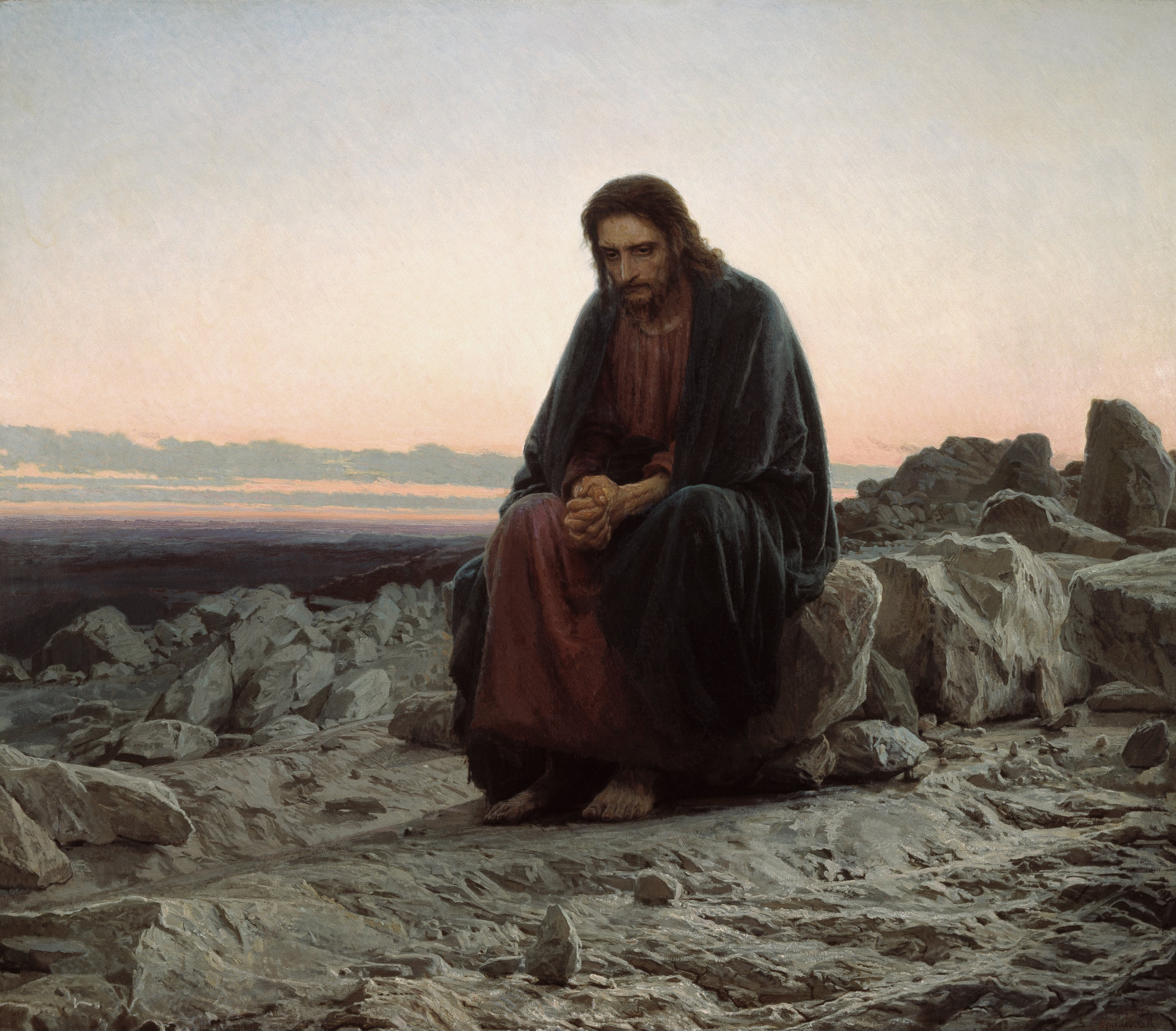
Image result for Christ in the Wilderness Iwan
Christ in the Wilderness - Iwan Kramskoi
For myself I was most moved, and am most haunted, by his poem The Adoration of the Image of God the piece in which he most directly takes up Williams' charge quoted above (though he contributes in a number of his other pieces as well). The poem reads, in many ways, like a post-coital ode to a lover. Blanchard takes a meditation on a male body and works the reader, organ by organ, though the ways in which this distinct, ever-person, man in front of him is a mystic window into the character of God; the meditation is summed up (but not concluded) with the lines

Masculine maculate immaculate glory
Incarnate archetype
and then, called by his own exquisite sensibility and iron honesty he crushes and recreates the entire poem in four final lines of resurrection and death. For Blanchard, his own poem seems to reflect a grace too real to deny and too terrible to survive. I am convinced that in this poem, a gay Catholic has shown me, a straight Anabaptist, aspects of God in the body of a man I cannot know. The object of his meditation is a window into the Divine which is of the same type as Beatrice and yet utterly distinct from her. Once comes away convinced that, without a gay man to tell us about it, this would be an aspect of God, the rest of us might never know. The poem needs to be read for itself so I will not try to convince you, but Blanchard has shown me a picture of God which, two weeks ago, I would have said I could not experience, and he has wept bitterly while giving his gift.

And still, ever the full orbed, near transparent creator, Blanchard refused to make this work into a simple, monochrome study of the darkness. As the night sky has stars, Wells of Night has Færy Ball, a narrative piece which manages to obey every rule of the pre-modern legendarium, presented in the idiom of the best of the romantics and so full of archetypal story blended with human and divine nobility that I found myself crying for joy while reading it.
Image result for stars
If this makes you want to dance, then read Færy Ball