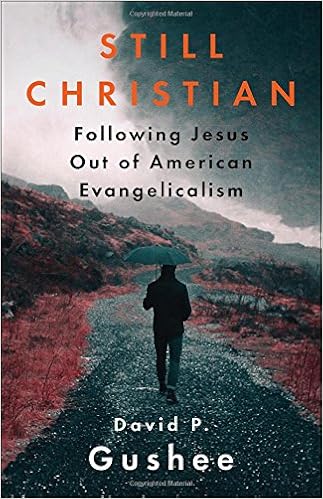
I love it when I get to review books which I can recommend without hesitation or caveats and am glad to say that David Gushee's
Still Christian: Following Jesus out of American Evangelicalism is one of them. This is a book which should be of interest to quite a few different people for different, if compatible, reasons. Before I get to that though, let me start by describing the book a little.
Still Christian is in the format of a memoir, Gushee isn't trying to persuade his audience(s) to do much of anything other than maybe to be more aware of what Evangelicalism is, and how it has come to be what that. It is a fairly short memoir because it focuses with pretty laser-like intensity of the single story of the role of Evangelicalism within Gushee's life. Thus it isn't the sort of full-orbed analysis of Evangelicalism as a historical, social, theological phenomenon of the sort that we are all probably waiting for
Mark Noll to write. Instead, this book is important because it will provide you with a narrative (and if you spent any part of the 80's, 90's, 00's or 10's as an Evangelical it will likely be a decidedly relate-able narrative) through which many of the beauties, thorns, and ultimately rot of evangelicalism can be more easily recognized.
In terms of style and readability, Gushee has a warm and winsome style and the book is tremendously easy to read. I blew through it in less than 48 hours (probably 4-5 hours of reading time over two evenings).
So who will benefit from and enjoy reading this book and why?
Ex-Evangelicals:
For those of us who grew up or spent significant time as evangelicals this book is incredibly easy to relate to and will almost certainly give you that "you are not alone" encouragement—particularly given Gushee's status as a Christian Ethicist and president of the Society of Christian Ethics and of the American Academy of Religion. Of course much of that has to do with shared experiences (his comfort with Evangelicalism was shaken by the "Women in Ministry" debate and by the Evangelical right's celebration of torture and his final break occurred over his affirmation of the full inclusion of LGBT folks), but it has a lot more to do with his carefully recorded process as he worked and lived through those experiences. Throughout the book he is unwaveringly gracious towards those with whom he has disagreed. Where people come across negatively he nearly always has something positive to say about them as well and even though Al Mohler does not come off especially well, he refuses to engage in any personal denouncement of him. Neo-Calvinism receives his single full-throated denouncement in chapter 7
Finding a Home and Leaving It where, when discussing the various perspectives operating at Evangelical colleges (and specifically Union where he taught) he says:
This is my best chance to say that I believe the resurgence of a doctrinaire Calvinism in contemporary evangelicalism is among the most odious developments of the last generation. I abhor its version of God and most of its version of Christian ethics, and I believe it could only have emerged among relatively privileged, hyper-cognitive, compassion-challenged white men, as it has. But I digress
That passage stands out because it is such a total break with the otherwise irenic tone he takes throughout the book. I am not condemning him for including it, but thought the fact was worth pointing out.
I think what gave me hope in reading this was not just that I could identify so much with Gushee's experience, but that he seems to have managed to get through it with so little bitterness and so few scars.
Evangelicals:
I am frankly not quite certain whether evangelicals will enjoy reading this, I do know that those evangelicals who seek to be well informed will appreciate reading this. This is a memoir by someone who was one of you, who experienced the "tent" of Evangelicalism shrinking around him (though his ultimate exit did involve movement to a place you had told him you would not go), and who will describe to you, winsomely and charitably, what it was about you that has caused him to feel relief on leaving. Surely this is something Evangelicals want to know.
Successful organizations need to conduct exit interviews. When someone leaves them, if they do not take the time to find out why, they are almost certainly doomed to eventual collapse. This is a charitable and kind voice (though he doesn't pull punches either) who will tell you what is going on and will challenge you to think about your culture as well as your practices. I don't think the goal of this is to convince anyone to leave or stay within evangelicalism, but it is a vital perspective for anyone who wants to understand evangelicalism as it is today.
non-Evangelical Christians:
If you are not and have never been an Evangelical, you are likely nevertheless well aware of them. As one friend of mine put it: "The thing about Evangelicals is that they
do things". For better or worse, Evangelicals have come to "represent" much of Christianity, or at least Protestantism, to the western world. While there are many great resources out there to help you understand the genesis and theology of evangelicalism (I have mentioned
Mark Noll haven't I?) this book will be your best tool to date in understanding the experience of Evangelicalism from the inside. It is rare to get a reflections from someone who was so recently a member of a "tribe", is now excluded from that tribe, and is nonetheless, compassionate, gracious, and fair towards them.
non-Christians:
Remember how
81% of Evangelicals (who voted) voted for Trump? If you think that understanding that dynamic is important to navigating the world. Or more broadly if you realize that political Evangelicalism is still a major power player in US politics and in globalizing culture, then you probably already know that it is important to have an accurate understanding of this group of people. This book will provide some stunning insights into what is really going on with that. It is, for you, serendipitous that Gushee is a professional ethicist as his perspective is one you will find particularly enlightening.
A Final Addendum on Fortuitous Timing
I can't think of it as anything but God-given grace that this book was released the same week as the
Nashville Statement.
Still Christian provides a lens on what is going on with the so called
Council on Biblical Manhood and Womanhood, the Southern Baptist Convention, and the rest. It is no coincidence in my mind that Al Mohler figures prominently in both works (his is the seventh signature on the Nashville Statement). In Chapter 6
Finding a Voice While Not Losing a Soul Gushee recounts his experience with Mohler at Southern Seminary:
Al Mohler, only thirty-three years old when he was named president, turned out to be a relentless implementer of the conservative agenda for Southern Seminary. He was committed to purging any faculty who strayed from conformity to the seminary's doctrinal statement, elevating faculty voices that would take visible conservative stands on key culture-war issues, and moving the school to a traditionalist position on the top question of the moment—namely, whether the Bible permitted women to be ordained or to serve as pastors in local churches.
...
...a new policy came down from the administration, one that would change everything at Southern. At an epic, miserable faculty meeting, the president [Mohler] declared that those who believed that women should serve as pastors would no longer be hired, promoted, or tenured at Southern Seminary. While some details of this policy remained to be addressed, the implications were clear enough. A school that had, over the years, worked its way around to a largely egalitarian understanding of gender roles was now, by decree, overnight, a place that required faculty both to believe and to teach that Holy Scripture clearly bars women from the highest office of church leadership. Dissenting tenured faculty members might survive but probably ought to leave, untenured faculty members who held the now-erroneous belief had no future at the school, and no new faculty members would be hired who were egalitarian.
This meant the end for pretty much all female faculty members. I vividly remember one of my younger female colleagues getting up from the meeting in which the policy was announced, running from the room, and throwing up in the hall. It's not every day that you are professionally executed by public decree. It just might make you physically ill.
If that doesn't frame the context for the recently released
Nashville Statement I don't know what does.