Search This Blog

Showing posts with label Evangelicalism. Show all posts

Sunday, August 11, 2019

Refugees from Evangelicalism

In church today, the preacher referred to a group of us as "refugees from evangelicalism" and that lodged in mind. Earlier this weekend another friend reflected "I found the Devil, right inside of the community where I also found God". So I think "refugee" may be exactly the right metaphor for my relationship to evangelicalism.

One big difficulty for those of us who are post-evangelical and yet still Christian is the fact that the toxicity which drove us out of white American Evangelicalism was not the only thing present in that space. For all of it's faults white American Evangelicalism was not all bad. Poisoned soup is still soup, even if poison is one of the ingredients. I certainly did find God through white American Evangelical style Christianity. That isn't to say that I might not also have found God through any of a million other faith traditions, it is only to say that white American Evangelicalism happens to be the vehicle through which (and, yes, in some ways in spite of which) I did find God. And also that is where I found the Devil.

Having spent some significant parts of my life with refugees it strikes me that there are some worthwhile parallels. Refugees are people who leave countries which have become entirely inhospitable to them, whether through wars, famines, or political tyrants. Countries fall apart; sometimes countries collapse. But many refugees can remember a time when their home countries were still habitable places, even places where they thrived. But then the rot set in, the war began, the economy collapsed, the crops failed. In some cases the rot was there all along; maybe the war was already being waged and they were protected from it for a time.

White American Evangelicalism is failing; it is collapsing; the center can not hold and it leaves behind a throng of refugees wondering who will take us in. Some of us are finding new homes, and some of us are still wandering. My family and some of my friends were accepted, welcomed, into a loving, Jesus-centered, LGBTQ+ affirming Mennonite Church in North Baltimore. I have seen other friends find refuge among the Episcopalians and the Eastern Orthodox, a few new groups have established themselves in the embers or on the edge of the desert. As so many refugees do, we are making real home, finding new citizenship among these lovely new communities (God has special blessing for those who welcome in the outcasts and the wanderers) and sometimes they let us bring a bit of our culture--the gold we smuggled out of Egypt--with us. And for all of that, some days it is hard to know how to feel about the death of the "land that gave us birth"--the communities where we found God and the Devil and were taught a love of both. "Home" must always have two meanings for us now because we are immigrant peoples finding home, making home, finding new Life away from the toxic home where we first found Life. But then, I suppose, that is what death and resurrection is like isn't it?

Wednesday, June 12, 2019

Anti-Intellectualism and the Rejection of Modernism: Wrapped in the Flag and Carrying a Cross—Evangelicalism and Fascism Part 2

Sinclair Lewis probably never said "When Fascism comes to America it will be wrapped in the flag and carrying a cross." But he should have because he would have been right.

For Part 1 in this series Tradition and the Mythic Past CLICK HERE.

I want to begin by backing up a little. The project for this series is to examine the intersections between white American Evangelicalism/Fundamentalism and U.S. fascism as a politics. But this is really two projects because it involves both demonstrating that U.S. fascism is a going concern in the present day—a claim which is not at all universally accepted—and also that it is shaped by and intersects with white American Evangelicalism/Fundamentalism (wAE/F). Because I take Trump himself to be a fascist—by which I mean that "fascism" describes his politics more accurately than any other term of which I am aware—I further take wAE/F support of Trump to indicate if not active support of fascism then a tolerance for and/or willing blindness towards U.S. fascism. I want to make it clear though that I do understand that the validity of the the latter argument (that support for Trump = support for fascism) depends on the validity of the former (that Trump is a fascist) and I will be making both of those arguments in parallel over the course of this series as I work to identify the presence of Eco's 14 features of ur-fascism and Stanley's 10 pillars of fascism in both Trumpism and wAE/F. Fascist politics does not necessarily lead to an explicitly fascist state but it is dangerous nonetheless. Thus the fact that the U.S. is not (yet at any rate) a fascist nation does not at all imply that the president is not a fascist.

I think that I demonstrated effectively in the last post that both wAE/F and U.S. fascism share a common national myth, or at least that there is a national myth which is accepted and promulgated by a segment of wAE/F which is perfectly conducive to the purposes of U.S. fascism. I hope to demonstrate in this post that there are significant voices and themes within wAE/F which share the anti-intellectualism and rejection of modernism around which U.S. fascism is able to coagulate. Once more, this is not to say that all white American Evangelicals (or even Fundamentalists) are fascists or crypto-fascists—just because the soil in a garden is conditioned in a way that is especially nutritious for one type of plant does not mean that it cannot or does not host other plants more or less effectively. I do think that wAE/F is especially hospitable soil for U.S. Fascism and there have been U.S. fascists among the ranks of white American Evangelicals and Fundamentalists but wAE/F plays host to other politics as well.

I am basing much of my work in this series off of  Umberto Eco's 14 features of Ur-Fascism from his essay Ur-Fascism together with Jason Stanley's 10 pillars of How Fascism Works: The Politics of Us and Them while much (but not all) of my analysis of white American Evangelicalism comes from Frances Fitzgerald's The Evangelicals: The Struggle to Shape America together with my own experience as someone who experienced Christian homeschooling in my elementary and middle school years, matriculated at a conservative Bible College, and who identified as an Evangelical for at least the first 30 years of my life.

Anti-Intellectualism and the Rejection of Modernism


While I intend to treat these two facets of fascism together I should begin by emphasizing that their relationship is more one of resonance than identity. One can be anti-intellectual without rejecting modernism per se and one can reject modernism (even in the very specific mode in which Eco is speaking) without being an anti-intellectual.

Anti-Intellectualism


Fascism is not alone in anti-intellectualism, it shares that quality with significant leftist forms of totalitarianism as well. The rejection of modernism is, perhaps, peculiar to fascism as a totalitarian politics since most (all?) leftist politics tend to locate their origins in the Enlightenment. Now both of these elements are evident in Trump and in white American Evangelicalism/Fundamentalism but they tend to manifest in ways that are more or less obvious depending on the context. That Trump and the modern Trumpist(1) movement are anti-intellectual is, on a surface level, fairly obvious in the stock in opposition to "educated elites", attacks on tenure for university professors, regular mockery of intellectuals and academics as functionally useless, and Trump's well known aversion to reading books. But Trumpist anti-intellectualism takes a deeper, and probably more sinister, form as well. Trump and trumpists make a point of casting suspicion on college in general and especially on non-technical college education (mostly sciences and the liberal arts). The tactic involves assertions that universities are functionally little more than indoctrination centers for "liberal" politics and is usually embedded in bad-faith arguments about free speech on college campuses(2).
conservative complaints against public intellectuals, the valorization of white blue collar culture framed

What really strikes me about that second form of anti-intellectualism is the degree to which it parallels a pernicious attitude among wAE/F. For a variety of historical and cultural reasons  fundamentalists and evangelicals often frame "secular" universities as centers of indoctrination to the point that a heavy focus of the youth ministries I was involved with as a teenager was "preparing our faith to withstand college". One friend of mine who attended Summit Ministries (currently advertising itself with testimonials from James Dobson, Josh McDowell, and Eric Metaxas as preparing post-high school students to "strengthen their faith, prepare for cultural engagement, and earn money for college") recounted "an amazing lecture" in which the central figure (a young woman) went to college without "world view preparation" and became successively, a communist, an atheist, a feminist, and a lesbian. Fitzgerald frames the Evangelical and Fundamentalist attitude towards higher education well describing her experience at Jerry Falwell's Thomas Road Baptist Church:
For Thomas Road people, education—in the broad sense of the word—was not a moral or intellectual quest that involved struggle or uncertainty. It was simply the process of learning the right answers. The idea that individuals should collect evidence and decide for themselves was out of the question. Once Falwell told his congregation that to read anything but the Bible and certain prescribed works of interpretations was at best a waste of time. He said that he himself read all the national magazines just to keep up with what others were saying, but that there was no reason for them to do so. (Most of his church members seemed to follow this advice faithfully; their weakness, if they had one, lay in the realm of television watching.) He and his fellow pastors attacked the public schools for teaching "immorality" and "secular humanism." But what bothered pious members of his congregation was not just that the public schools taught wrong answers; it was that they did not protect children from information that might call their beliefs into question. When I asked Jackie Gould whether she would consider sending her children to something other than a Bible college, she said, "No, because our eternal destiny is all-important, so you can't take a chance. Colleges so often throw kids into confusion." The progress of education, then, was to progress in one direction to the exclusion of all others.
Notice that technical college and degrees are, in this analysis "safe" in that they exist to teach skills and provide pre-established answers whereas liberal arts and theoretical sciences, which teach students to think critically and engage with a large variety of ideas are viewed as "corrupting" and "dangerous". At the most basic level, the anti-intellectualism of U.S. fascism and of white American Evangelicalism and (especially) Fundamentalism values training rather than education. And this is important because fascism is not, strictly speaking, opposed to all schools or all teaching; fascism is opposed to teaching and schools which deviate from the party line, which teach students to question
authority, teach histories which challenge their nationalist mythologies, develop empathy in students and teach them to broaden their horizons and assumptions about the nature of the world and their (collective and individual) place in it. Fascism requires technical expertise since technology is fundamentally one method whereby humans gain power over one another and our environment but is threatened by critical thinking, and this accords very nicely with the Evangelical/Fundamentalist desire to see people trained towards a specific predetermined set of conclusions and skills without "endangering their faith" through exposure to challenging facts, ideas, cultures, and beliefs.

Before going on I want to say that this is one area in which white American evangelicals, particularly more recently, take some pride in distinguishing themselves from fundamentalists. When I was studying at Columbia International University (CIU), an evangelical Bible college(3), I was told that the key difference between "us" and fundamentalists was that we evangelicals were not afraid of the academy or the intellectual life. While I have since come to believe that there is no hard distinction to be made between white American evangelicals and fundamentalists but that they exist along a spectrum, the distinction made sense to me at the time. The other major Bible college in my state was Bob Jones University, a school so fundamentalist that it did not allow interracial dating until 2000 when it dropped that policy in an effort to shield George W. Bush from national criticism, and which was regularly cited as a foil for CIU in our efforts to prove that we were not fundamentalists. I will have more to say about the "evangelical vs. fundamentalist" distinction in future posts, but here I think it worth saying that in my experience white American evangelicals differ academically from fundamentalists primarily in their levels of confidence. Whereas fundamentalists tend to think that their children will be corrupted by a modern liberal education, white American evangelicals are more prone to believe that, with sufficient training, their children will prevail because they are already correct about all matters of faith. Put another way, the fundamentalist approach to education and the truth is more fideist while the white American evangelicals take a more apologetic approach. Neither, however are fully open to the full and free exchange of ideas or to following a line of questioning wherever it might lead. That is to say that their fidelity is to a pre-defined truth rather than to truth-whatever-it-may-be.

Rejection of Modernism


The rejection of modernism is somewhat more complicated, both as Umberto Eco means it, and as it applies to the Evangelical world. In discussing the rejection of modernism, Eco acknowledges that fascists embrace technology—remember that they champion technique rather than understanding—it is rather the larger philosophy of the Enlightenment (particularly the political and social philosophies which emerged from the enlightenment) that they reject. His exploration of the theme in Ur-Fascism is worth quoting in full:

Traditionalism implies the rejection of modernism. Both Fascists and Nazis worshiped technology, while traditionalist thinkers usually reject it as a negation of traditional spiritual values. However, even though Nazism was proud of its industrial achievements, its praise of modernism was only the surface of an ideology based upon Blood and Earth (Blut und Boden). The rejection of the modern world was disguised as a rebuttal of the capitalistic way of life, but it mainly concerned the rejection of the Spirit of 1789 (and of 1776, of course). The Enlightenment, the Age of Reason, is seen as the beginning of modern depravity. In this sense Ur-Fascism can be defined as irrationalism.
The desire to parse the Enlightenment in order to critique or affirm it in parts is not, I think, peculiar to fascism though its concomitant rejection of Enlightenment liberal thought is clearly an important element in fascist thinking. Certainly post-modernism, of which many leftists and anti-fascists today are often fans, is more define-able as a critique and rejection of modernism than in any other way. It is the politics of the enlightenment that liberals tend to celebrate and which fascists reject.

Cornelius Van Til
At this juncture it could be tempting to imagine that wAE/F folk must embrace the liberal and antifascist, rather than the fascist critique of modernism. Given the wAE/F boosterism of the United States, and the U.S. history of championing liberal democracy(4) it would make sense that wAE/F people would largely support the liberal politics of the Enlightenment—and in some cases that is exactly how it plays out. However, as I described in my last post in this series, wAE/F (particularly in the more Fundamentalist leaning portions of the wAE/F spectrum) includes an element of historical revisionism which involves defining "America" not as the first liberal democracy birthed of the Enlightenment (the standard "secular" story of the country's identity) but as a fundamentally Christian (and white) nation. Further, as Fitzgerald makes clear, this anti-liberal democratic outlook is only one element of a far larger tendency on the part of wAE/F which does include a significantly larger portion of the Evangelical side of the wAE/F spectrum.

The apologetics of Gresham Machen and most Princeton scholars, based on Common Sense Realism, sought to prove the truth of Christianity through factual evidence. Van Til, by contrast, held that facts did not speak for themselves but were meaningful only within some presupposed framework of interpretation. The truth, he held, lay only in God's framework as revealed in the Bible. Natural law, or autonomous human reason, reflected only man's fallen state, and the attempt by nonbelievers to create their own coherent interpretation of reality was doomed to failure. (His interpretation of the Bible was nonetheless based on Common Sense Realism.) Rushdoony took this notion farther, arguing that there could be no common ground between believers and nonbelievers. Then, while Van Til avoided the social and political consequences of presuppositionalism, Rushdoony did not. In the 1960s he became an early advocate of home schooling, arguing that education was not theologically neutral, and the state had no business imposing its own truth and its own religion on the American populace. (p.339)
Rushdoony and the christ-fascist re-imagining of the American myth are thus situated as an offshoot of a larger branch (mostly Calvinist—now celebrated largely by the PCA, reformed Southern Baptists and especially the Gospel Coalition crowd) of an Evangelicalism which rejects Enlightenment epistemology—the study of knowing and truth. It is important to recognize that this rejection of Enlightenment epistemology is, in its incarnation in individual thought leaders among these groups, almost always concomitant with a rejection of post-modernism as well. This is, at first blush, ironic since both Van Til and the post-modernists agree both in the rejection of Enlightenment epistemology. What makes sense of this is the fact that Van Til influenced presuppositionalists reject modernist epistemology by a method which is just as much (or more) subject to the post-modern critique as the system they both reject; presuppositionalism amounts to a sort of fideism which responds to modern and post-modern observations, critique, and questions by the simple expedient of refusing to recognize their legitimacy. The presuppositionalist claims to win all arguments by refusing to "see" anything which would undermine their central tenets with the result that they will only really entertain discourse with people who agree with their narrowly defined vision of reality. Again the training vs. education distinction comes into play since any apriori restriction of the realm in which truth is deemed "discoverable" must ultimately be reduced to training by restricting the questions and critiques which can be acknowledges or explored.

Conclusion to Part 2


So do white American Evangelicals/Fundamentalists engage in anti-intellectualism and the rejection of modernism in the same way that fascists do? Clearly there are some differences, the popularity of the new atheism and sort of banal nihilism (as distinct from philosophically informed nihilism) among America's online alt-right communities makes that abundantly clear. However there is much that both groups share in their habits of mind—rejection of both modern and post-modern epistemologies, a preference for technique over theory and question, distrust of liberal education to name a few—which precondition wAE/F individuals and communities to be particularly receptive to fascist propaganda and politics under the right conditions (such as the emergence of a shared and powerful enemy or a sense of threatened identity). There are also, certain stop-gap, beliefs of many wAE/F groups which need to be overcome before they (or the individuals of which they are constituted) can be subborned by US fascism. The Bible cannot be easily interpreted to allow for ethno-nationalism and, at the very least, presuppositionalim does include sufficient intellectual resources to argue against such a politics. So, I am not saying that white American Evangelicalism/Fundamentalism is tantamount to fascist thinking. What I am saying is that there are major (and increasingly dominant) strains within white American Evangelicalism/Fundamentalism which encourage habits of mind able to serve as a hospitable environment to US fascism.

As a coda to this post I want to emphasize that these problems in white American Evangelicalism/Fundamentalism are (so far as I can tell) particular to those specific strains of Christianity and are not shared by the many Christian traditions which are distinct from that particular stream. Within the US Roman Catholicism, for instance, has a profound intellectual tradition which could hardly be farther from the presuppositionalism of Van Til (for those who are interested in peculiarly Roman Catholic vulnerabilities to Fascism I would recommend this piece over at Mudblood Catholic); the so called "progressive and ex-evangelical" movement which has emerged in the US  over the last decade or so, is largely defined by its embrace of doubt—see particularly Pete Enns' bibliography—, of openness to questions and exploration—one defining feature of the late Rachel Held Evans' work—,and sometimes of an almost naif acceptance of modernist empiricism and the authority of the sciences—check out "Science" Mike McHargue. That is not to say that either tradition is perfect by any means, only that they are different and that in those differences they posses greater protections against US fascism in this instance.

Footnotes


(1) I want to begin using Trumpist and Trumpism to distinguish the president and those whose political affiliation seems to be driven by allegiance to his leadership, personality, and political "style" from Republicans or political conservatives whose relationship to Trump may take a number of different forms.
(2) For a good run down on the ways in which trumpists and the alt-right utilize bad faith arguments about free speech generally, check out this video essay.
(3) I am, in retrospect, well aware of how ironic it was that I learned this at a Bible college.
(4) I am not claiming the US has always been a particularly good or effective champion of liberal democracy, only that "championing liberal democracy" on a global scale has been the primary stated raison d'être for US interventionism since WWI. "Being a champion of democracy" is, in the US mind, roughly equivalent to "being a good patriot".

Tuesday, May 28, 2019

Wrapped in the Flag and Carrying a Cross — An Introduction to Evangelicalism and Fascism Part 1: Tradition and the Mythic Past

Sinclair Lewis probably never said "When Fascism comes to America it will be wrapped in the flag and carrying a cross." But he should have because he would have been right.


Introduction: White American Evangelical Christianity and Fascism 


This post will begin a series on the rise of fascism in the US today and the ways in which it intersects with, co-opts, and is suborned by white American Evangelicalism. My goal is to work through what is happening in our current political moment and how it has happened. Umberto Eco's 14 features of Ur-Fascism from his essay Ur-Fascism together with Jason Stanley's 10 pillars of How Fascism Works: The Politics of Us and Them are my key texts for the nature of fascism. Much (but not all) of my analysis of white American Evangelicalism comes from Frances Fitzgerald's The Evangelicals: The Struggle to Shape America together with my own experience as someone who experienced Christian homeschooling in my elementary and middle school years, matriculated at a conservative Bible College, and who identified as an Evangelical for at least the first 30 years of my life. I will also bring in additional readings and sources as appropriate and necessary. While this series of essays will take the form of a series of positive arguments informing one another and building towards a final conclusion, I hope that it will be read as an invitation to discussion. To that end I would invite reflection, reaction, push back and suggestions in the comments section of each post.
Recommended reading for this blog series

One important caveat I want to make at the outset is that I am not claiming that all white American Evangelicals are fascists or crypto-fascists. I do not at all believe that to be the case. I do, however, believe that some white American Evangelicals and particularly American Fundamentalists, are functional fascists (by which I mean that they do not recognize or realize the fascist nature of their own politics) and that there are significant historical and thematic strains within white American Evangelicalism which render its adherents particularly vulnerable to fascist ideology and leadership. It is, for instance, importantly true that 19% of the Evangelicals who voted in the 2016 election rejected Trump, but it is equally important that 81% of voting Evangelicals voted for him. Specifically this means that Trump received a higher percentage of the self-identified white Evangelical vote than any previous Republican candidate on record. The most fascist GOP president to date was more attractive to white Evangelicals than any previous GOP presidential candidate. Even that does not mean that the 81% of voting white Evangelicals who voted for a fascist president are themselves fascist, but it does at least suggest they were drawn (reluctantly or enthusiastically) by some degree of fascism. In this series I hope to explore that.

Features of Fascism


In Ur-Fascism Umberto Eco identified 14 common features of "Eternal Fascism or Ur-Fascism" that is, Fascism as a political practice and ideology abstracted from its specific instantiation in early 20th century Europe. Eco suggests that each of these may be present in other forms of totalitarianism "But it is enough that one of them be present to allow fascism to coagulate around it." The features are:
  • The cult of tradition
  • The rejection of modernism (but not technology)
  • The cult of action for action's sake
  • Disagreement is treason
  • Fear of Difference
  • Appeal to social frustration
  • The obsession with a plot
  • The enemy is both strong and weak
  • Pacifism is trafficking with the enemy
  • Contempt for the weak
  • Everybody is educated to become a hero
  • Machismo and weaponry
  • Selective Populism
  • Ur-Fascism speaks Newspeak
Jason Stanley provides an overlapping "list of pillars" of abstracted Fascism in How Fascism Works: The Politics of Us and Them.
  • A Mythic Past
  • Propaganda
  • Anti-Intellectualism
  • Unreality: the rejection of truth
  • Hierarchy
  • Victimhood
  • Law and Order
  • Sexual Anxiety
  • Sodom and Gomorrah: heartland values vs. decadent cities
  • Arbeit Macht Frei: portrayal of the out-group as "lazy"
My plan is to combine the two lists where I can but also bring them into conversation with one another and with what I have seen and read about what is happening in US politics and with white American Evangelicalism.


The Cult of Tradition/Mythic Past


Both Eco and Stanley (and pretty much everyone else who has studied fascism) point out that fascism establishes, or reinforces a mythologized past in which the "us" flourished. Now, there can be some value in a national myth, so long as it is recognized as myth and not mistaken for an actual period in real history. A national myth which is known to be a-historical can be aspirational—a dream of what the nation hopes to become—and insofar as the aspirations are good, the myth will serve a good purpose. However when myth is mistaken for real history even good myth is going to corrupt; bad (racist, bigoted, xenophobic, imperialist etc...) myth will not be any better but it might be easier to spot. Contemporary US fascists use bad myth to feed their base supporters while using good-myth-mistaken-for-history as propaganda. Specifically, the myth they feed their base is the myth of northern Europeans "heroically" dominating the continent and "properly" subjugating indigenous peoples (they don't like to think of them as Americans) and African people in the service of a white nation. This myth minimizes all contributions and achievements of non-white (and usually non-Protestant Christian) people as often as possible. The myth that US fascists feed the moderates as propaganda on the other hand essentially erases the genocide and slavery which the first myth celebrates; it focuses on the good that the US has done (always incidentally crediting Euro-Christian folks for those achievements) and minimizes the harms and atrocities the country has committed, blaming them on "liberals", "humanists", "outsiders", and  "socialists" when they can't get away with ignoring them. Of course the two myths are contradictory but that is entirely irrelevant to Fascists. The myths suit their purposes. They are each attractive to their target audience and they each occlude the actual history of the nation in favor of one which will elicit anger and defensiveness on the part of the adherent when it is challenged by factual histories. In the latter effort Fascists have made particular inroads with Evangelicals and Fundamentalist Christians. 

Conservative and Evangelical home school and private school curriculum has long included a false American History narrative claiming that the american founders were Evangelical-equivalent Christians who founded the US as a Christian nation to the extent that the Constitution and Declaration of Independence are really Christian documents thinly disguised as secular or pluralist documents. As it turns out, the connection between conservative Evangelicalism/Fundamentalism and U.S. Fascism goes back quite a ways. In the words of Frances Fitzgerald's magisterial history of Evangelicalism in US Politics The Evangelicals: The Struggle to Shape America
In the early 1930's a number of other leaders, among them Arno Gaebelein, James M. Gray, William B. Riley [whom Fitzgerald credits as the architect of northern fundamentalism] and Gerald Winrod, embraced the notorious forgery The Protocols of the Elders of Zion and integrated it into their end times scenarios—uncomfortably, as it sat with their prophetic Zionism....Like the notorious Father Charles Coughlin and his Protestant associate, Gerald L. Smith, some of these fundamentalist leaders became Nazi sympathizers. Hitler, Riley wrote, has snatched his country "from the very jaws of atheist Communism" with "help from on high."(p.144-145)
They also tend to propagate Lost Cause revisions of civil war history, downplaying slavery and emphasizing states rights narratives. Certainly this is something I encountered in the the Christian homeschooling curriculum I grew up with (Bob Jones, and Abecka mostly). In general, the homeschool narrative (one which traditionalist conservatives, dominionist and Christian Reconstructionist thinkers have had a large hand in shaping) teaches a remarkably strident version of the myth of white Christian/Protestant American exceptionalism. Again from The Evangelicals:
A voracious reader and a prolific writer, Rushdoony [a prominent proponent of the Christian homeschooling movement and whom Fitzgerald credits as one of the two "thinkers of the Christian Right" in the second half of the 20th century]  in the mid 1960's wrote two books on American history... he argued that the intellectual roots of the American Revolution were purely Calvinist and owed nothing to the Enlightenment... The Constitution, he maintained, was a secular document in appearance only... The early American Republic, he maintained, was an orthodox Christian nation with an economic and social Protestant feudal system. By 1860, however, only the South had a Christian system, and in the Civil War the Union troops destroyed it. ... The South, he wrote, had a right to defend slavery because the radical reordering of its society by atheists was a far worse alternative.
R.J. Rushdoony a Christian Fascist
...
Rushdoony discovered the works of Palmer and two other leading Presbyterian defenders of the Confederacy and used them to argue that the Civil War was essentially a "theological war"—and the civil rights movement anti-Christian. Rushdoony found both the Thirteenth and Fourteenth Amendments unconstitutional and nothing but an effort to impose the power of the federal government on the states. By his account, it was downhill from there on, with increasing federal power and increasing racial and religious diversity. "Minority groups," he wrote in 1965 "hold the balance of power in many states—Negroes, Catholics, Zionist Jews, pensioners, and the like... Only by restoring localism, by amending the Constitution to require the coincidence of the electoral college and its vote with the structure of Congress, can minority rule, with its attendant evils, hatred and injustice, be checked." Rushdoony's America was white and Calvinist, and at the heart of his politics was not just racism but an all-purpose, full-service bigotry"(p.339-340)
If those don't sound to you like the talking points of "alt-right" today then may I suggest that you have not been paying attention. I think it is important to recognized the myth that conservative Evangelicals and the Christian Right have been promulgating as it does so much to explain the current co-incidence of Evangelicalism of far-right Trumpist Fascism. The Evangelical "myth of America" is a myth of a white and Protestant America which was founded on reformation (rather than enlightenment—I will be addressing the "rejection of modernism" in a future post) ideals, which was most fully instantiated in the Confederacy, and which has been under attack from "liberals" both theological and political (the conflation is a popular and much-exploited one) since the nation's inception. This provides them all the fodder that Fascists need from their Nationalist myths. In the words of Jason Stanley "Fascist politics invokes a pure mythic past tragically destroyed."  The Fundamentalist/Evangelical "pure mythic past" which was lost because of the work of "the enemy" (political and theological liberals) but which good members of the "us" group (white, conservative, patriarchalist Evangelicals) can work to reclaim by (re)gaining political power integrates rather seamlessly with that of more readily identifiable alt-right and neo-fascist groups specifically because they both locate the mythic past in a fundamentally white and "Christian" America and both see "liberalism" (though they put different spins on the meaning of the term) as the villainous force responsible for the decline they are trying to reverse.

Further, of course, is the fact that Evangelicalism and Fundamentalism understand themselves largely in opposition to theological liberalism—particularly 19th century German liberalism—and as fighting to reclaim a Christian theological past which only they have preserved. Certainly my own experience with church history classes specifically structure the history of "true Christianity" as one which faded after the fall of Rome (one Church history course from the Reformed Theological Seminary ignores the Eastern Orthodox church altogether, not even mentioning the Great Schism) and was practically resurrected at the reformation. Again, this is not to say that all white American Evangelicals are fascists, but to point to themes within white American Evangelicalism which render its adherents more open to fascist propaganda and red pilling.

From this perspective, it is entirely consistent that the Charlottesville Protests, centered around the "Unite the Right" rally served as the first significant conflict between American fascists and an alliance of Liberal Mainline and Progressive clergy with Antifa counter-protesters. Nor should it be surprising that Evangelicals, in defending Trump for his "both sides" speech, have centered the question of "honoring the Confederate past" rather than the obviously racist intent of the initial rally.
Clearly this is about more than just statues for them

By now the heavy blending of the religious right with the Republican party—particularly the tea-party, freedom caucus, Trumpist arm of the GOP—has resulted in a state level pressure campaign to promulgate the myth of white and Christian American exceptionalism in public schools. Essentially, Congressional Prayer Caucus Foundation and allied groups (the National Legal Foundation, and Wall Builders in particular) are pushing legislation which would make the Fundamentalist white, Christian revisionist US history of my home schooling days in the late 80's and early 90's the standard curriculum in public education after painting it with a thin veneer of secular pluralism. According to their Project Blitz playbook (they even name it after a Nazi battle tactic) the first focus category in their project is to enact "legislation regarding our Country's religious heritage". 

All of this is to say nothing of the fact that the current president's campaign slogan was Make America Great Again a statement which both references and participates in the creation of nationalist mythology.

Wednesday, January 10, 2018

Early Pebbles: A Dinner Which Led Me Away From Politically Conservative US Christianity

"Why do our Christian brothers and sisters in the United States hate us?"

I was only just old enough to overhear this question when it changed my life. I suppose that people change for a lot of reasons and in a lot of different ways—certainly I have. Sometimes we encounter someone or learn something that changes us in a flash. One moment we were convinced of one thing and were living our lives by it and then—bam—we learn a missing fact or meet someone new and are convinced almost instantly that we had been wrong, that a different proposition is actually true, and our lives change. But most of the time I don't think it works like that. I think most of the time we have these experiences and they settle in and start to work on us slowly. If our significant changes in the way we are oriented towards our world can be compared to landslides, then most landslides start with pebbles bouncing down the hill; they bring a few other pebbles with them and those pebbles loosen bigger rocks. Now the hillside is less stable and then there is a rainstorm and then, in what seems like an instant, the whole vista gives way and changes irrevocably.

I have experienced a number of these shifts in my life; I consider it a sign of health. After all, I know more now than I did when I was younger, and I have picked up habits of reasoning which (I hope) have improved my capacity to analyze what I know. Additionally my character has been formed through relationships and through my reading; the weight things have with me has shifted and—I  hope—grown into a more accurate reflection of the real value of the world.

The question I opened with—Why do our Christian brothers and sisters in the United States hate us?—is one of the pebbles, possibly the first pebble, in the what became the landslide which marked my ultimate rejection of politically conservative US Christianity. Of course, few quotes are meaningful without context and the context for this one is critical. I was in (I think) seventh grade at the time, and the question was on the lips of a Palestinian Christian. He asked the question to my Dad after dinner.

In fact it took a lot for me to hear that question. My family moved to Turkey when I was seven years old—my dad was offered and accepted a position at a joint venture company in Ankara—and I lived there till college. While I was there my parents helped to found the International Protestant Church of Ankara and have been involved in its leadership ever since. When I was around twelve my parents planned a family vacation to tour Israel and Palestine. In the course of planning the trip, they spoke with some fellow church members of ours who were Palestinian Christians studying at one of the universities in Ankara. One of those students was from Bethlehem and was determined for us to go and visit his family while we were in the area. At that point in the mid-90's the Israel/Palestine conflict was in one of its hotter periods so American visitors had been warned against going to Bethlehem. Our friend the college student gave my dad some instructions about how to ensure that our car would be protected by Palestinians and insisted that we visit. You can imagine that for a twelve year old, this was the very height of international adventure. We were going to act on privileged information, put the right symbol in the dashboard of our car and be granted special access to visit Bethlehem at a time when most Americans were afraid to go.
Image result for church of the nativity
The Church of the Nativity
And all of it worked. We drove into Bethlehem, visited the Church of the Nativity, and had a lovely ham dinner with a charming and hospitable Palestinian family. The delight of the ham particularly stuck with me because, as an American Christian living in Turkey, I didn't get to enjoy pork products all that often and, since we were vacationing in Israel for most of the trip, I hadn't been able to get any on vacation either. After dinner my two younger siblings wandered away from the table to play with some of the children of the family but, as there weren't any children my age, I stayed at the table and listened to the adults talking. That is when one man asked my Dad the question—Why to our Christian brothers and sisters in the United States hate us? I don't remember what my Dad's answer was—I don't think he was a fan of Christian Zionism even back then, so I imagine he did his best to regretfully explain a culture of largely uniformed religious ethnocentrism—and I don't remember the rest of the conversation. I think I asked my parents about it in the car on our way back to Jerusalem later because I was never able to be politically pro-Israel after that trip, and I have a vague memory of thinking that American Christians were "sort of confused" about the Middle East (a belief which was only reinforced when I began to attend bible college in South Carolina and found that telling people I had grown up in Turkey inevitably conjured up images from the film Casablanca in their minds).

Image result for Palestinian Christians
You aren't going to convince me to hate Palestinians
That was one family, one conversation. But it made its impression. It was a pebble rolling down the mountain and, once down, it could not roll back up the hill and regain its place. It was only a few years later that I became an Evangelical teenager in the late 90's (for those of you who shared that cultural moment with me, you will already know the weight of it, for those who did not, I will only say that it was both the heyday and swan song of American White Evangelical culture). I bought in almost to the hilt. I built a mental, religious, political, and philosophical structure out of the materials of late 90's White American Evangelical culture. Francis Schaeffer, DC Talk, the OC Supertones, True Love Waits, I Kissed Dating Goodbye, Quiet Times, Passion, Republicanism, Apologetics, the lot. My first vote was for George W. Bush and I worked my first job out of college to the sound of conservative talk radio.

But that structure had been built on an undermined foundation. That pebble (and others—they will have to wait for other blog posts) was missing. And I should say that it was consciously missing. I thought it gave me nuance. Knowing the kind of person I was in college, I probably thought it made me a little bit better than most of my peers. I understood that things were really more complex. But here is where that pebble really starts to make itself known. You see, the thing about having a pebble missing from under your foundation is that it is really difficult to just "let the empty space be" you need to fill it with something—I may be stretching this analogy too far, but work with me here—so you start to excavate the little hole. You study it, you dig around it, you try to figure our why the pebble that fell out of the hole didn't "work" there. This displaces more pebbles as you find that they don't really work either. Then you displace more pebbles.

Back in the real world (and away from pebble-analogy land) this excavation process really sped up after 9/11. I remember going online that night and somehow getting involved in a chat room (remember chat rooms?) where someone wanted "us" to "just go bomb the crap out of them" without any clear awareness of who "them" was beyond "middle eastern Muslims". I was somewhat horrified (remember that I have family and friends in a predominantly Muslim middle eastern country, and then that family in Bethlehem came to mind) and when I tried to push back I encountered the full, unveiled face of Christian American Nationalism. It was ugly, and more pebbles rolled down the mountain. See, it is hard to hate people you know. It is even harder to want the destruction of people who have been kind to you. It is harder than that to categorize as a "good" the mistreatment of people with whom you have identified—our Christian brothers and sisters—and who have been kind to you. It is hard to support a structure which keeps telling you to be against them.

This is not the space for a full story of the deconstruction of my politically conservative Christianity; I hope to write my way through that in time. But from here I hope the outlines of the process have become clear. If religious political Conservatism was wrong about Israel then what else might it have been wrong about? And the "space" around the pebble grows... The questioning process, once properly begun, will not stop until it is frightened into remission, or has scoured the hillside down to the bedrock. In the end my trust in Jesus survived (HERE is a series about what my relationship with Jesus looks like these days), my Christian Nationalism and religious political conservatism did not.

Wednesday, December 13, 2017

White Evangelical Politics are Less Christian than American Politics

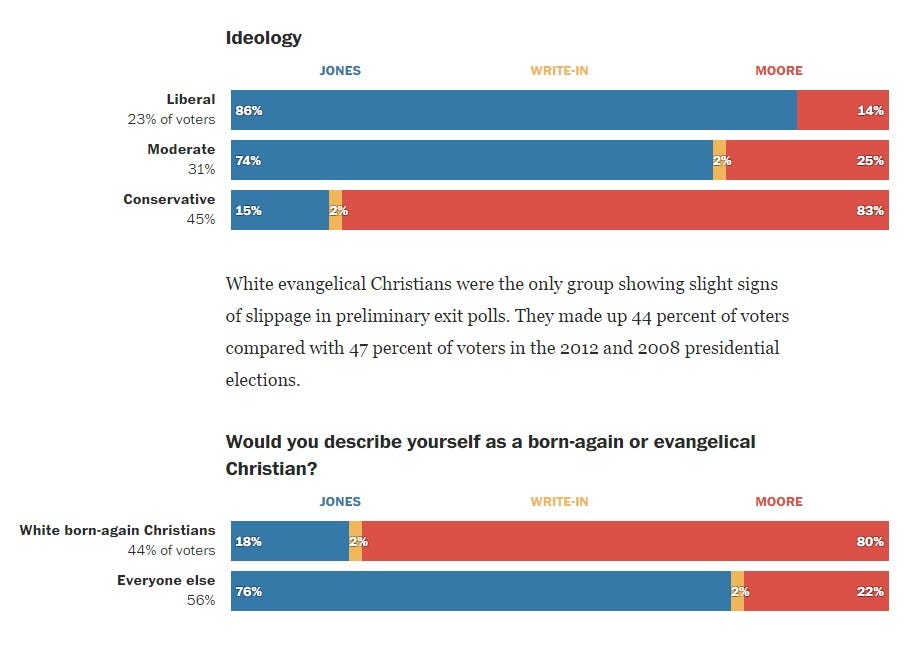
Last night Alabama elected a Democrat to a statewide office for the first time since the 90’s. That is sort of cool in its own right I suppose, but what particularly struck me about it is the demographic breakdown behind Doug  Jones’ victory, specifically the religious breakdown, and most specifically the behavior of self-identified Evangelical Christians. 
Whatever else comes out of the analysis (Here is the original Washington Post Analysis). There are two trends which really strike me today. If we take Moore’s loss as representative of a decline in the strength of Trump-ism over the last year (Nate Silver over at FiveThirtyEight make that pretty clear) then it seems to me that Trump-ism is on the decline (huzzah) and that despite its overall decline, it is hanging on most stubbornly among white self-identified Evangelicals. Again:
  1. 1. Trump-ism is deteriorating.
  2. 2. Trump-ism is deteriorating more slowly among white self-identified Evangelicals than it is in the general population.
This leads me to conclude that white Evangelicalism as an institution and an ideology is a healthy environment for Trump-sim.
From the Washington Post
Now I have already made the argument that Trump is pretty thoroughly anti-Jesus, so the implication here is that white Evangelicalism is a healthy environment to a determinedly anti-Christian element in the world. But I don’t think it is prudent to let this fact sit in isolation; I also want to point out that white Evangelicalism claims to reflect, and encourage growth in, the Way of Jesus.
So now we have a movement/ideology which specifically claims to follow Jesus and is simultaneously acting as an incubator for anti-christian activity and behavior.
At this point I think the relevant question is not so much “Is Evangelicalism corrupt?” that it is seems obvious. The question is more “How long should good Evangelicals keep fighting for Evangelicalism?” I honestly don’t know what the answer ought to be. I know my answer was to take what was good, the “Egyptian gold”, and leave.

Some final caveats

  1. I don’t think this means that individual white Evangelicals are themselves anti-christian; they have accepted a doctrine or ideology which, if left unchallenged and uncorrected, is going to incline them in that direction but there are many influences in any person’s life — their own will and character not the least — so many can and do resist it.
  2. I am aware that there are many sub-strands of white Evangelicalism and that many white Evangelicals are fighting valiantly to change at least some of the many broken and damaging elements in this ideology. I wish them the very best and if I had not broken with some basic tenets of Evangelicalism a while back I hope that I would be right there with them. Unfortunately I believe that this last year is evidence that they are currently losing that fight.

Friday, September 1, 2017

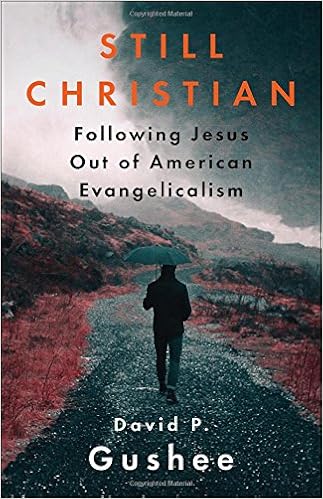
Book Review: Still Christian

I love it when I get to review books which I can recommend without hesitation or caveats and am glad to say that David Gushee's Still Christian: Following Jesus out of American Evangelicalism is one of them. This is a book which should be of interest to quite a few different people for different, if compatible, reasons. Before I get to that though, let me start by describing the book a little. Still Christian is in the format of a memoir, Gushee isn't trying to persuade his audience(s) to do much of anything other than maybe to be more aware of what Evangelicalism is, and how it has come to be what that. It is a fairly short memoir because it focuses with pretty laser-like intensity of the single story of the role of Evangelicalism within Gushee's life. Thus it isn't the sort of full-orbed analysis of Evangelicalism as a historical, social, theological phenomenon of the sort that we are all probably waiting for Mark Noll to write. Instead, this book is important because it will provide you with a narrative (and if you spent any part of the 80's, 90's, 00's or 10's as an Evangelical it will likely be a decidedly relate-able narrative) through which many of the beauties, thorns, and ultimately rot of evangelicalism can be more easily recognized.

In terms of style and readability, Gushee has a warm and winsome style and the book is tremendously easy to read. I blew through it in less than 48 hours (probably 4-5 hours of reading time over two evenings).

So who will benefit from and enjoy reading this book and why?

Ex-Evangelicals:

For those of us who grew up or spent significant time as evangelicals this book is incredibly easy to relate to and will almost certainly give you that "you are not alone" encouragement—particularly given Gushee's status as a Christian Ethicist and president of the Society of Christian Ethics and of the American Academy of Religion. Of course much of that has to do with shared experiences (his comfort with Evangelicalism was shaken by the "Women in Ministry" debate and by the Evangelical right's celebration of torture and his final break occurred over his affirmation of the full inclusion of LGBT folks), but it has a lot more to do with his carefully recorded process as he worked and lived through those experiences. Throughout the book he is unwaveringly gracious towards those with whom he has disagreed. Where people come across negatively he nearly always has something positive to say about them as well and even though Al Mohler does not come off especially well, he refuses to engage in any personal denouncement of him. Neo-Calvinism receives his single full-throated denouncement in chapter 7 Finding a Home and Leaving It  where, when discussing the various perspectives operating at Evangelical colleges (and specifically Union where he taught) he says:
This is my best chance to say that I believe the resurgence of a doctrinaire Calvinism in contemporary evangelicalism is among the most odious developments of the last generation. I abhor its version of God and most of its version of Christian ethics, and I believe it could only have emerged among relatively privileged, hyper-cognitive, compassion-challenged white men, as it has. But I digress
That passage stands out because it is such a total break with the otherwise irenic tone he takes throughout the book. I am not condemning him for including it, but thought the fact was worth pointing out.

I think what gave me hope in reading this was not just that I could identify so much with Gushee's experience, but that he seems to have managed to get through it with so little bitterness and so few scars.

Evangelicals:

I am frankly not quite certain whether evangelicals will enjoy reading this, I do know that those evangelicals who seek to be well informed will appreciate reading this. This is a memoir by someone who was one of you, who experienced the "tent" of Evangelicalism shrinking around him (though his ultimate exit did involve movement to a place you had told him you would not go), and who will describe to you, winsomely and charitably, what it was about you that has caused him to feel relief on leaving. Surely this is something Evangelicals want to know.

Successful organizations need to conduct exit interviews. When someone leaves them, if they do not take the time to find out why, they are almost certainly doomed to eventual collapse. This is a charitable and kind voice (though he doesn't pull punches either) who will tell you what is going on and will challenge you to think about your culture as well as your practices. I don't think the goal of this is to convince anyone to leave or stay within evangelicalism, but it is a vital perspective for anyone who wants to understand evangelicalism as it is today.

non-Evangelical Christians:

If you are not and have never been an Evangelical, you are likely nevertheless well aware of them. As one friend of mine put it: "The thing about Evangelicals is that they do things". For better or worse, Evangelicals have come to "represent" much of Christianity, or at least Protestantism, to the western world. While there are many great resources out there to help you understand the genesis and theology of evangelicalism (I have mentioned Mark Noll haven't I?) this book will be your best tool to date in understanding the experience of Evangelicalism from the inside. It is rare to get a reflections from someone who was so recently a member of a "tribe", is now excluded from that tribe, and is nonetheless, compassionate, gracious, and fair towards them. 

non-Christians:

Remember how 81% of Evangelicals (who voted) voted for Trump? If you think that understanding that dynamic is important to navigating the world. Or more broadly if you realize that political Evangelicalism is still a major power player in US politics and in globalizing culture, then you probably already know that it is important to have an accurate understanding of this group of people. This book will provide some stunning insights into what is really going on with that. It is, for you, serendipitous that Gushee is a professional ethicist as his perspective is one you will find particularly enlightening.

A Final Addendum on Fortuitous Timing

I can't think of it as anything but God-given grace that this book was released the same week as the Nashville Statement. Still Christian provides a lens on what is going on with the so called Council on Biblical Manhood and Womanhood, the Southern Baptist Convention, and the rest. It is no coincidence in my mind that Al Mohler figures prominently in both works (his is the seventh signature on the Nashville Statement). In Chapter 6 Finding a Voice While Not Losing a Soul Gushee recounts his experience with Mohler at Southern Seminary:
Al Mohler, only thirty-three years old when he was named president, turned out to be a relentless implementer of the conservative agenda for Southern Seminary. He was committed to purging any faculty who strayed from conformity to the seminary's doctrinal statement, elevating faculty voices that would take visible conservative stands on key culture-war issues, and moving the school to a traditionalist position on the top question of the moment—namely, whether the Bible permitted women to be ordained or to serve as pastors in local churches.
...
...a new policy came down from the administration, one that would change everything at Southern. At an epic, miserable faculty meeting, the president [Mohler] declared that those who believed that women should serve as pastors would no longer be hired, promoted, or tenured at Southern Seminary. While some details of this policy remained to be addressed, the implications were clear enough. A school that had, over the years, worked its way around to a largely egalitarian understanding of gender roles was now, by decree, overnight, a place that required faculty both to believe and to teach that Holy Scripture clearly bars women from the highest office of church leadership. Dissenting tenured faculty members might survive but probably ought to leave, untenured faculty members who held the now-erroneous belief had no future at the school, and no new faculty members would be hired who were egalitarian. 
This meant the end for pretty much all female faculty members. I vividly remember one of my younger female colleagues getting up from the meeting in which the policy was announced, running from the room, and throwing up in the hall. It's not every day that you are professionally executed by public decree. It just might make you physically ill. 
If that doesn't frame the context for the recently released Nashville Statement I don't know what does.

Wednesday, July 19, 2017

5 Good Books Which Will Challenge Your Conservative Evangelicalism

In reading Chesterton, as in reading MacDonald, I did not know what I was letting myself in for. A young man who wishes to remain a sound Atheist cannot be too careful of his reading. There are traps everywhere—"Bibles laid open, millions of surprises," as Herbert says, "fine nets and stratagems." God is, if I may say it, very unscrupulous.
- C.S. Lewis, Surprised by Joy
Writing as someone who has traversed the bridge from Solidly Evangelical to, well, not (I identify as a Charismatic Anabaptist) I thought it might be fun annotating a list of books which, once read, are likely to ease a person's transition out of Evangelicalism (of the American and White variety) and into some other form of Christianity. As such, this isn't a list of books by the "New Atheists" but a list of books by authors who operate in and around the edges of Conservative American Evangelicalism and who are all dedicated Christians.

Of course there are millions of Evangelicals (and I am using the term to designate those culturally conservative Christians in America who self-identify as Evangelical and have, in recent history been associated with right-wing politics) who who have read and appreciated these books, they don't have any mysterious power to rip the evangelicalism out of someone. What they do, and do well, is fuzz the (mostly cultural) boundaries which have been set up around American white Evangelicalism. Not challenging any of the basic tenets of the faith (the authors are all robustly Nicene or, as Lewis would have said, "Mere" Christians) allowing alert and critical readers the realization that God is, indeed, moving powerfully out there

The Great Divorce by C.S. Lewis

'Ye can know nothing of the end of all things, or nothing expressible in those terms. It may be, as the Lord said to the Lady Julian, that all will be well, and all will be well, and all manner of things will be well. But it's ill talking of such questions.'
'Because they are too terrible, Sir?'
'No. Because all answers deceive. If ye put the question from within Time and are asking about possibilities, the answer is certain. The choice of ways is before you. Neither is closed. Any man may choose eternal death. Those who choose it will have it. But if ye are trying to leap on into eternity, if ye are trying to see the final state of all things as it will be (for so ye must speak) when there are no more possibilities left but only the Real, then ye ask what cannot be answered to moral ears. Time is the very lens through which ye see—small and clear, as men see through the wrong end of a telescope—something that would otherwise be too big for ye to see at all. That thing is Freedom: the gift whereby ye most resemble your Maker and are yourselves parts of eternal reality. 

Nobody ever really warned me about C.S. Lewis back when I was an Evangelical. In fact, throughout my childhood and through college he remained something of a hero among Evangelicals of my stripe. Mere Christianity (having been instrumental in the conversion of so many Baby Boomers) was, and still is, revered as am Evangelical classic.

I, like many others, first encountered Lewis through The Chronicles of Narnia and later his Space Trilogy and The Screwtape Letters. I started to read his apologetic and theological works in college and moved on to his Literary theory while working on my masters. I remain an enormous fan. There are, to my mind, few authors of the 20th century who possess the lucidity of thought, keenness of intellect, and sheer creativity that Lewis demonstrates in so many of his works—academic or fictional.

Of course Lewis himself was an Anglican, not an Evangelical and his writing doesn't back down from that, so it shouldn't be surprising that reading and agreeing with Lewis will have the tendency of moving someone's "center" away from Evangelicalism and towards something more like "mere" Christianity. All the same, I don't know that there are any of his works which will prove more challenging to the Evangelicalism of a person, than The Great Divorce. The book is a fictional supposal in which Lewis goes on a bus ride to the outskirts of heaven where he encounters a series of individuals being given the opportunity to stay and flourish. The book is a masterwork of theological psychology as Lewis uses it to examine our reasons for resisting a Very Good God, the reasons a person might choose their own misery over infinite joy. Critical to our purposes here however, the conversations the fictional Lewis has with his "Master" George MacDonald, will do much to gently yet firmly undermine a good Evangelical's confidence in doctrines like eternal damnation. It isn't perfect (it contains a little too much of neo-Platonism to my mind) but it is both good and powerful.


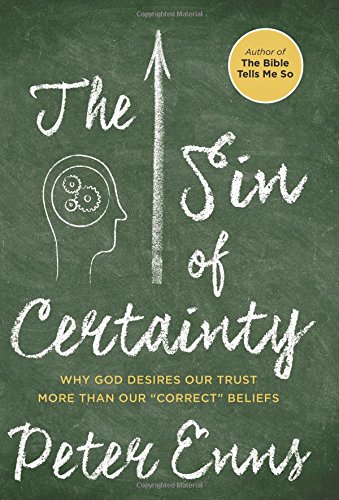
The Sin of Certainty by Pete Enns

Correct thinking provides a sense of certainty. Without it, we fear that faith is on life support at best, dead and buried at worst. And who wants a dead or dying faith? So this fear of losing a handle on certainty leads to a preoccupation with correct thinking, making sure familiar beliefs are defended and supported at all costs. How strongly do we hold on to the old ways of thinking? Just recall those history courses where we read about Christians killing other Christians over all sorts of disagreements about doctrines few can even articulate today. Or perhaps just think of a skirmish you’ve had at church over a sermon, Sunday-school lesson, or which candidate to vote into public office. Preoccupation with correct thinking. That’s the deeper problem. It reduces the life of faith to sentry duty, a 24/7 task of pacing the ramparts and scanning the horizon to fend off incorrect thinking, in ourselves and others, too engrossed to come inside the halls and enjoy the banquet. 
This book is specifically targeted at one of the great fetishes of Evangelicalism: The conviction that certainty = faith and that the basic duty of  a good Christian is to police a particular set of propositions. I think the first attack God mounted on this stronghold in my life was through the Catholic Philosopher Peter Kreeft who once remarked on how bizarre (and un-biblical) it was to think that one had to pass a theology exam in order to get into heaven. Enns writes in a conversational, confessional style and his own commitment to God and his love of the Bible come through clearly. This book makes the list specifically because it is not the sort of book that an Evangelical who reads it will be able to dismiss as having been written by someone without a deep trust in God. Enns' life and reasoning work together to force the reader to take him seriously. Then, once he is taken seriously, the arguments cut winsomely and incisively right at the heart of the "salvation by correct-thoughts-alone" heresy.


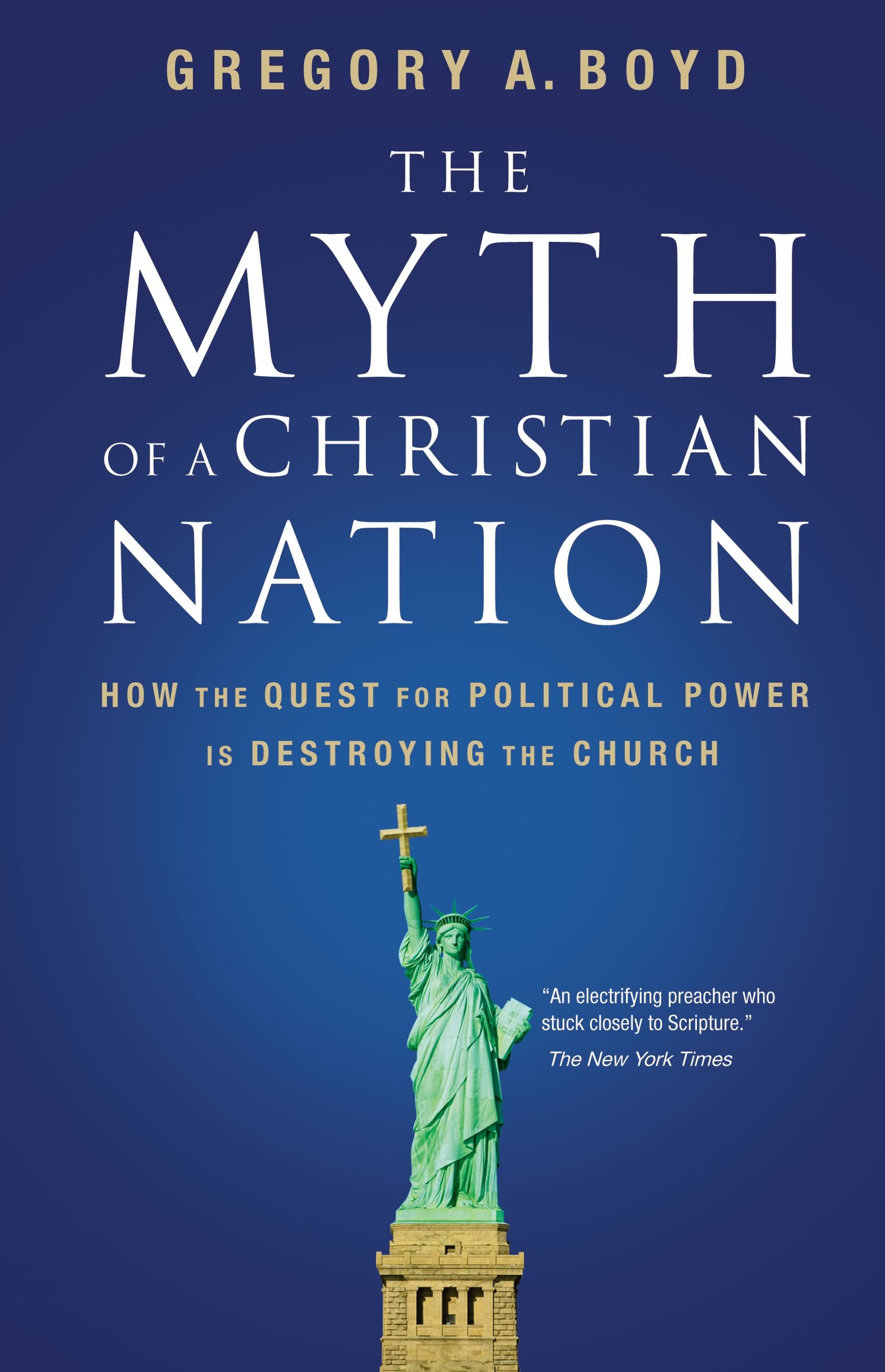
The Myth of a Christian Nation by Greg Boyd

Consider these questions: Did Jesus ever suggest by word or example that we should aspire to acquire, let alone take over, the power of Caesar? Did Jesus spend any time and energy trying to improve, let alone dominate, the reigning government of his day? Did he ever work to pass laws against the sinners he hung out with and ministered to? Did he worry at all about ensuring that his rights and the religious rights of his followers were protected? Does any author in the New Testament remotely hint that engaging in this sort of activity has anything to do with the kingdom of God? The answer to all these questions is, of course, no.
What Lewis does to the Evangelical doctrine of hell, and Enns does to the salvation-by-correct-thoughts-alone doctrine, Boyd does to the civil religion endemic to so much of white Evangelicalism in America today. Like the previous two authors, Boyd is a committed Christian (and a Charismatic to boot). He takes the Bible seriously and Jesus even more so, he is committed to spreading the Gospel, and speaks, fluently, the language of Evangelicalism—he has even written a book of personal apologetics: Letters From a Skeptic: A Son Wrestles with his Father's Questions about Christianity.

Meanwhile, this book is an axe at the root of the tree of civil religion. In it, Boys works with both narrative and lucid argument to demonstrate that the Kingdom of God, as Jesus and Paul taught about it throughout the New Testament, is utterly different from governments as we understand them. He cuts right thought the false equation of "Good Christianity" with "Patriotism", carefully distinguishing this world's power over approach from Jesus' power under. 


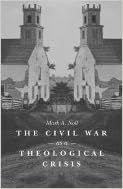
The Civil War as Theological Crisis by Mark Noll

The Book that made the nation was destroying the nation; the nation that had taken to the Book was rescued not by the Book but by the force of arms.
It is worth stating up front that Noll is an Evangelical Christian with all of the Evangelical bona fides—a Wheaton College graduate, and later professor who has taught at Notre Dame and is currently at Regent—because this book will feel far more challenging to many Evangelicals than several of the previous ones. It doesn't so much challenge a particular belief of pillar of Evangelicalism as it does shake a basic conceit. When I was an Evangelical I held on hard to the belief that people who worked hard to interpret the Bible, so long a they worked at it in good faith, would arrive at the same, correct, conclusion. This book holds an almost painfully revealing mirror up to that conceit by examining the theological crisis among Evangelicals who lived up to and during the American civil war (yes there is some important historical difference between them and the Evangelicals of today). Noll's history is alarmingly reminiscent of the sorts of theological arguments Evangelicals are having today and most troublingly (to the Evangelical mind) it was the thinkers and pastors who were arguing for slavery—either as a necessary evil or as an outright good—who most clearly map onto the Evangelicals of today. They were the one's arguing for the "plain meaning of Scripture" they were the ones who accused their theological opponents of obfuscation-through-nuance. The Evangelical who reads this book will begin to find herself more and more nonplussed and eventually disturbed by the sort of arguments she sees her Evangelical compatriots making when they argue about the "hot button issues" facing the church today.


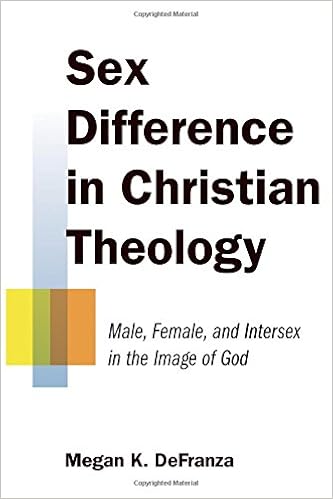
Sex Difference in Christian Theology by Megan DeFranza


We need to say, is Genesis giving us Adam and Eve as the ideal for all times and places? Or are we bringing those assumptions to the text? I think, too, about racial difference. If we're trying to get back to Adam and Eve, we'll lose racial difference. And yet we don't just have Genesis. We have a whole canon that ends with this glorious vision of every tribe and language and nation gathered before the throne and worshiping. We have racial difference, not in Eden, but in the new creation. I think we're trying to ask too much of Genesis 1, 2, and 3 to give us all of God's blueprint for a good creation and anything that doesn't fit there is a result of the fall. I think that's a false reading. I think it's the beginning of the story, but there's so much more that God has done in the scriptures and in creation that we need to consider.
Like Noll, Megan DeFranza checks all of the Evangelical boxes. She grew up in a conservative Evangelical context, managed a couple of masters (Theology and Biblical Languages) at Gordon-Conwell before getting he Ph.D. in Religious studies, and speaks fluent Evangelicalese. She understands her current calling to be bridge-building between conservatives and intersex people. And yet this book smashes headlong into nearly all of the basic Evangelical assumptions about the nature of sex and gender. Sex Difference in Christian Theology meticulously examines the current science on how bodies are formed and what contributes to the ways in which doctors and scientists assign gender and sex labels to individual persons, and in that light critically (using fully approved Evangelical exegetic techniques) examines the witness of the Bible concerning gender and sex. The result for an Evangelical who reads the book with an open, yet still critical, mind is likely to be the crumbling, not of the book, but of his own understanding of what the Bible does and does not actually have to say about the meaning of physical sex and about gender. Having been disarmed by her passion and care for Scripture, the Evangelical will soon be alarmed to discover just how many of his beliefs on this subject were little more than assumptions—and weak assumptions at that.

How about you?

Are there any books you would like to add to the list. Leave them in the comments section together with a brief explanation.