Having finished Solus Jesus: A Theology of Resistance I found myself feeling massively encouraged about the future of post-Evangelical Christianity in the United States. Ken Wilson and Emily Swan have written a book which focuses far more on how to move forward than it does on what was wrong with the way "we used to think about things". Not that there isn't anything wrong with doing the latter (critique—prophetic or otherwise—is important), but it is just as important to start actually going somewhere once we decide to leave behind what we have found to be broken.
For many ex-Evangelicals, the process of breaking ties with American White Evangelicalism is two-fold: there is the breaking away from and also the clinging to. The "breaking away from" part is pretty straight forward and much discussed these days. White Evangelicalism in the United States has (despite the heroic efforts of many outstanding Christians) aligned itself with forces of authoritarianism, racism, and exclusion, forces that (to borrow from this book's observations) align more often with oppression rather than with the oppressed. All this is well documented and properly discussed. But it is never enough to know that you are not part of a thing, and many of us who have left Evangelicalism remain deeply committed to Jesus and his Way. The first great joy of Solus Jesus for me is that it proposes a vision of what next might look like for us—more than being a book which calls us to leave or fix the broken thing, it is a vision for what is (and I will say always was) better.
This is a book I have been looking forward to since I first heard that Ken Wilson and Emily Swan, the co-pastors of Blue Ocean Faith Ann Arbor, were working on it. I have already done some writing on how the concept of Solus Jesus has been of significant benefit to my theology and life as a whole, so it should not be surprising to hear that I was thrilled. There is a LOT going on in this book. It certainly did not disappoint, but it did surprise me—in a remarkably encouraging way.
When I sat down to read Solus Jesus: A Theology of Resistance, I was expecting an extended explanation and defense of what Blue Ocean Faith people mean when they talk about the concept. As someone who has been hanging around the fringes of the Blue Ocean Faith community (and cheering it on) for a while now, I was already familiar with the idea in broad terms. Essentially Solus Jesus is a riff on, and reaction to, the reformation credo "Sola Scriptura". Inspired by Phyllis Tickle's suggestion that the Church, guided by the Holy Spirit, will begin to work in a fresh paradigm every five hundred years or so, Solus Jesus recommends a decentering of the Bible as a source of certainty and instead placing our confidence in the person of Jesus Christ. Ken Wilson and Emily Swan are both post-Evangelicals who were put through the ringer by the Evangelical "machine" over the issue of full LGBTQ+ inclusion (Ken Wilson tells the story of this in his previous book A Letter to My Congregation). It was probably for that reason, as well as the general timeliness of the subject, that I expected this book to be that defense and explanation.
It turns out that the vision Swan and Wilson had for their book was much bigger than mine. While there is some defense of the concept (I found Chapter 4: In Defense of Experience—Wilson and Chapter 5: The age of the Spirit—Swan particularly helpful here) the greater portion of the book is devoted to a theological and practical working out of what Solus Jesus can look like in the contemporary world. In essence, the authors delivered to my expectation in Part 1 (Solus Jesus) of the book, and then went well beyond, bringing the titular concept into conversation with Girardian scapegoat theory to recommend a more developed and ambitious theology in Part 2 (A Theology of Resistance), and then working though some of what an application of this theology might look like if implemented by the contemporary Church in Part 3 (A New Way Forward). While all three cohere nicely and the chapters all build effectively on one another, each part really could have been its own work. In fact, the only critique I can think of for this book is that I would have really enjoyed a bit more of each section, so maybe a trilogy would have worked well.
Both Swan and Wilson have engaging and complementary writing styles and they are both up-front with their backgrounds and perspectives. As a result, Solus Jesus is both accessible on a popular level and "challenging and thought provoking" as a book of theology. The co-authorship takes the form of independently written chapters with Wilson and Swan each writing from their respective strengths.
In terms of the actual ideas presented, Solus Jesus represents a serious candidate for a Girardian post-evangelical (and possibly renewed mainline Protestant) theology. Taking the title to represent the two major themes of the book in conversation: First Solus Jesus as a re-centering of Jesus and de-centering of the Bible-as-source-of-certainty in the life of the Christain, then A Theology of Resistance built on the foundation of Solus Jesus and complimented by Girardian mimetic and scapegoat theory. In both cases, Swan and Wilson come across far more as offering, than as arguing, their ideas.
The Solus Jesus thesis is grounded, not in a rejection of the Bible as such, but in a rejection of the Bible as a source of certainty, first, because certainty isn't turning out to be a realistic demand, and second because the Bible itself points more to Jesus of Nazareth than to its self as a source for confidence. While the book does lay out a case for this, it strikes me that Wilson and Swan are writing this book at a time when the evangelical (and post-evangelical) case against rigid understandings of Biblical authority and infallibility have already been made (Pete Enns' The Sin of Certianty is both referenced and relevant here). Swan and Wilson are, I suspect, largely done with attempting to justify their Christianity to the Evangelical machine and have moved on to offer their insights to those who are already searching for something more.
So, too, with their Theology of Resistance. Swan and Wilson waste almost no time attacking or critiquing existing Evangelical theologies of ethics, politics, and atonement beyond sharing a few of their own helpful stories of times and ways in which those theologies came up short for them in the past. Instead, the authors work to interpret much of the (particularly Western) Church's crisis of being and failure through the lens of Girardian mimetic and scapegoat mechanics. While I don't find Girard to provide any sort of perfect, comprehensive model for human behavior or a theology of the atonement (nor do Swan and Wilson claim that he does), I was impressed with how well the model fit both the atonement and as an explanation for the repeated failure of the Church to take the side of justice as it has interacted with an unjust society throughout history. In line with the aphorism "all models are wrong, but some are useful", Solus Jesus: A Theology of Resistance demonstrates clearly that Girard's is a useful model in understanding God's actions in the world and through the church.
Ultimately I found Solus Jeusus: A Theology of Resistance both satisfying and challenging in all of the best ways, and I sincerely hope that it will have a place in determining the direction that post-evangelicalism will take at this juncture in history—it certainly deserves to.
Search This Blog
Showing posts with label Pete Enns. Show all posts
Saturday, July 28, 2018
Friday, May 18, 2018
Deconstructing as a Legacy of Modernism
As a heads up this is a particularly in-the-weeds post about my relationship with exEvangelicalism and some of the minutia of Christian theology in the United States.
In contrast to that, the enlightenment model worked far more carefully to examine each proposition for it's truth value before incorporating it into the model as seamlessly as possible (imagine building a stone wall). The goal for any proposition was indubitability, (un-doubt-able-ness) arguably the highest bar for confidence we, as a species, have managed to devise. In fact, indubitability turns out to be an impossible bar—though many Enlightenment thinkers managed to stay in denial about that for several hundred year—but it has remained as the sort of "gold standard" or aspiration for people who build their understanding of reality under the influence of enlightenment modernism. For Evangelical Christians, the Bible worked dangerously well as a source of indubitable "knowledge". The only catch was that the Bible is not indubitable in and of itself—billions of people manage to doubt it every day—so it can only serve as an indubitable truth-source by an act of trust or a white-knuckled act of the will. As children who were raised in churches, we trusted the adults who just told us that the "Bible is true" and, for a time, that enabled us to treat it as a source of indubitablity. But as we grew we eventually faced the challenge of working out for ourselves just what it was that made the Bible indubitable. In my experience the answer comes down, not to an explanation but to the command to "not doubt". We are told that doubting the Bible is a sin and we might (or might not) be pointed towards some thinker or other who has scraped together an apologetic defense of the doctrine of inspiration (which can temporarily alleviate the tension but doesn't actually solve the problem in the long run). This amounts to the "white-knuckled act of the will" approach which cannot last.
Stories of deconstruction are a pretty solid way to get a blog post to go viral on the Christian internet these days. The haters (mostly conservative white Evangelicals) get to hate and break down your story into a million little warnings about the danger of doubt, Progressive Christians cheer you on and leap to your defense (sometimes after a little checking to make sure that you aren't harboring any problematically oppressive views which you haven't quite managed to deconstruct away just yet) and and since nothing drives site hits so much as controversy, your blog stats spike nicely. If you are really lucky you might even get invited to do a podcast with one of the more influential progressive Christian conversation leaders.
All of that probably sounds cynical so let me follow with this: aside from the vitriol which tends to work its way into these things, I think this is a really good thing and a natural outgrowth of the desperate need so many Christian and Christian-adjacent people in the US have to know that they are not alone, aren't insane, and aren't going to hell because of their doubts, thoughts, and concerns. I do not think it would be accurate to classify white Evangelicalism as a cult, but I do think that it has in common with cults, the need for those who are trying to leave it to find a way to deprogram ourselves from ideas and thinking patterns which are so ingrained that they still shape our lives and reactions even though we no longer accept them on a cognitive level. "My Deconstruction" stories can be really helpful towards that end—which is probably also why Conservative Evangelical leaders make such a point of attacking them and the people who pen them.
All of that said, I don't have a deconstruction story. Or at least, if I do, I certainly didn't experience my own story in a way that felt particularly like deconstruction to me. It mostly felt like growth. And yet, I get asked about my deconstruction and the people whose theology and life/faith experiences I identify most closely with are people who speak fairly regularly about their deconstructions. I was raised in solidly conservative white US Evangelicalism. There were a few quirks (and, as I will point out later, they were pretty important) but on the whole I can tell an honest and accurate version of my childhood which fits the deconstruction narrative really well.
I have attended Evangelical churches my entire life*. I was home schooled in elementary, at least in part to protect me from the "New Age agenda" (look it up); I attended a Christian private school; my parents were part of a church start-up/planting team; I attended a conservative southern Bible College, I have—on more than one occasion—thrown away collections of "secular" media; I debated classmates and teachers as a staunch young-earth creationist; there is a picture of my still floating around the internet wearing a "straight pride" t-shirt while attending a Christian music festival (LGBTQ+ friends, I am so sorry for that); the list could go on and on. Now I could probably be accurately described as a Progressive Christian (I am a Charismatic Anabaptist and my politics are unorthodox but that term probably fits better than any other) so how did I transition from the one to the other without a deconstruction?
I think the answer lies in the way I understand the project of understanding reality—I have tended towards a more pre-modern than enlightenment modernist approach to understanding the world. I could be very wrong here and I would love to get feedback from people who have gone through a deconstruction (and maybe their own reconstruction process?) to let me know whether I have understood y'all's experience accurately, but my impression is that—for a lot of folks—deconstruction is a bit like messing with a house of cards. Over time, they start to worry more and more that some aspect or tenet of their faith may not be all that accurate. This leads to a period (short or long) wherein they are internally wrestling with whether or not it is "safe" to examine that bit of their faith structure. The worry frequently seems to be based on a conviction that all the parts of their faith need all the other parts of their faith. This often seems to be related to their understanding of the Bible and its relationship to the truth value of much or all of their understanding of reality as a whole. White US Evangelicalism deeply inculcates its adherents with the conviction that the Bible accurately describes reality. If a proposition contradicts "the Bible" then it is necessarily wrong and the job of good intellectual Christians becomes finding a way to demonstrate that wrongness. Of course there are many, many problems with this approach to understanding realty (the Bible is a text which needs to be interpreted, there is no structure for determining an "absolute" interpretation of the Bible, the Bible doesn't actually speak about every aspect of reality etc...) but that hasn't deterred its near-total integration into the very meaning of Evangelical.
Back to the house of cards.
Eventually, the person in question will either repress their concerns, avoid a deconstruction, and go back to being a good (if somewhat defensive) Evangelical or they will bite the bullet and take a good hard look at the tenet which was giving them all the trouble. In my experience—and this is part of what makes being in a supportive relationship with doubting Evangelicals so tense—they almost always find that they can't really support a continued adherence to the tenet they are examining. Whether it is young earth creationism, LGBTQ+ exclusion, gender complimentarity, a particular reading of the "texts of terror", the historicity of the exodus, the authorship of Isaiah, or something else entirely, a doubt which had to be so painfully resisted almost always turns out to be a pretty legitimate doubt. This then seems to usually presage entry into "full deconstruction". It doesn't always, some folks (and I suspect that this has a lot to do with the specifics of the denomination and the tenet in question) manage to maintain themselves as slightly unorthodox Evangelicals but it seems that often the removal of the this tenet starts a cascade of other tenets the total removal and examination of which amounts to what Progressive Christians seem to be talking about when they talk about their deconstruction: a semi-systematic examination of much of their worldview with a subsequent rejection of many aspects of it.
Or, at least, that is how it is often described. In fact (and I want to say that I think that this is inevitable given basic human psychology) it often seems to mean the systematic examination of a number of tenets of Evangelical faith followed by a reidentification on the part of the deconstructor as an ex-evangelical (or possibly as an agnostic or atheist) once a critical mass of tenets is reached. For some folks I know that critical mass has been a single tenet (young earth creationism), for others it took more that ten to reach the critical mass. However it goes though, the effect is that the person who is "going through the deconstruction" eventually rejects much of the structure and content of their previous faith. Depending on what is left afterwards (and this varies significantly but that is probably a subject for another post) the person may or may not follow this by a period of reconstruction in which they carefully build a new structure incorporating what survived the deconstruction.
As best as I have been able to observe, all of that describes a fairly "typical" deconstruction process**. The thing is, it doesn't really describe the process by which I moved from there to here and after years of wondering about it, I finally have a theory. I think it has a lot to do with how we think about reality. I will take it as a matter of agreement that humans like certainty. We like to know and be confident about how things are. I am sure that psychologists have a lot of explanations for why—I am partial to the view that feeling certain about how things are gives us a sense of control and security—but at the end of the day it seems clear that we do. We also tend to cluster in ideologically homogeneous communities. As a result I suspect (and my conversations with many of my friends who go through deconstruction have borne this out) that we tend to build ideological structures which are both extremely strong, and extremely brittle. They are strong insofar as they are really resistant to change once they "set" and they are brittle insofar as the removal of any one part of them tends to represent a threat to the entire structure.
That approach, the strength and the brittleness are, I think, representative of the great strength and
brittleness of western enlightenment modernism as a whole. Before the enlightenment, Western society tended to understand reality in terms of a great, intricate, complex, yet fluid structure (imagine a chandelier or a symphony). Premodern society tended to understand reality in terms of stories, music, and logic. When some new proposition was presented to a pre-modern thinker and accepted as true, the thinker would then cheerfully insert that proposition into the edifice which was their model of reality and then get to work tweaking assumptions, re-telling stories, and re-tuning harmonies, until the whole thing came back into some sort of resonance. When presented with evidence or argument that a previously accepted proposition was actually false, that proposition would be removed and the removal would necessitate years of discussion, argumentation, and re-interpretation in order to be re-tuned back to a resonant state.
In contrast to that, the enlightenment model worked far more carefully to examine each proposition for it's truth value before incorporating it into the model as seamlessly as possible (imagine building a stone wall). The goal for any proposition was indubitability, (un-doubt-able-ness) arguably the highest bar for confidence we, as a species, have managed to devise. In fact, indubitability turns out to be an impossible bar—though many Enlightenment thinkers managed to stay in denial about that for several hundred year—but it has remained as the sort of "gold standard" or aspiration for people who build their understanding of reality under the influence of enlightenment modernism. For Evangelical Christians, the Bible worked dangerously well as a source of indubitable "knowledge". The only catch was that the Bible is not indubitable in and of itself—billions of people manage to doubt it every day—so it can only serve as an indubitable truth-source by an act of trust or a white-knuckled act of the will. As children who were raised in churches, we trusted the adults who just told us that the "Bible is true" and, for a time, that enabled us to treat it as a source of indubitablity. But as we grew we eventually faced the challenge of working out for ourselves just what it was that made the Bible indubitable. In my experience the answer comes down, not to an explanation but to the command to "not doubt". We are told that doubting the Bible is a sin and we might (or might not) be pointed towards some thinker or other who has scraped together an apologetic defense of the doctrine of inspiration (which can temporarily alleviate the tension but doesn't actually solve the problem in the long run). This amounts to the "white-knuckled act of the will" approach which cannot last.
Footnotes:
*With the exception that I am currently attending (and a member of) a wonderful open and affirming Mennonite church.
**I want to clarify that nearly every person I know who has been through this process would not want to use the term "typical" to describe their experience. It is a journey which requires significant personal and intellectual courage and I have great respect for those friends of mine who have been able to manage it regardless of where they "ended up".
Resources;
When it comes to facing the importance of doubt I would recommend. Pete Enns' The Sin of Certainty and The Bible Tells Me So as well as Greg Boyd's Benefit of the Doubt.
Wednesday, July 19, 2017
5 Good Books Which Will Challenge Your Conservative Evangelicalism
In reading Chesterton, as in reading MacDonald, I did not know what I was letting myself in for. A young man who wishes to remain a sound Atheist cannot be too careful of his reading. There are traps everywhere—"Bibles laid open, millions of surprises," as Herbert says, "fine nets and stratagems." God is, if I may say it, very unscrupulous.
- C.S. Lewis, Surprised by Joy
Writing as someone who has traversed the bridge from Solidly Evangelical to, well, not (I identify as a Charismatic Anabaptist) I thought it might be fun annotating a list of books which, once read, are likely to ease a person's transition out of Evangelicalism (of the American and White variety) and into some other form of Christianity. As such, this isn't a list of books by the "New Atheists" but a list of books by authors who operate in and around the edges of Conservative American Evangelicalism and who are all dedicated Christians.
Of course there are millions of Evangelicals (and I am using the term to designate those culturally conservative Christians in America who self-identify as Evangelical and have, in recent history been associated with right-wing politics) who who have read and appreciated these books, they don't have any mysterious power to rip the evangelicalism out of someone. What they do, and do well, is fuzz the (mostly cultural) boundaries which have been set up around American white Evangelicalism. Not challenging any of the basic tenets of the faith (the authors are all robustly Nicene or, as Lewis would have said, "Mere" Christians) allowing alert and critical readers the realization that God is, indeed, moving powerfully out there.
The Great Divorce by C.S. Lewis
'Ye can know nothing of the end of all things, or nothing expressible in those terms. It may be, as the Lord said to the Lady Julian, that all will be well, and all will be well, and all manner of things will be well. But it's ill talking of such questions.'
'Because they are too terrible, Sir?'
'No. Because all answers deceive. If ye put the question from within Time and are asking about possibilities, the answer is certain. The choice of ways is before you. Neither is closed. Any man may choose eternal death. Those who choose it will have it. But if ye are trying to leap on into eternity, if ye are trying to see the final state of all things as it will be (for so ye must speak) when there are no more possibilities left but only the Real, then ye ask what cannot be answered to moral ears. Time is the very lens through which ye see—small and clear, as men see through the wrong end of a telescope—something that would otherwise be too big for ye to see at all. That thing is Freedom: the gift whereby ye most resemble your Maker and are yourselves parts of eternal reality.
Nobody ever really warned me about C.S. Lewis back when I was an Evangelical. In fact, throughout my childhood and through college he remained something of a hero among Evangelicals of my stripe. Mere Christianity (having been instrumental in the conversion of so many Baby Boomers) was, and still is, revered as am Evangelical classic.
I, like many others, first encountered Lewis through The Chronicles of Narnia and later his Space Trilogy and The Screwtape Letters. I started to read his apologetic and theological works in college and moved on to his Literary theory while working on my masters. I remain an enormous fan. There are, to my mind, few authors of the 20th century who possess the lucidity of thought, keenness of intellect, and sheer creativity that Lewis demonstrates in so many of his works—academic or fictional.
Of course Lewis himself was an Anglican, not an Evangelical and his writing doesn't back down from that, so it shouldn't be surprising that reading and agreeing with Lewis will have the tendency of moving someone's "center" away from Evangelicalism and towards something more like "mere" Christianity. All the same, I don't know that there are any of his works which will prove more challenging to the Evangelicalism of a person, than The Great Divorce. The book is a fictional supposal in which Lewis goes on a bus ride to the outskirts of heaven where he encounters a series of individuals being given the opportunity to stay and flourish. The book is a masterwork of theological psychology as Lewis uses it to examine our reasons for resisting a Very Good God, the reasons a person might choose their own misery over infinite joy. Critical to our purposes here however, the conversations the fictional Lewis has with his "Master" George MacDonald, will do much to gently yet firmly undermine a good Evangelical's confidence in doctrines like eternal damnation. It isn't perfect (it contains a little too much of neo-Platonism to my mind) but it is both good and powerful.
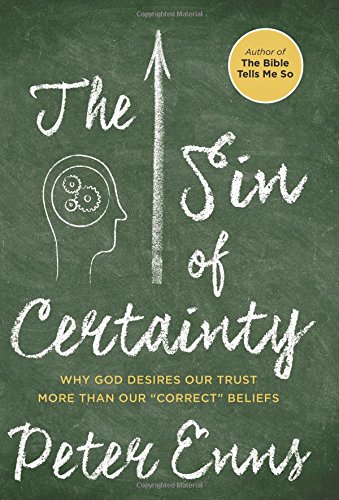
The Sin of Certainty by Pete Enns
This book is specifically targeted at one of the great fetishes of Evangelicalism: The conviction that certainty = faith and that the basic duty of a good Christian is to police a particular set of propositions. I think the first attack God mounted on this stronghold in my life was through the Catholic Philosopher Peter Kreeft who once remarked on how bizarre (and un-biblical) it was to think that one had to pass a theology exam in order to get into heaven. Enns writes in a conversational, confessional style and his own commitment to God and his love of the Bible come through clearly. This book makes the list specifically because it is not the sort of book that an Evangelical who reads it will be able to dismiss as having been written by someone without a deep trust in God. Enns' life and reasoning work together to force the reader to take him seriously. Then, once he is taken seriously, the arguments cut winsomely and incisively right at the heart of the "salvation by correct-thoughts-alone" heresy.Correct thinking provides a sense of certainty. Without it, we fear that faith is on life support at best, dead and buried at worst. And who wants a dead or dying faith? So this fear of losing a handle on certainty leads to a preoccupation with correct thinking, making sure familiar beliefs are defended and supported at all costs. How strongly do we hold on to the old ways of thinking? Just recall those history courses where we read about Christians killing other Christians over all sorts of disagreements about doctrines few can even articulate today. Or perhaps just think of a skirmish you’ve had at church over a sermon, Sunday-school lesson, or which candidate to vote into public office. Preoccupation with correct thinking. That’s the deeper problem. It reduces the life of faith to sentry duty, a 24/7 task of pacing the ramparts and scanning the horizon to fend off incorrect thinking, in ourselves and others, too engrossed to come inside the halls and enjoy the banquet.
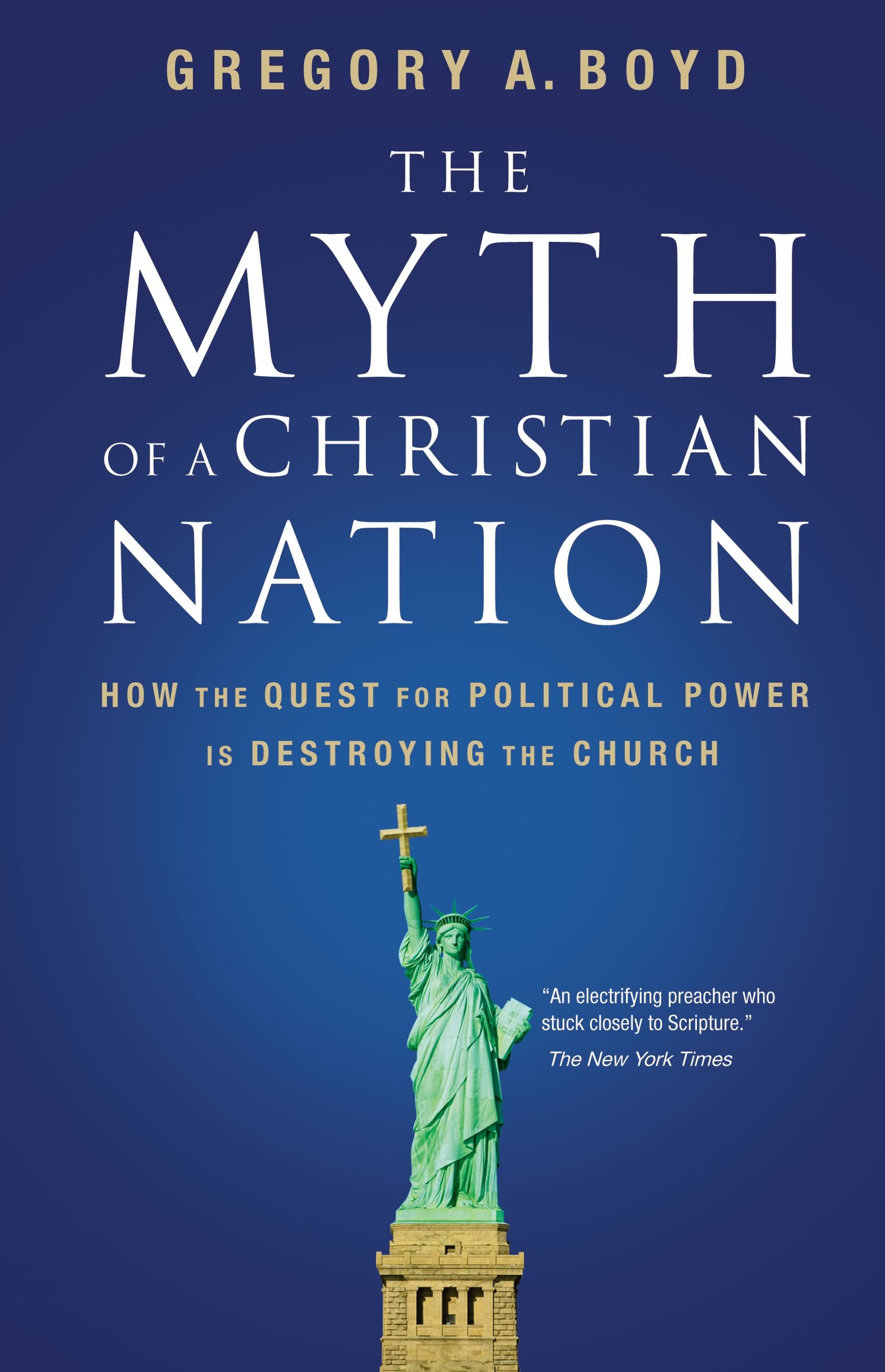
The Myth of a Christian Nation by Greg Boyd
What Lewis does to the Evangelical doctrine of hell, and Enns does to the salvation-by-correct-thoughts-alone doctrine, Boyd does to the civil religion endemic to so much of white Evangelicalism in America today. Like the previous two authors, Boyd is a committed Christian (and a Charismatic to boot). He takes the Bible seriously and Jesus even more so, he is committed to spreading the Gospel, and speaks, fluently, the language of Evangelicalism—he has even written a book of personal apologetics: Letters From a Skeptic: A Son Wrestles with his Father's Questions about Christianity.Consider these questions: Did Jesus ever suggest by word or example that we should aspire to acquire, let alone take over, the power of Caesar? Did Jesus spend any time and energy trying to improve, let alone dominate, the reigning government of his day? Did he ever work to pass laws against the sinners he hung out with and ministered to? Did he worry at all about ensuring that his rights and the religious rights of his followers were protected? Does any author in the New Testament remotely hint that engaging in this sort of activity has anything to do with the kingdom of God? The answer to all these questions is, of course, no.
Meanwhile, this book is an axe at the root of the tree of civil religion. In it, Boys works with both narrative and lucid argument to demonstrate that the Kingdom of God, as Jesus and Paul taught about it throughout the New Testament, is utterly different from governments as we understand them. He cuts right thought the false equation of "Good Christianity" with "Patriotism", carefully distinguishing this world's power over approach from Jesus' power under.
The Civil War as Theological Crisis by Mark Noll
It is worth stating up front that Noll is an Evangelical Christian with all of the Evangelical bona fides—a Wheaton College graduate, and later professor who has taught at Notre Dame and is currently at Regent—because this book will feel far more challenging to many Evangelicals than several of the previous ones. It doesn't so much challenge a particular belief of pillar of Evangelicalism as it does shake a basic conceit. When I was an Evangelical I held on hard to the belief that people who worked hard to interpret the Bible, so long a they worked at it in good faith, would arrive at the same, correct, conclusion. This book holds an almost painfully revealing mirror up to that conceit by examining the theological crisis among Evangelicals who lived up to and during the American civil war (yes there is some important historical difference between them and the Evangelicals of today). Noll's history is alarmingly reminiscent of the sorts of theological arguments Evangelicals are having today and most troublingly (to the Evangelical mind) it was the thinkers and pastors who were arguing for slavery—either as a necessary evil or as an outright good—who most clearly map onto the Evangelicals of today. They were the one's arguing for the "plain meaning of Scripture" they were the ones who accused their theological opponents of obfuscation-through-nuance. The Evangelical who reads this book will begin to find herself more and more nonplussed and eventually disturbed by the sort of arguments she sees her Evangelical compatriots making when they argue about the "hot button issues" facing the church today.The Book that made the nation was destroying the nation; the nation that had taken to the Book was rescued not by the Book but by the force of arms.
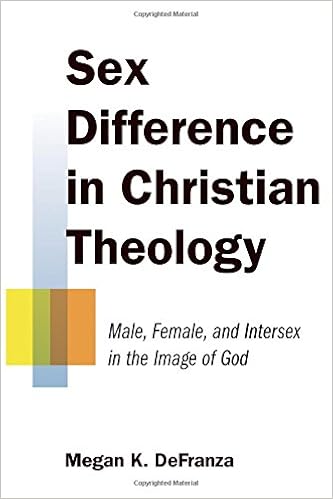
Sex Difference in Christian Theology by Megan DeFranza
![]() |
We need to say, is Genesis giving us Adam and Eve as the ideal for all times and places? Or are we bringing those assumptions to the text? I think, too, about racial difference. If we're trying to get back to Adam and Eve, we'll lose racial difference. And yet we don't just have Genesis. We have a whole canon that ends with this glorious vision of every tribe and language and nation gathered before the throne and worshiping. We have racial difference, not in Eden, but in the new creation. I think we're trying to ask too much of Genesis 1, 2, and 3 to give us all of God's blueprint for a good creation and anything that doesn't fit there is a result of the fall. I think that's a false reading. I think it's the beginning of the story, but there's so much more that God has done in the scriptures and in creation that we need to consider.
Like Noll, Megan DeFranza checks all of the Evangelical boxes. She grew up in a conservative Evangelical context, managed a couple of masters (Theology and Biblical Languages) at Gordon-Conwell before getting he Ph.D. in Religious studies, and speaks fluent Evangelicalese. She understands her current calling to be bridge-building between conservatives and intersex people. And yet this book smashes headlong into nearly all of the basic Evangelical assumptions about the nature of sex and gender. Sex Difference in Christian Theology meticulously examines the current science on how bodies are formed and what contributes to the ways in which doctors and scientists assign gender and sex labels to individual persons, and in that light critically (using fully approved Evangelical exegetic techniques) examines the witness of the Bible concerning gender and sex. The result for an Evangelical who reads the book with an open, yet still critical, mind is likely to be the crumbling, not of the book, but of his own understanding of what the Bible does and does not actually have to say about the meaning of physical sex and about gender. Having been disarmed by her passion and care for Scripture, the Evangelical will soon be alarmed to discover just how many of his beliefs on this subject were little more than assumptions—and weak assumptions at that.
How about you?
Are there any books you would like to add to the list. Leave them in the comments section together with a brief explanation.
Subscribe to:
Posts (Atom)