Search This Blog

Friday, January 12, 2018

Let America Be...


Image result for two face
If I had to recommend a mascot for the USA...
In the wake of President Trump's "shithole" comment, I have noticed one well intentioned but not quite accurate theme in the responses. It essentially boils down to "this is not who we really are". This is usually offered by good people who are trying to tell others (other nations, other people) that the President's racism does not have the support of the whole country—that there is real opposition to him. And I think that is a good thing to want to communicate, as far as it goes, but I don't think that framing—this is not who we are—is the right one because... well... this is exactly who we are. The United States is the nation which made Trump possible. Yes our #resistance is real, but our bigotry, our racism, our xenophobia — that is real too. Trump wasn't an accident. Trump was encouraged, and tolerated by enough of us that he became our executive, our leader.

Trump does not represent my values, my interests, or my desires, but the plain fact is that he does represent the nation of which I am a part. He does represent me; to me that is one more reason to resist him.

I worry a little, that the desire to say "this isn't us" comes from a desire to pretend that a mythology has more historicity than it does. There is a real United States and then there is also a dream of the United States. The real, historical United States is a country born in the blood of genocide and built on the back of chattel slavery. The real historical United States has, truly, built and accomplished great things; but far too often it has accomplished those great deeds over the corpses of others. The real, historical United States really is a purveyor of beauty, grandeur, holocaust, theft, and oppression. The real, historical, United States has nailed the body of Jesus to the front of our Roman Imperial temple. That, horrific and grand nation is the real and historical United States.

But there is also a mythology. And as mythologies go, the myth of the Unites States is a good one. It is a myth of all persons, free and equal in dignity. The myth is a myth of liberty and liberation. Of siblings, children, and parents; of hard work and good play; of education and simplicity. As an aspiration it is able to move us closer to the good—as many of the great myths are able to. The danger is in confusing our history with our myth. The history is who we are, the myth is who we want to be. I have never found this more perfectly represented than by Langston Hughes:

O, let America be America again—
The land that never has been yet—
And yet must be.

"The land that never has been yet—and yet must be." We are, still, the land of Donald Trump. We will, now, forever be the land that once elected Donald Trump. That is who we are; it is not who must be.

Wednesday, January 10, 2018

Early Pebbles: A Dinner Which Led Me Away From Politically Conservative US Christianity

"Why do our Christian brothers and sisters in the United States hate us?"

I was only just old enough to overhear this question when it changed my life. I suppose that people change for a lot of reasons and in a lot of different ways—certainly I have. Sometimes we encounter someone or learn something that changes us in a flash. One moment we were convinced of one thing and were living our lives by it and then—bam—we learn a missing fact or meet someone new and are convinced almost instantly that we had been wrong, that a different proposition is actually true, and our lives change. But most of the time I don't think it works like that. I think most of the time we have these experiences and they settle in and start to work on us slowly. If our significant changes in the way we are oriented towards our world can be compared to landslides, then most landslides start with pebbles bouncing down the hill; they bring a few other pebbles with them and those pebbles loosen bigger rocks. Now the hillside is less stable and then there is a rainstorm and then, in what seems like an instant, the whole vista gives way and changes irrevocably.

I have experienced a number of these shifts in my life; I consider it a sign of health. After all, I know more now than I did when I was younger, and I have picked up habits of reasoning which (I hope) have improved my capacity to analyze what I know. Additionally my character has been formed through relationships and through my reading; the weight things have with me has shifted and—I  hope—grown into a more accurate reflection of the real value of the world.

The question I opened with—Why do our Christian brothers and sisters in the United States hate us?—is one of the pebbles, possibly the first pebble, in the what became the landslide which marked my ultimate rejection of politically conservative US Christianity. Of course, few quotes are meaningful without context and the context for this one is critical. I was in (I think) seventh grade at the time, and the question was on the lips of a Palestinian Christian. He asked the question to my Dad after dinner.

In fact it took a lot for me to hear that question. My family moved to Turkey when I was seven years old—my dad was offered and accepted a position at a joint venture company in Ankara—and I lived there till college. While I was there my parents helped to found the International Protestant Church of Ankara and have been involved in its leadership ever since. When I was around twelve my parents planned a family vacation to tour Israel and Palestine. In the course of planning the trip, they spoke with some fellow church members of ours who were Palestinian Christians studying at one of the universities in Ankara. One of those students was from Bethlehem and was determined for us to go and visit his family while we were in the area. At that point in the mid-90's the Israel/Palestine conflict was in one of its hotter periods so American visitors had been warned against going to Bethlehem. Our friend the college student gave my dad some instructions about how to ensure that our car would be protected by Palestinians and insisted that we visit. You can imagine that for a twelve year old, this was the very height of international adventure. We were going to act on privileged information, put the right symbol in the dashboard of our car and be granted special access to visit Bethlehem at a time when most Americans were afraid to go.
Image result for church of the nativity
The Church of the Nativity
And all of it worked. We drove into Bethlehem, visited the Church of the Nativity, and had a lovely ham dinner with a charming and hospitable Palestinian family. The delight of the ham particularly stuck with me because, as an American Christian living in Turkey, I didn't get to enjoy pork products all that often and, since we were vacationing in Israel for most of the trip, I hadn't been able to get any on vacation either. After dinner my two younger siblings wandered away from the table to play with some of the children of the family but, as there weren't any children my age, I stayed at the table and listened to the adults talking. That is when one man asked my Dad the question—Why to our Christian brothers and sisters in the United States hate us? I don't remember what my Dad's answer was—I don't think he was a fan of Christian Zionism even back then, so I imagine he did his best to regretfully explain a culture of largely uniformed religious ethnocentrism—and I don't remember the rest of the conversation. I think I asked my parents about it in the car on our way back to Jerusalem later because I was never able to be politically pro-Israel after that trip, and I have a vague memory of thinking that American Christians were "sort of confused" about the Middle East (a belief which was only reinforced when I began to attend bible college in South Carolina and found that telling people I had grown up in Turkey inevitably conjured up images from the film Casablanca in their minds).
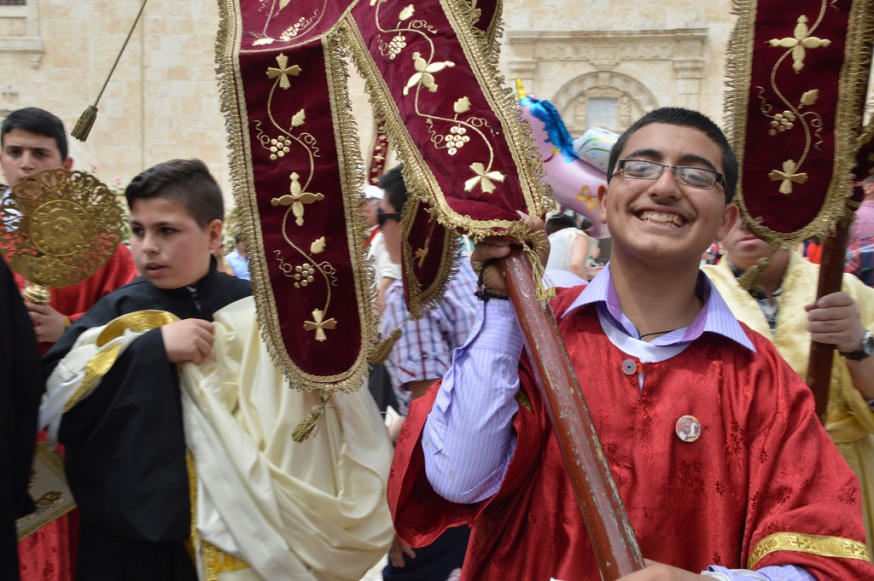
Image result for Palestinian Christians
You aren't going to convince me to hate Palestinians
That was one family, one conversation. But it made its impression. It was a pebble rolling down the mountain and, once down, it could not roll back up the hill and regain its place. It was only a few years later that I became an Evangelical teenager in the late 90's (for those of you who shared that cultural moment with me, you will already know the weight of it, for those who did not, I will only say that it was both the heyday and swan song of American White Evangelical culture). I bought in almost to the hilt. I built a mental, religious, political, and philosophical structure out of the materials of late 90's White American Evangelical culture. Francis Schaeffer, DC Talk, the OC Supertones, True Love Waits, I Kissed Dating Goodbye, Quiet Times, Passion, Republicanism, Apologetics, the lot. My first vote was for George W. Bush and I worked my first job out of college to the sound of conservative talk radio.

But that structure had been built on an undermined foundation. That pebble (and others—they will have to wait for other blog posts) was missing. And I should say that it was consciously missing. I thought it gave me nuance. Knowing the kind of person I was in college, I probably thought it made me a little bit better than most of my peers. I understood that things were really more complex. But here is where that pebble really starts to make itself known. You see, the thing about having a pebble missing from under your foundation is that it is really difficult to just "let the empty space be" you need to fill it with something—I may be stretching this analogy too far, but work with me here—so you start to excavate the little hole. You study it, you dig around it, you try to figure our why the pebble that fell out of the hole didn't "work" there. This displaces more pebbles as you find that they don't really work either. Then you displace more pebbles.

Back in the real world (and away from pebble-analogy land) this excavation process really sped up after 9/11. I remember going online that night and somehow getting involved in a chat room (remember chat rooms?) where someone wanted "us" to "just go bomb the crap out of them" without any clear awareness of who "them" was beyond "middle eastern Muslims". I was somewhat horrified (remember that I have family and friends in a predominantly Muslim middle eastern country, and then that family in Bethlehem came to mind) and when I tried to push back I encountered the full, unveiled face of Christian American Nationalism. It was ugly, and more pebbles rolled down the mountain. See, it is hard to hate people you know. It is even harder to want the destruction of people who have been kind to you. It is harder than that to categorize as a "good" the mistreatment of people with whom you have identified—our Christian brothers and sisters—and who have been kind to you. It is hard to support a structure which keeps telling you to be against them.

This is not the space for a full story of the deconstruction of my politically conservative Christianity; I hope to write my way through that in time. But from here I hope the outlines of the process have become clear. If religious political Conservatism was wrong about Israel then what else might it have been wrong about? And the "space" around the pebble grows... The questioning process, once properly begun, will not stop until it is frightened into remission, or has scoured the hillside down to the bedrock. In the end my trust in Jesus survived (HERE is a series about what my relationship with Jesus looks like these days), my Christian Nationalism and religious political conservatism did not.

Friday, January 5, 2018

Book Review: According to Folly

35055333Imagine that Socrates, Peter Kreeft, and Jostein Gaarder sat down to write a book together. They might come up with something a little like Daniel Heck's According to Folly—at least, there are elements of this book which one can imagine each of them contributing. This book is in the form of an imagined series of conversations which a self-identified Fool has with a Conservative, a Liberal, and a Skeptic. On it's surface that premise is engaging enough in a straightforward "up the Moderates, and boo to polarization" sort of way; it is a premise which could be fairly compelling in the right hands or would, more likely, descend into nearly suffocating insufferability if executed poorly. Fortunately the book moves well beyond that surface premise by drilling down into the particularity of the author.

In According to Folly, the respective Fool, Conservative, Liberal, and Skeptic are not the generic stereotypes of those ideologies as found in the contemporary Unites States—a move which would have doomed the project in the hands of any but the wisest and most well informed social critics. Instead Heck has written the characters as his Conservative, his Liberal, and his Skeptic (I will have more to say about the Fool below). The characters do not, therefore, employ the sort of straw man arguments one might expect. Instead they embody (one suspects) both the strongest and weakest of the arguments Heck has experienced in his own life. This is a critical move. The job of presenting the actual total arguments made by each of these camps would have been well beyond the abilities of any (almost any?) single author. What we get in this book instead is both much narrower and far more enlightening. Heck uses the person of the fool to socratically interrogate his own essential experience of these types.

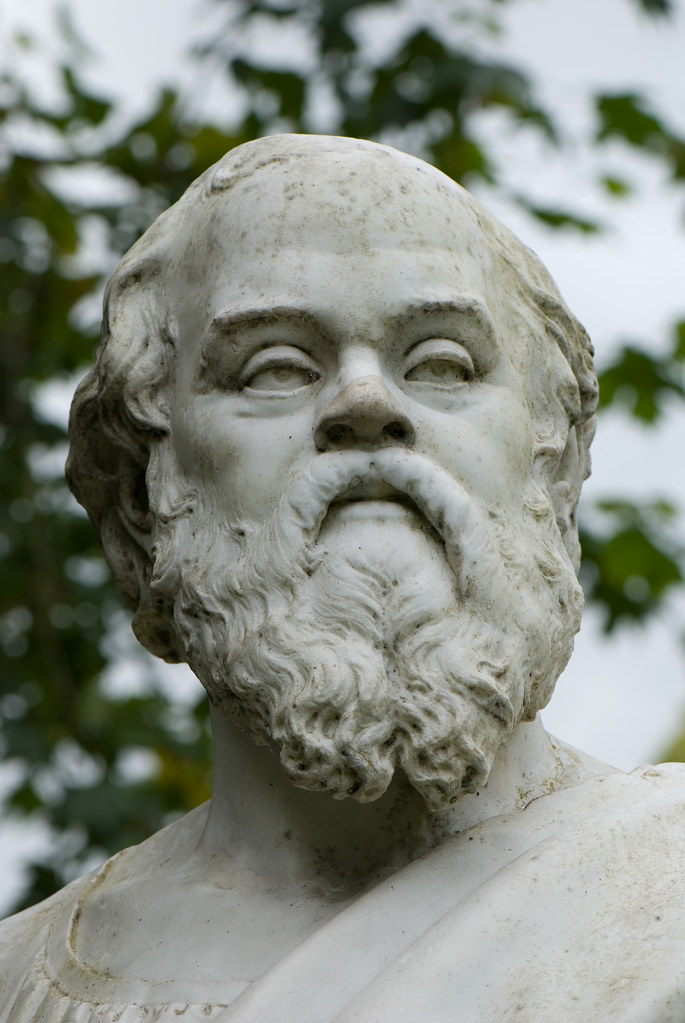
Image result for socrates
Socrates
It is the person of the Fool who brings the most value to the book and sets the whole project in line. The character is not—quite—a stand-in for the author himself. In fact Heck does write himself into the narrative in several Gaarderian moments in the book. Instead, the Fool identifies himself as, sequentially, the Conservative's Fool, the Liberal's Fool, and the Skeptic's Fool. My understanding of him was as a sort of Socrates character with a little of the edge taken off and a little of Jesus added in. Like Socrates, the Fool is dedicated to determining the "logic" of his successive interlocutors, and like Socrates his method is to first work out the "rules of their game" and then to rigorously apply those rules to their thinking. Heck's Conservative is therefore confronted with the her own hermeneutic principles used in a way which lead to very different conclusions than those she is comfortable accepting. The same process is then employed with and against the Liberal and the Skeptic. The fool departs from direct Socratic interrogation though in two critical ways. First, Heck's Fool comes across as genuinely desiring to learn from each of his interlocutors. He really wants to get at the best of what they have to offer, is often thrilled when he finds insights of value, and is discouraged when the process fails. Second, the Fool treats his interlocutors like real friends rather than as opponents. Whatever you ultimately think of the book, you are almost guaranteed to like the Fool.

It would be cliche'd to say that Conservatives, Liberals, and (Modernist) Skeptics will each love 2/3s of this book and hate the third which focuses on them; and while it  may be true in some cases, I suspect that it is least true of the best of them. In fact I suspect that it is the wisest of our Conservatives, Liberals, and Skeptics who will enjoy this book the most. The temperament I believe least likely to appreciate this work is the person so committed to the rightness of his conclusions that he cannot bear to examine his own reasoning. It is the weak, rather than the strong and committed ideologue who will chafe, as this is a book which burns down straw men only so that the stronger ideas they hid can be revealed. C.S. Lewis wrote in his preface to Mere Christianity that
It is at her centre, where her truest children dwell, that each communion is really closest to every other in spirit, if not in doctrine. And this suggests that at the centre of each there is something, or a Someone, who against all divergences of belief, all differences of temperament, all memories of mutual persecution, speaks with the same voice.
According to Folly adds further evidence to support his thesis.

Thursday, January 4, 2018

The Best Books I Read in 2017


I am a fan of the Goodreads reading challenge. For two years now it has done a good job of helping me to keep reading a priority without (as I was afraid it would at first) making reading into a chore for me. One of the side benefits has been that at the end of the year I have a nice list of books I read that year. So I thought it would be fun to go ahead an throw together a list of recommendations from my 2017 reading list. According to my 2017 challenge, I read 62 books in 2017, which I feel is pretty good. However I should note that I did include audio books and that just under half of the books I read were science fiction or fantasy novels. I am not apologizing for that—I am an unabashed fan for genre fiction—but mentioning it probably important in painting any sort of accurate picture of my reading habits.
One last note before I get into my top book recommendations for each of four categories (plus a "best overall") is that I try to do at least a short one or two sentence review of each of these on Goodreads when I read them as I know how helpful book reviews (particularly Goodreads and Amazon book reviews) are for new and indie authors hint hint. You can find the piece I wrote up about that HERE.

Science Fiction - Fantasy


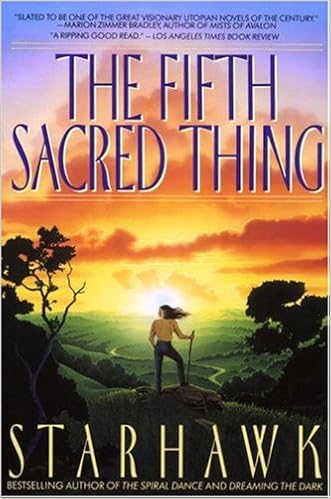
So just under half of the book I read in 2017 were either Science Fiction or Fantasy. And I was only able to keep that under 50% by including Young Adult books as a separate category so if I include the YA sci-fi novels I read I think I end up at exactly 50%. Of those, my favorite read was The Fifth Sacred Thing by Starhawk. I had actually never heard of the book before I started discussing resistance dystopias with some friends online and one of them recommended it. The Fifth Sacred Thing is unabashedly pagan to the extent that the author would probably be at least a little upset that I filed her book under sci-fi and fantasy. That said it is excellently written; the characters are well developed, fully fleshed out, and entirely compelling. Additionally the book has the benefit of actually managing an pacifist apologetic and still being suspenseful and full of action.

Note: If I had read more I would have separated these sci-fi and fantasy as categories so let be add that my favorite sci-fi book (actually series) I read was Craig Alanson's Expeditionary Force series which starts with Columbus Day. It is not "great lit" by any stretch of the imagination but it is an unremittingly fun series and the AI character in it is one of my favorite AIs I have ever read. I did these on audiobook and I have to say that R.C. Bray does an amazing job narrating the books.


YA (Young Adult)


As a high school teacher (and let's be honest, just because I enjoy them) I try to read a number of YA novels each year. I read some really good ones this year including the Nemesis series by April Daniels and John Green's return to publication Turtles All the Way Down. However, the best YA book of the year for me has to go to Angie Thomas' The Hate U Give. I know this thing has won awards all over the place and it frankly deserves them. This book is really engaging, entirely immersive, and constituted one of those moments where a message finds its perfect genre. The book dives straight into a narrative of police violence, racial divides, code switching, cultural whiplash, as well as structural and individual racism and builds all of it in a complex and powerful protagonist's social bildungsroman. The book will break you and heal you and make you fall downs and jump for joy. I can't recommend it enough.


Theology/Philosophy


2017 was a good year for me in these genres as well. I started the year with the specific goal of improving my Inklings studies by taking a dive into the works of Inkling, poet, and philosopher Owen Barfield. In the end my "dive" turned out to consist only of reading his Poetic Diction and Saving the Appearances as well as starting his fairy tale The Silver Trumpet which I finished yesterday so it didn't end up making the 2017 list. Of the two I was more excited to read Saving the Appearances but ended up appreciating Poetic Diction far more. In fact Poetic Diction ended up being my runner-up in this category and I have every intention of re-reading it in 2018. Beyond my Barfield reads, I spent time in 2017 boning up on my Anabaptist, Anabaptist-adjacent, and "progressive Christain" theology. I  started Greg Boyd's The Crucifixion of the Warrior God which I am still working on, and did finish his popular treatment of the subject Crossvision. I read some Wes Howard Brook and started a series on Blue Ocean Faith.

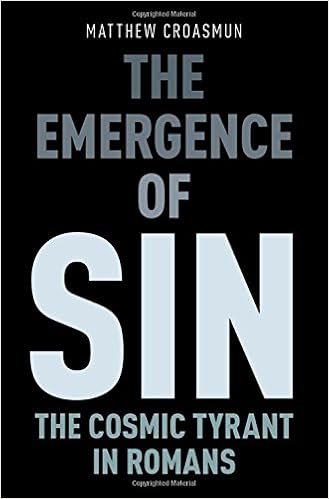
So I really appreciated my theological reading this last year and want to add a little more direct philosophy back into the mix in 2018. With all that in place, the book which, I think, has had the greatest impact on my this year is Matthew Croasmun's The Emergence of Sin. To give fair warning the book is a pretty darned scholarly piece of work and takes some serious wrestling and work to get through (at least it did for me). But the work is 100% worth it. Corasmun brings to Christian theology a model which has the potential to unlock a whole lot of our (or at least my) understanding of both philosophy and the spiritual. In the book he takes emergence theory as it has been developed variously by philsophers, sociologists, and "hard" scientists and uses it as a lens for approaching the concept of S/sin in Romans. While I think his applications in Romans are pretty much on the mark, the far more exciting aspect of this book for me, is the potential this lens has for thinking about further spiritual reality. This book will certainly have me pondering and reflecting for the next several years.
Note: A friend of mine wrote the other book which had a good shot at winning this category (According to Folly by Daniel Heck) and I certainly recommend it.

Other non-fiction


Yeah this is a terrible category but the fact of the matter is that it covers fourteen of the sixty two books I read last year. Without it I would have ended up with far too many one and two book categories. So poetry has to compete with memoir, politics, and theory books (or maybe it would be better to say that they have to compete with poetry). In fact, scanning through the books in this category gives a pretty good picture of my interests over 2018. There is some poetry and biography, then the list leans towards sociology, psychology, gender, and race theory with a definite background of political theory haunting many of the books in the list. A further reflection I had here was that I very much still appreciate all of the books I read in this category (which stands in contrast to—for instance—sci-fi and fantasy. That isn't' to say that I agreed with everything I read—I make an effort to read things that will challenge me and which represent views I don't necessarily agree with—but they all turned out to be helpful and substantive this year.

For all of that, the number one slot has to go to one of them and my favorite of all of these books was Whipping Girl by Julia Serano. I know, I am quite a few years late to the party on this one, but I am glad to have made it there eventually. Whipping Girl (I got the tenth anniversary edition) is, in addition to it's manifest intellectual virtues, an incredibly compelling and incisive account of the transgender experience from "the inside". The book was good enough that I read another of her more recent books a little later in the year (Outspokenit was also terrific but is a little more "in the weeds" than Whipping Girl). Serano is, among other things, a spoken word poet and a professional biologist and the qualities associated with both of these vocations are evident in the book: passion and eloquence blended with careful and critical observation and reflection. Certainly this is a book which is more than worth the read for anyone who wants to engage publicly in the "conversation" around gender and sex. It certainly caused me to go back, re-read, and re-think some of what I have written.


The Best Book I read in 2017


Of course when we are talking about books 'best' is an inadequate descriptor. I think that what I mean by it here is that this book had a more profound effect on me than any other book I read this year. Put another way, if I had to choose to lose the experience of reading all but one of my 2017 books, this is the one I would save. Reading In the Shelter by Pádraig Ó Tuama is a book which breaks you apart only to put you together again far more whole than you were to begin with. I tried to get at this a bit in my Goodreads review of the book:
This is probably the most powerful book I have read all year. It is, to borrow C.S. Lewis' summation of "Lord of the Rings", good beyond hope. The author's blending of poetry, theology, biography,and story is an artifact too rich to be summarized—it must be experienced. Reading this book will wound, heal, and grow your heart. The author approaches the painful, glorious fact of being one's self in the world and the inscrutable love of god in a way that will have me coming back and back to this book.


The book itself is memoir so laden with philosophical and theological reflection that it could just as easily be classified as a piece of narrative theology or philosophy. Pádraig Ó Tuama has also included poems between chapters in a tacit acknowledgement of the final inability of prose to communicate all that needs to be said. If I were to find that he writes music as well I would pay much to hear him communicate through that medium as well. More than nearly any author I have read Pádraig Ó Tuama brings together a deep wisdom and the beauty of medium. This book is worth reading for so many reasons but here is one reason that would be enough all on it's own. In In the Shelter the three transcendentals: Truth, Goodness, and Beauty dance together and are as one. After reading it, one does not, quite, feel that any discussion of the relation between those three will be adequately understood by those who have not read it. 


Reviews of Other Books I Read This Year


Monday, December 18, 2017

The Person at the Center

As I have mentioned periodically on this blog, I am a fan of centered set theology. To go a little further, I am a fan of centered set theology to a degree that quite a few self-proclaimed fans of centered set thinking have told me that I take it too far. I am pretty much cool with that. I have already talked a good bit about what centered set theology is in this post in my Blue Ocean Reflections series, but for those of you who don't want to fall down an internet link-hole, I have posted a summary at the bottom of this piece. Feel free to scroll down and come back.

Related image

Which Jesus?

One of the most common objections I have seen to centered set theology is the question "yes but which Jesus?" Quite a few people have argued that centered set is all well and good, so long as it is bounded (see what I did there) by the correct understanding of Jesus, that is to say, so long as it is the "right" Jesus at the center of the centered set. When this argument is developed it turns out that this idea of the "right Jesus" is often a Trojan horse which can be used to smuggle in nearly any degree of bounded set confessionalism. What "the right Jesus" means, it turns out, is a more or less particular definition of who Jesus is. It is Jesus "as defined my the creeds" or "as presented in the New Testament" etc... In fact, it is Jesus, stripped of his actual existence as a person and reduced to a series of propositions. So long as a real relationship with a real and interacting person forms the heart of centered set theology, the system (while never easy for us) works well and is not really susceptible to the "which Jesus" critique since the answer is clearly and obviously "Jesus".  

This is where I think those who make the "which Jesus" critique have inadvertently tipped their hand. The idea that the Jesus at the center of the centered set needs to be defined in order for the model to hold, presupposes not a living, relational center, but a dead propositional center. It assumes a center who is not known but defined. And once the center is defined it must inevitably collapse into a more or less broadly bounded set instead. 

The whole problem with the critique isn't that it fundamentally undermines centered set theology as such (though it does), but that it reduces the Divine Person to a series of doctrinal propositions—it isn't bad theology, it is idolatry. Of course once they have substituted God-in-Christ for a series of propositions-about-God centered set theology cannot long survive, the living stone has been rejected and nothing can last long built on a shell or a corpse. The "which Jesus" crowd don't fail to understand centered set because of its flaws (though it certainly has them—it is a model of reality not reality itself and as such is imperfect); they fail to understand centered set because they have not yet broken free of that enlightenment modernist way of thinking which must reduce truth to proposition and thinking to machine logic. They fail to recognize the human and relational logic which sees the other as real, knows the reality of relationship, and knows reality through relationship. 

There is, there must be, a knowing of persons (but never of propositions) able to endure the most distorting of factual inaccuracies. Change every particular about a person you love, lose even your love for them as it turns to hate, and it will still be the same person to whom you are relating. Let me be wrong about everything I know about God, and it will still be God about whom I was wrong. 

This is the mystery at the center of centered set thinking: the center is never a what—always a who

Summary of the theory


Image result for centered set theory
Centered set theology exists in apposition to Bounded set theology. The bounded set spiritual model views all people as divided into two camps (sets), in or out; and usually a person’s position in this model is determined by whether or not they have a sort of mental assent to some series of propositions. In usually means that the person will go to heaven some day and out means that they won’t.  The centered set approach denies the in/out distinction in favor of orientation. The important question in this model is whether or not a person is oriented towards the center (in my circles this means oriented towards Jesus). In this model it is not so important to get people to cross lines and form new mental assent lists as it is to get people to notice and love Jesus, to orient their lives towards Him.

Wednesday, December 13, 2017

White Evangelical Politics are Less Christian than American Politics

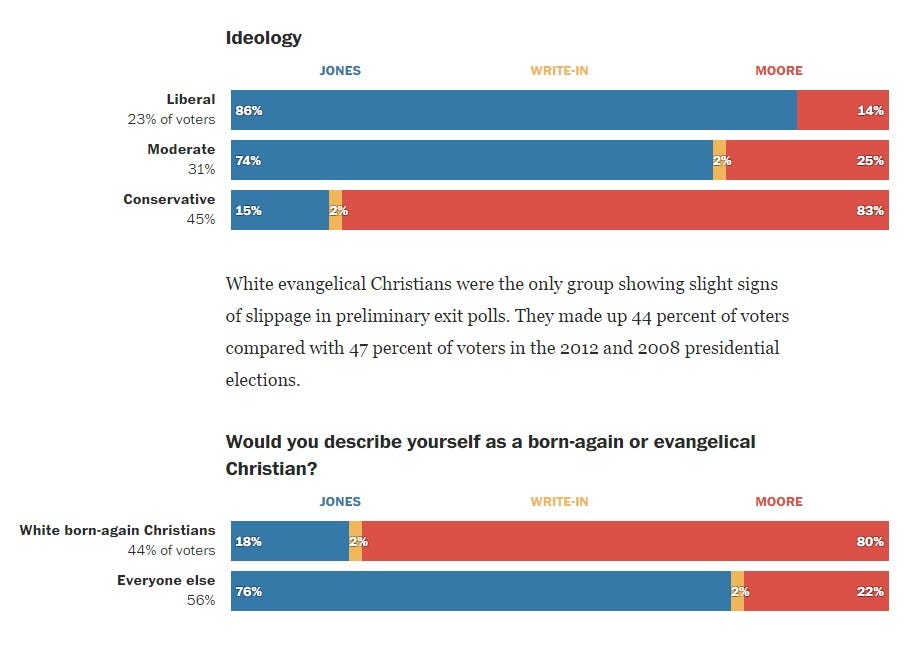
Last night Alabama elected a Democrat to a statewide office for the first time since the 90’s. That is sort of cool in its own right I suppose, but what particularly struck me about it is the demographic breakdown behind Doug  Jones’ victory, specifically the religious breakdown, and most specifically the behavior of self-identified Evangelical Christians. 
Whatever else comes out of the analysis (Here is the original Washington Post Analysis). There are two trends which really strike me today. If we take Moore’s loss as representative of a decline in the strength of Trump-ism over the last year (Nate Silver over at FiveThirtyEight make that pretty clear) then it seems to me that Trump-ism is on the decline (huzzah) and that despite its overall decline, it is hanging on most stubbornly among white self-identified Evangelicals. Again:
  1. 1. Trump-ism is deteriorating.
  2. 2. Trump-ism is deteriorating more slowly among white self-identified Evangelicals than it is in the general population.
This leads me to conclude that white Evangelicalism as an institution and an ideology is a healthy environment for Trump-sim.
From the Washington Post
Now I have already made the argument that Trump is pretty thoroughly anti-Jesus, so the implication here is that white Evangelicalism is a healthy environment to a determinedly anti-Christian element in the world. But I don’t think it is prudent to let this fact sit in isolation; I also want to point out that white Evangelicalism claims to reflect, and encourage growth in, the Way of Jesus.
So now we have a movement/ideology which specifically claims to follow Jesus and is simultaneously acting as an incubator for anti-christian activity and behavior.
At this point I think the relevant question is not so much “Is Evangelicalism corrupt?” that it is seems obvious. The question is more “How long should good Evangelicals keep fighting for Evangelicalism?” I honestly don’t know what the answer ought to be. I know my answer was to take what was good, the “Egyptian gold”, and leave.

Some final caveats

  1. I don’t think this means that individual white Evangelicals are themselves anti-christian; they have accepted a doctrine or ideology which, if left unchallenged and uncorrected, is going to incline them in that direction but there are many influences in any person’s life — their own will and character not the least — so many can and do resist it.
  2. I am aware that there are many sub-strands of white Evangelicalism and that many white Evangelicals are fighting valiantly to change at least some of the many broken and damaging elements in this ideology. I wish them the very best and if I had not broken with some basic tenets of Evangelicalism a while back I hope that I would be right there with them. Unfortunately I believe that this last year is evidence that they are currently losing that fight.

Monday, November 20, 2017

Trump is Herod Antipater


Obviously they are not identical, since no two people are the same, but the similarities are striking. Consider the following:
He serves his own power and isn’t really loyal to “Rome.” #TrumpisHerod
Herod Antipater was exiled near the end of his life after playing a political game during a Roman succession struggle. Trump has systematically used an appearance of near jingoistic patriotism as a tool to increase his own power. He did this before, during, and after his campaign for president.
He panders to power hungry religious conservatives. #TrumpisHerod
Herod used the Sadducees (a group of theologically conservative power brokers) to establish and bolster his power base among the people he governed despite the fact that he did not follow the moral or religious dictates of their theology. Religious conservatives make up a central part of Trump’s base and he panders to them by offering them power and a cultural prestige they have not recently enjoyed.
He is creepily obsessed with the sexuality of his own female relatives. #TrumpisHerod
Herod married his brother’s wife, who was also his own niece. Trump has made quite a few really disturbing comments about his daughter and her sexuality.
He is terrified that people will think he is weak; also he is weak. #TrumpisHerod
Herod imprisoned John the Baptist for speaking out against his marriage but actually found the prophet rather compelling in general. He was manipulated into beheading John the Baptist when he made a promise to his step-daughter which he then felt compelled to keep for fear that the people around him would think he was weak if he didn’t carry through on her request for the head of John. Trump seems to be almost viscerally motivated by the need to appear strong, but his inability to shrug off criticism and insult belie the fundamental weakness of his character.
His father was a builder, he built some things too. He thinks that makes him special. #TrumpisHerod
Herod’s father (also Herod) initially gained favor with the local conservative religious power brokers by restoring the Temple in Jerusalem. Having seen the public prestige that had granted his father, Herod Antipater also undertook several building projects in order to secure prestige and respect (though he ended up having to scramble and “patch” some of these attempts which his ignorance of the public’s actual religious positions undermined some of his projects). Trump’s basic boast is that he builds big things.
Herod built a wall (at Beth Haran); Trump thinks building a wall will make him great. #TrumpisHerod
One of Herod’s signature building projects was a new defensive wall at Beth Haran. Trump rose to power promising to build a wall across the US’ southern border.
Trump has a problematic relationship with marriage but is given a pass by the religious conservatives of his day (because he gives them power). #TrumpisHerod
Herod’s marriage to his second wife (his niece who had been his brother’s wife) should have been a total scandal to the conservative religious establishment as it was a flagrant violation of their religious law. However thanks to the cozy relationship he had with them they turned a blind eye to it. In the end it was John the Baptist (a religious outsider who made the conservative establishment extremely uncomfortable) who called Herod out.
He has a really problematic relationship with Syria. #TrumpisHerod
Herod’s relationship with the governor of Syria (Vitellius) was complicated and he ended up having to try and force Vitellius to support him by going over his head. Even then Vitellius backed out of the aid as soon as he could manage it.
He is a misogynistic predator who boasts about the sexuality of underage girls. #TrumpisHerod
Herod infamously showed off his step daughter (apocryphally named Salome) by having her perform an erotic dance for the guests he was trying to impress. He was himself so impressed that he ended up promising her anything she asked for, which led to the John the Baptist debacle. Trump has spoken and acted in incredibly misogynistic and predatory ways throughout his career but particularly with regard to Miss Teen USA contestants.
Most of these facts about Herod Antipater are based on either the Biblical record or may be found in the relevant entry in the New World Encyclopedia (which drew largely on Josephus and Philo of Alexandria)